

The teacher hiring process should assess practical teaching skills before candidates reach the demo class. Resumes reveal qualifications, but they rarely establish whether applicants can explain concepts clearly or manage classroom situations.
A skills-first approach evaluates subject knowledge, spoken communication, reasoning, and classroom judgment early. Schools and EdTech companies can then reserve demo classes for candidates who demonstrate the required competencies.
What Makes Teacher Hiring Hard?
Teacher hiring is difficult because the most relevant teaching abilities are rarely visible in resumes. Schools must assess communication, subject knowledge, patience, and classroom judgment before committing senior educators to time-consuming demonstrations and interviews.
Three challenges repeatedly affect schools, coaching institutes, and online tutoring companies:
- High application volumes: A single vacancy may attract hundreds of applicants. Senior teachers cannot evaluate every candidate through individual demonstrations.
- Spoken communication gaps: Subject knowledge does not guarantee clear explanations. Written applications provide limited evidence of pronunciation, comprehension, or instructional communication.
- Remote screening integrity: Online assessments support large recruitment drives, but suspicious activity requires careful examination. In one PMaps education-sector deployment, AI proctoring flagged 45% of attempts for review.
Assessment flags should trigger investigation rather than automatic rejection. A suspicious attempt does not independently establish dishonest behavior. These recruitment challenges establish the need for measurable screening criteria. Schools can reduce unnecessary demo classes by evaluating relevant teaching competencies before candidates advance further in the selection process.
What Should You Test Before the Demo Class?
Teacher assessments should evaluate subject knowledge, spoken communication, reasoning, and classroom judgment. These competencies help schools identify candidates who meet instructional expectations before scheduling teaching demonstrations and allocating senior educators' time.
Build Your Own Teacher Assessment in Minutes with PMaps Test Creator
Every school has different teaching requirements. With PMaps Test Creator, hiring teams can build custom teacher assessments in minutes by selecting competencies relevant to the subject, grade level, and role. Schools can include questions covering subject knowledge, reasoning, and classroom judgment without creating every assessment from scratch. This allows recruitment teams to screen candidates against consistent, job-specific criteria before scheduling demo classes.
Why Should Schools Set Separate Assessment Cutoffs?
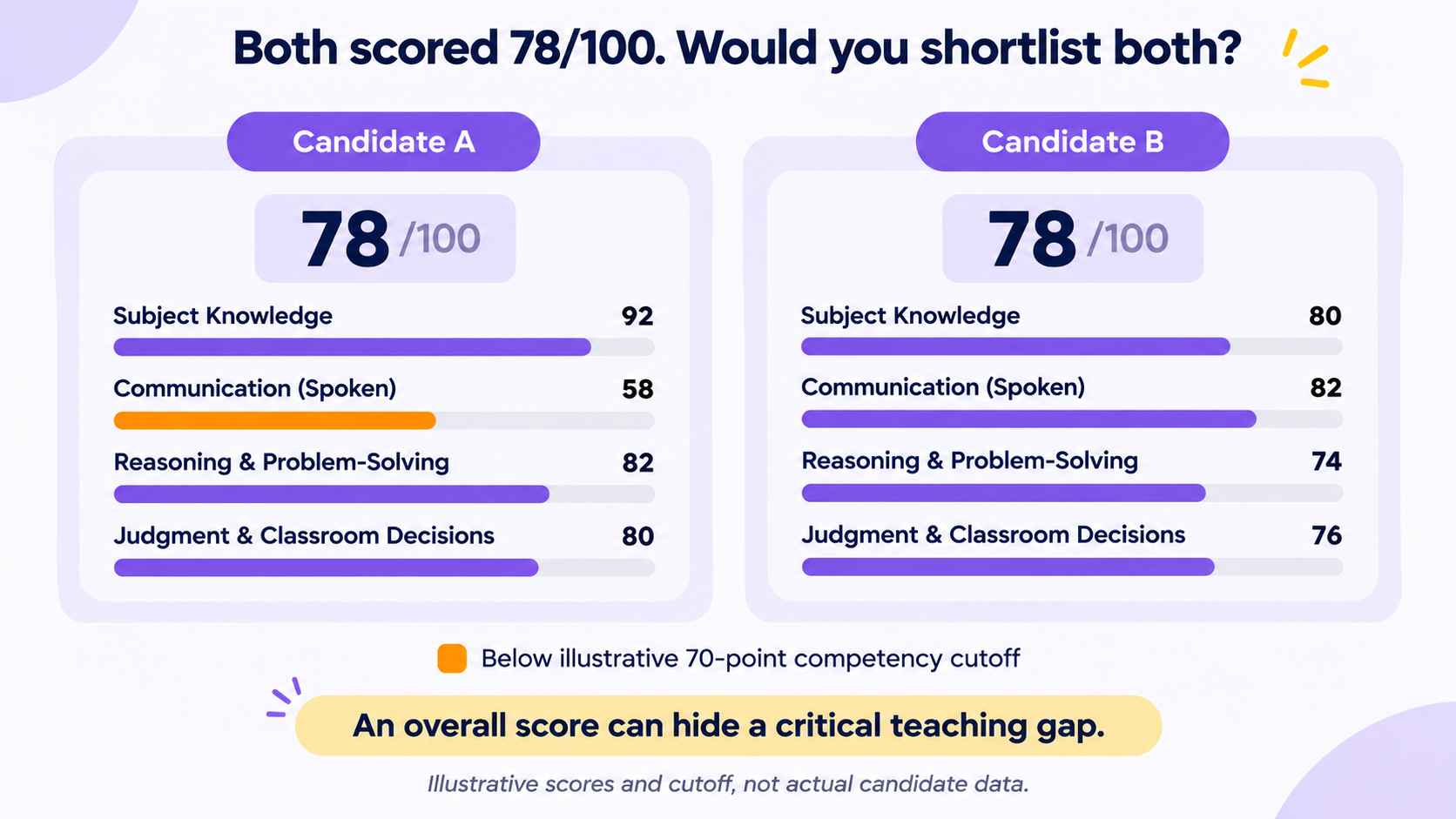
Each competency should have its own minimum qualifying score. A candidate with excellent subject knowledge but weak instructional communication may struggle during classroom teaching. One overall score can conceal such differences.
Separate cutoffs allow schools to evaluate each competency against the actual teaching requirements.
How Can Combined Assessments Support Teacher Screening?
A combined teacher assessment can evaluate multiple competencies within one screening process.
PMaps provides skills assessments, cognitive ability tests, communication evaluations, and AI-enabled proctoring. Schools can configure relevant assessments around subject requirements and instructional expectations. Standardized assessments establish comparable evidence across applicants. The next step is using these results to decide which candidates should advance through the teacher hiring process.
How Should the Teacher Hiring Process Run, Step by Step?
A structured teacher hiring process should move from competency definition to assessments, demonstrations, interviews, and final selection. Each stage must measure relevant teaching abilities through consistent criteria rather than subjective impressions.
1. Define the role through teaching competencies. Identify the subject, grade level, instructional language, and teaching format. Online tutors may need different communication skills than classroom teachers.
2. Screen applicants through online assessments. Combine subject knowledge, spoken communication, reasoning, and classroom judgment. A 45–60-minute assessment can be considered according to test requirements.
3. Review flagged assessment attempts. AI proctoring can identify suspicious activity requiring investigation. Review flagged attempts before making decisions, and consider supervised reassessment when necessary.
4. Conduct demo classes for shortlisted candidates. Use a standard topic and scoring rubric. Every candidate should receive comparable instructions, preparation time, and evaluation criteria.
5. Hold structured teacher interviews. Ask consistent questions about classroom situations, motivation, and parent communication. Evaluate responses against predefined behavioral indicators.
6. Verify references and finalize selection. Check relevant employment history and professional references. Document hiring decisions before extending offers to selected candidates.
PMaps analytics dashboards can help recruitment teams review assessment results, candidate comparisons, and competency scores within a centralized evaluation process.
A consistent hiring sequence reduces unnecessary screening activities. Spoken communication deserves separate attention because subject knowledge alone cannot establish whether candidates can explain concepts effectively to students.
How Do You Assess Spoken English for Teaching Roles?
Spoken English assessments measure fluency, pronunciation, grammar, vocabulary, and comprehension through recorded responses. These tests help schools evaluate instructional communication before candidates participate in live demonstrations or parent-facing conversations.
Candidates should respond to spoken prompts rather than complete written grammar questions alone.
An AI-scored speaking assessment records candidate responses and evaluates defined language competencies. Recruiters can compare results using consistent scoring criteria. This approach is particularly relevant for online tutoring positions. Teachers must communicate clearly through virtual classrooms without relying entirely on physical gestures or classroom boards.
What Should Schools Measure in Spoken English Assessments?
The assessment should reflect actual instructional communication requirements.
- Fluency: Ability to communicate without frequent disruptions.
- Pronunciation: Clarity and intelligibility of spoken words.
- Grammar: Appropriate sentence construction during explanations.
- Vocabulary: Ability to explain concepts using suitable language.
- Comprehension: Ability to interpret spoken questions accurately.
Accent differences should not automatically affect hiring decisions. Schools should prioritize intelligibility and role-related communication requirements.
In the PMaps education deployment referenced earlier, spoken comprehension and vocabulary showed 22-point differences between candidates classified as fit and unfit.
This finding illustrates the value of measuring spoken competencies separately. It does not establish a universal benchmark for teacher suitability. Spoken assessments establish whether candidates meet communication requirements. Demo classes then reveal how effectively teachers apply these abilities when explaining concepts and responding to student questions.
What Does a Good Demo Class Rubric Look Like?
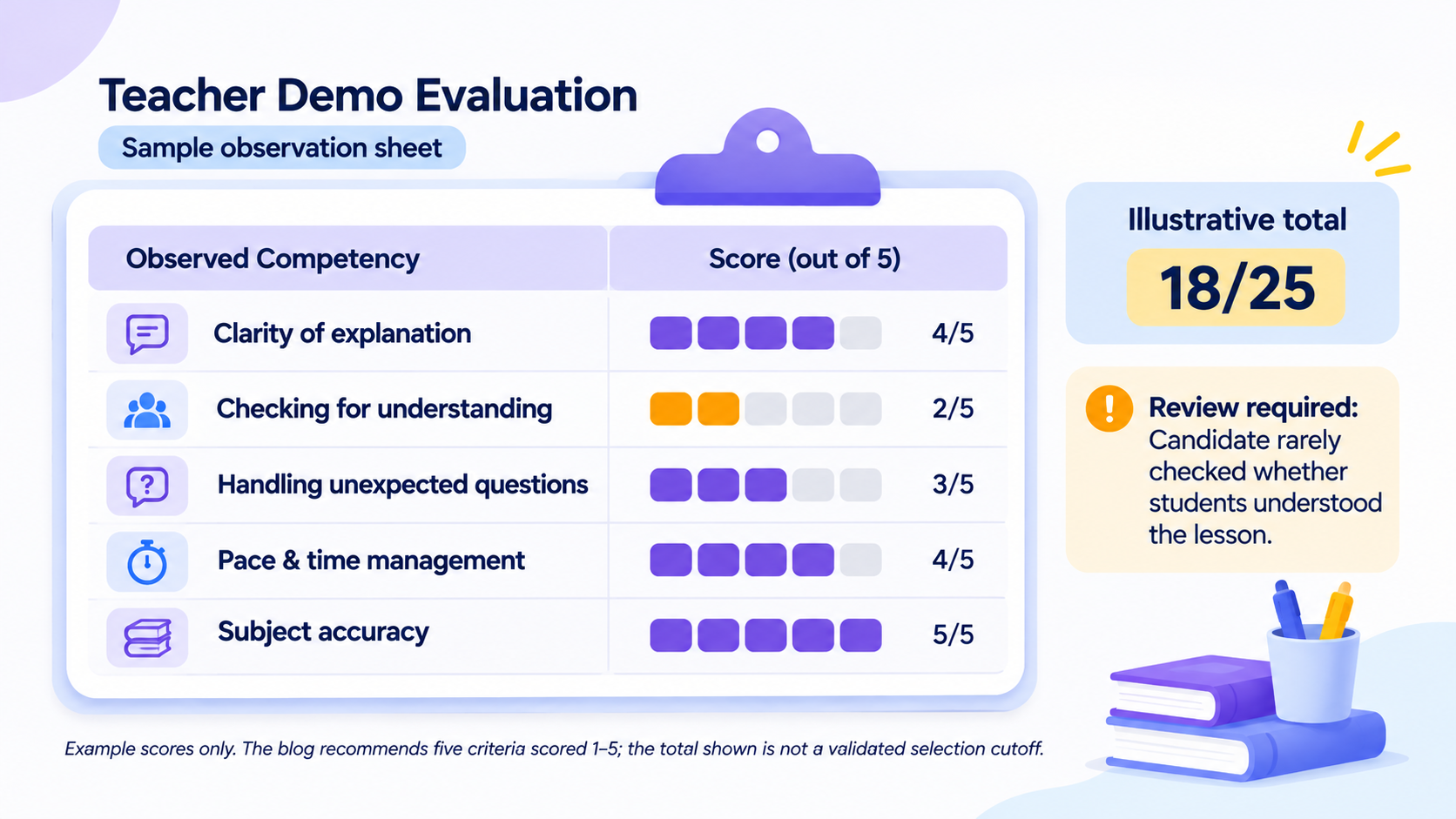
A teacher demo class rubric should assess five instructional competencies using a consistent five-point scoring scale. Standardized evaluation criteria help reviewers compare candidates based on observed teaching behavior rather than personal preferences.
The five areas should include:
- Clarity of explanation: Can the candidate explain concepts accurately using accessible language?
- Checking for understanding: Does the candidate confirm whether students understand the lesson?
- Handling unexpected questions: Can the candidate respond accurately to unfamiliar student questions?
- Pace and time management: Does the candidate allocate lesson time appropriately?
- Subject accuracy: Are the concepts, examples, and explanations correct?
Each competency should receive a score from 1 to 5. Reviewers should define what scores of 1, 3, and 5 represent before evaluating candidates.
A score of 1 indicates that the candidate does not demonstrate the expected competency. A score of 3 reflects acceptable performance with identifiable gaps. A score of 5 represents consistent demonstration of the required teaching behavior.
Without a scoring rubric, demo classes may reflect reviewer preferences. Standardized criteria make instructional performance easier to compare and document.
How Can PMaps Support Teacher Assessments Before Demo Classes?
PMaps helps schools evaluate candidates before allocating resources to live teaching demonstrations.
Its assessment capabilities include subject-related skills testing, cognitive assessments, voice evaluations, AI proctoring, and candidate analytics.
Recruitment teams can review assessment reports and select candidates who meet defined competency requirements. Final teaching decisions should still incorporate human review and demonstrated classroom performance.
A consistent demo class rubric completes the skills-first screening process. Schools can combine assessment results, interview evidence, and observed teaching performance before making their final recruitment decisions.