.webp)
.webp)


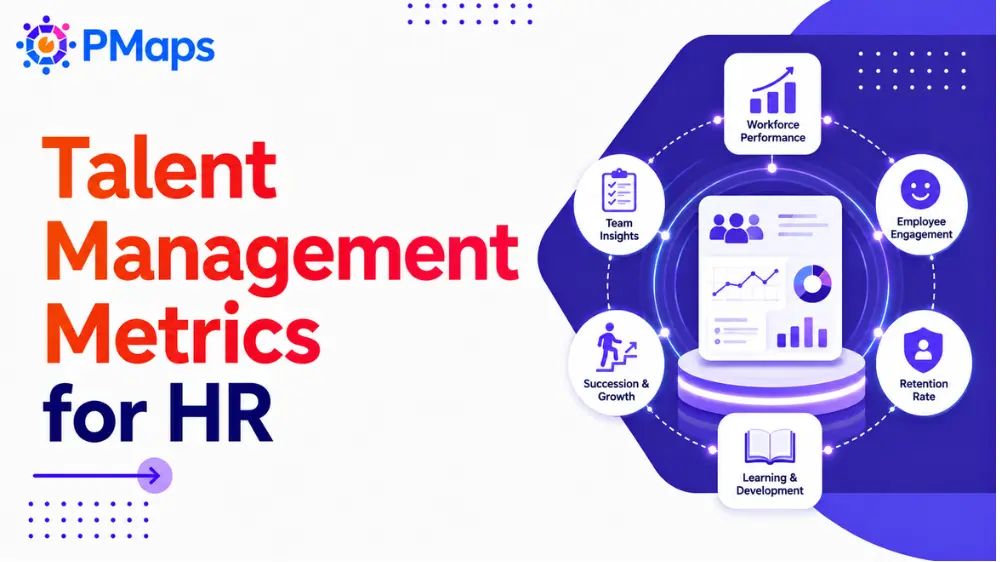
Talent management metrics are quantitative measures that track how effectively an organization attracts, develops, engages, and retains employees across the entire talent lifecycle, turning workforce decisions into something measurable rather than assumed.
Companies that balance leading and lagging indicators consistently outperform those tracking data in isolation, and HR teams now monitor everything from quality of hire to high-potential turnover. The sections below break these talent management KPIs down by where they sit in the employee journey: hiring, growth, mobility, and retention.
Want cleaner talent data behind these metrics? Check out our Talent Assessment Solution to connect hiring, skills, and retention signals.
Talent Acquisition and Hiring
Talent acquisition metrics reveal how efficiently your hiring funnel converts candidates into employees, and whether the people you bring on actually perform once they start the role.
- Time to hire — days from first candidate contact to signed offer acceptance
- Cost per hire — total recruiting spend divided by the number of positions filled
- Offer acceptance rate — percentage of extended offers candidates actually accept
- Quality of hire — blend of new-hire performance ratings and 90-day retention data
- Yield ratio — percentage of candidates from a source who progress to the next stage
Need sharper hiring signals? Know more about What is Talent Assessment? And use them well to connect candidate potential, role fit, and workforce decisions objectively.
Learning, Development, and Productivity
Development metrics show whether training actually changes behavior and output, not just attendance. Tracking time to productivity alongside skill growth tells you if onboarding investment is paying off.
- Training completion rate — percentage of enrolled employees who finish a learning program
- Training ROI — net performance gains measured against the cost of the program
- Time to productivity — days between a new hire’s start date and full output
- Skills gap analysis — gap between current employee skills and role requirements
- Training effectiveness — behavior and business-result change measured against established evaluation levels
Planning employee growth? Read here on What is Talent Development? And efficiently link learning, performance, mobility, and long-term retention.
Internal Mobility and Career Progression
Internal mobility metrics show whether employees can grow without leaving. A healthy promotion and transfer rate usually signals stronger retention and a more engaged, future-ready workforce.
- Internal promotion rate — internal promotions divided by total headcount, company-wide or by team
- Internal mobility rate — total internal moves divided by average employee count
- Succession coverage ratio — percentage of critical roles with at least one ready successor
- Bench strength — number of ready-now or ready-soon candidates for key leadership roles
- High-potential percentage — share of the workforce formally identified as high-potential talent
Confusing potential with current ability? Learn about the difference between talent and skills before designing hiring, training, or succession plans.
Engagement and Retention
Engagement and retention metrics flag dissatisfaction before it turns into resignations. Tracking these consistently helps HR catch flight risk early instead of reacting after an exit interview.
- eNPS — percentage of promoters minus percentage of detractors from a loyalty survey
- Voluntary turnover rate — employees who resigned divided by average headcount, over a period
- Absenteeism rate — unplanned absent days divided by total available working days
- Employee retention rate — percentage of employees who remain over a given time period
- HiPo turnover rate — high-potential employees who left divided by total identified HiPos
Why is Talent Management Metrics Important for HRs?
The benefits of talent management analytics go beyond reporting. Metrics give HR a factual basis to defend budget requests, catch problems early, and prove that talent strategy actually moves business results.
- Identifies what’s working before small issues become expensive ones
- Justifies HR investment with evidence leadership can act on
- Aligns talent decisions directly with broader business objectives
- Surfaces flight risk and skill gaps before they affect output
- Benchmarks teams and roles against each other consistently
How to Measure Talent Management Metrics?
Most of these metrics follow simple formulas — totals divided by headcount or time elapsed — but calculating the actual financial impact of a hiring or training decision takes more than a spreadsheet.
Try our free ROI calculator to instantly see what better talent management could actually be worth to your bottom line.
How to Improve These HR Metrics?
Improving talent management metrics rarely requires new tools first — it requires tying each number to a specific action plan, owner, and review cadence everyone actually follows.
- Automate data collection — pull metrics directly from ATS and HRIS systems automatically
- Set realistic benchmarks — compare scores against your industry, not abstract universal standards
- Close the loop with managers — translate dashboard numbers into specific coaching conversations
- Revisit metrics quarterly — retire indicators that no longer reflect current business priorities
- Combine leading and lagging data — pair early-warning signals with outcome-based measures
Final Words
Talent management metrics only matter if someone acts on them. A dashboard full of numbers nobody reviews is just decoration. The real question is whether your current metrics are actually changing decisions, or simply confirming what you already assumed. If you’re unsure, that’s worth a closer look. Call 8591320212 or write to assessment@pmaps.in to see how these metrics could work harder for your HR team.