.webp)
.webp)


Item Response Theory (IRT) is a psychometric framework used in hiring assessments to analyze how candidates respond to individual test questions (items) to accurately measure their underlying, unobservable traits, such as cognitive ability, technical skills, or personality traits. Unlike traditional scoring methods that simply calculate the percentage of correct answers, IRT evaluates candidate responses based on the specific statistical properties of each question.
The theory took shape in the late 1960s, when psychometricians Frederic Lord and Melvin Novick formalized it in a landmark text, building on earlier work by Georg Rasch.
So what is item response theory in plain terms? It's a scoring model built on the statistical properties of individual questions, not just the final tally of right answers. As more HR teams try to build assessments in-house using AI, understanding item response theory has stopped being an academic exercise and has become a practical necessity.
Core Components of IRT
Every IRT model rests on a handful of statistical building blocks. Knowing these terms is what separates a scientifically defensible assessment from a set of AI-generated questions with no statistical backbone behind them.
Latent Trait (θ, Theta)
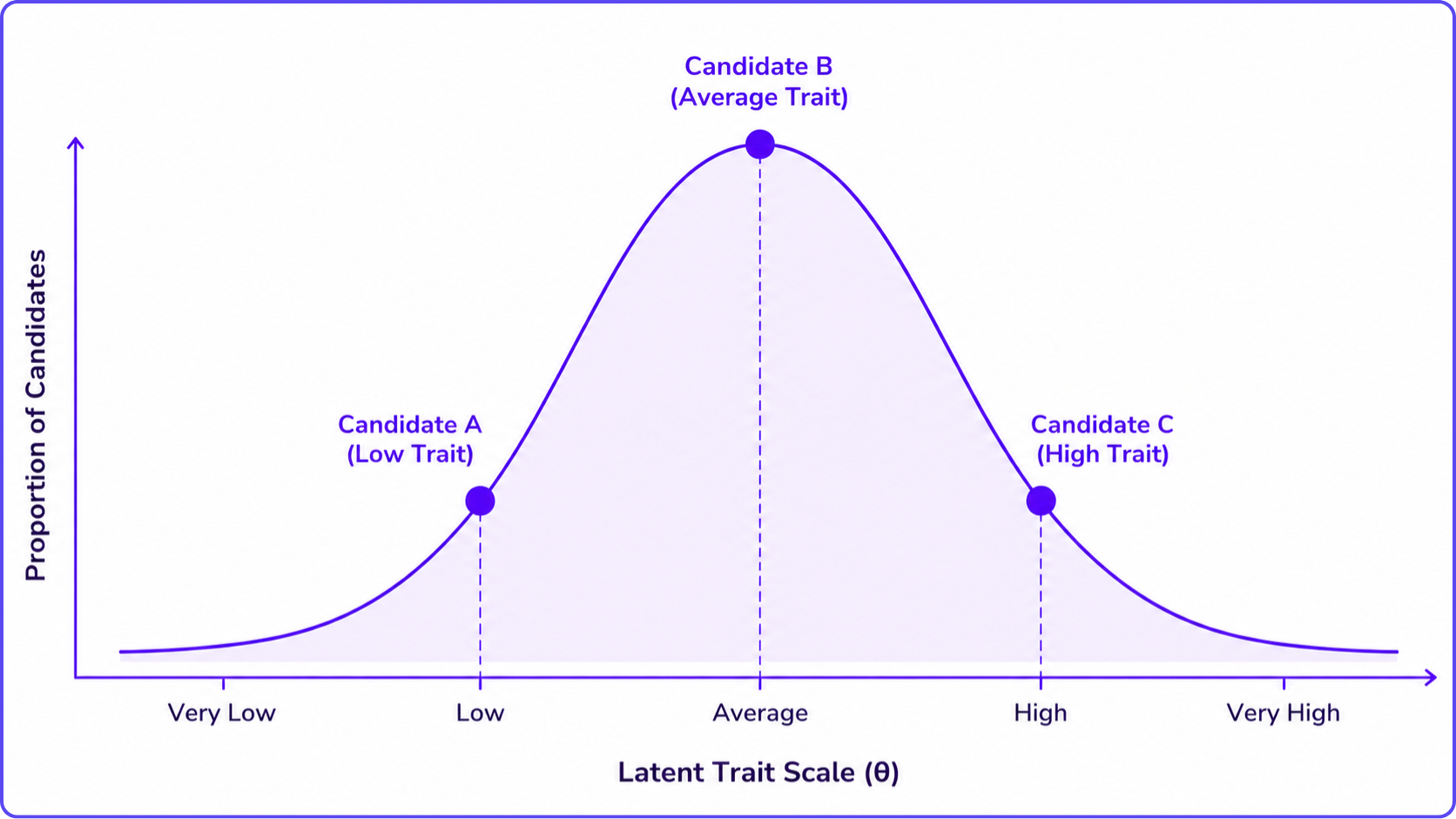
Definition: the unobservable ability or trait being measured, placed on a continuous scale.
Elaboration: Theta is never observed directly. It's inferred from the pattern of a candidate's answers, the same way weight is inferred from a scale reading rather than seen with the naked eye. It typically sits on a standardized scale centered at 0, with most candidates falling between -3 and +3.
Utility: Every other IRT parameter, difficulty, discrimination, and guessing, is defined relative to this same theta scale. That shared reference point is what keeps scores comparable across different test forms and hiring cycles.
Example: Two candidates who each answer 7 out of 10 questions correctly can still end up with different theta estimates if one of them answered the harder items correctly and the other didn't.
Item Difficulty (b)
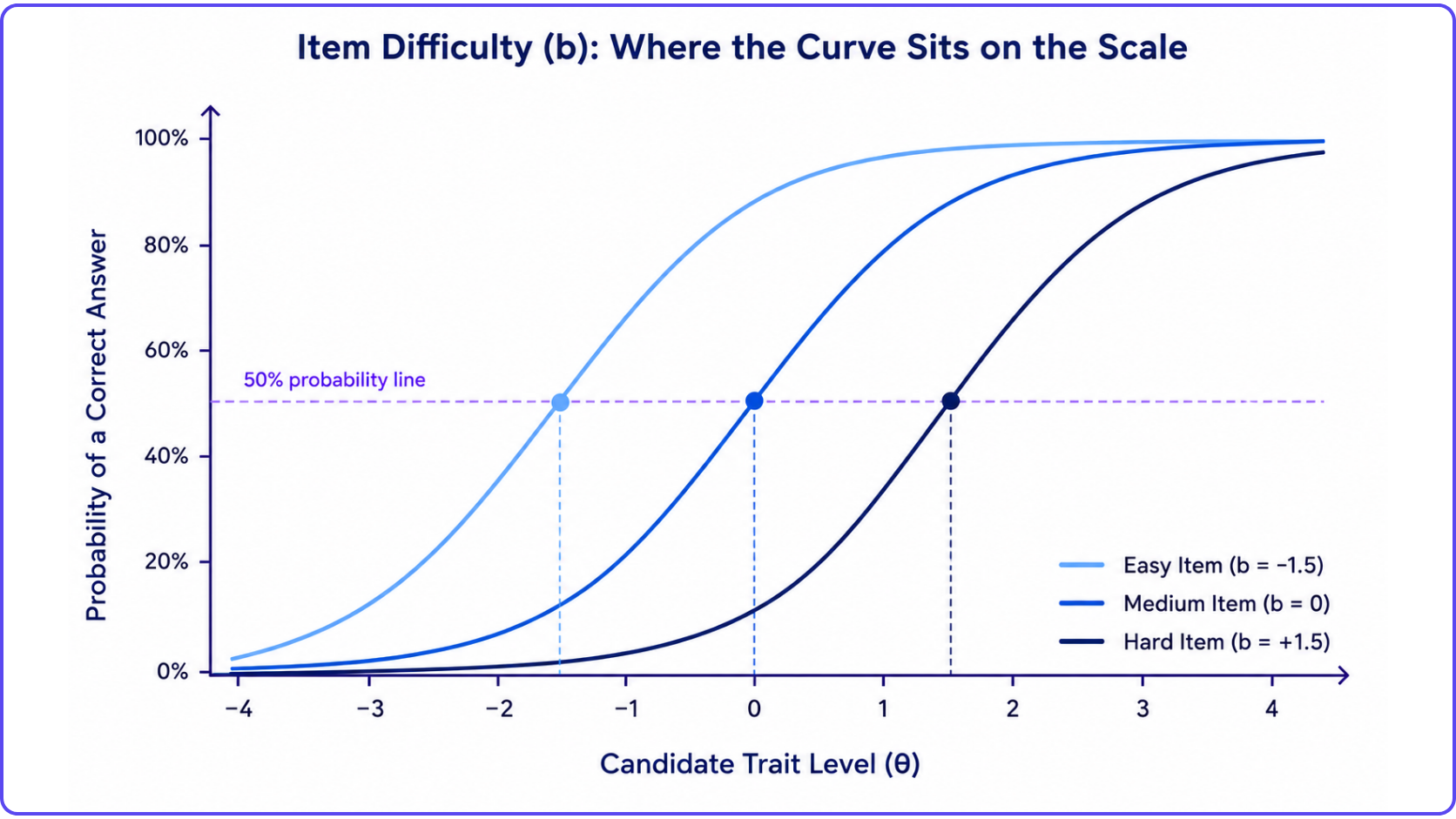
Definition: the trait level at which a candidate has roughly a 50% chance of answering correctly.
Elaboration: b sits on the same scale as theta, so a b of +1.5 means only candidates with an above-average trait level are likely to get that item right. Different b values shift the item's S-shaped curve left or right along the trait scale, without changing its shape.
Utility: Difficulty lets test designers build an item bank that spans easy to hard questions, exactly what a computerized adaptive test needs to zero in on a candidate's true ability efficiently.
Example: A basic arithmetic question might have a b of -2, easy for nearly everyone, while a multi-step statistical reasoning question might sit at b = +2, answered correctly only by the strongest candidates.
Item Discrimination (a)
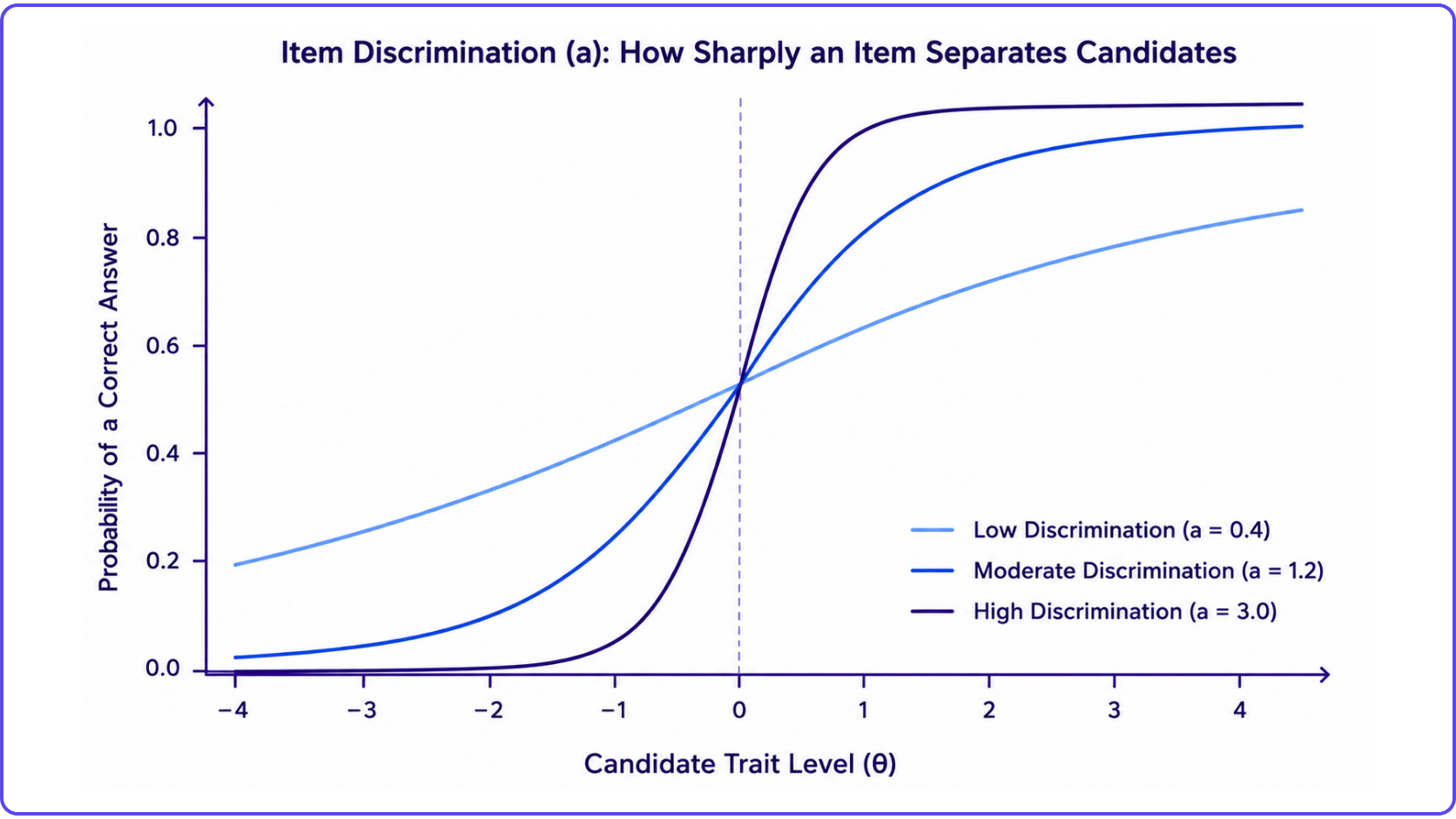
Definition: how sharply a question distinguishes high-trait candidates from low-trait candidates.
Elaboration: Geometrically, a controls how steep the item's curve is at its midpoint. A high value means a small increase in ability produces a large jump in the probability of a correct answer, so the item cleanly separates strong candidates from weak ones. A low value means the item barely tells them apart.
Utility: High-discrimination items carry the most statistical weight in scoring and are the ones item writers protect and reuse. Low-discrimination items are usually flagged for revision or removed from the bank.
Example: A question that top performers and weak performers answer correctly at similar rates has low discrimination and adds little diagnostic value, even if it reads like a well-written question.
Guessing Parameter (c)
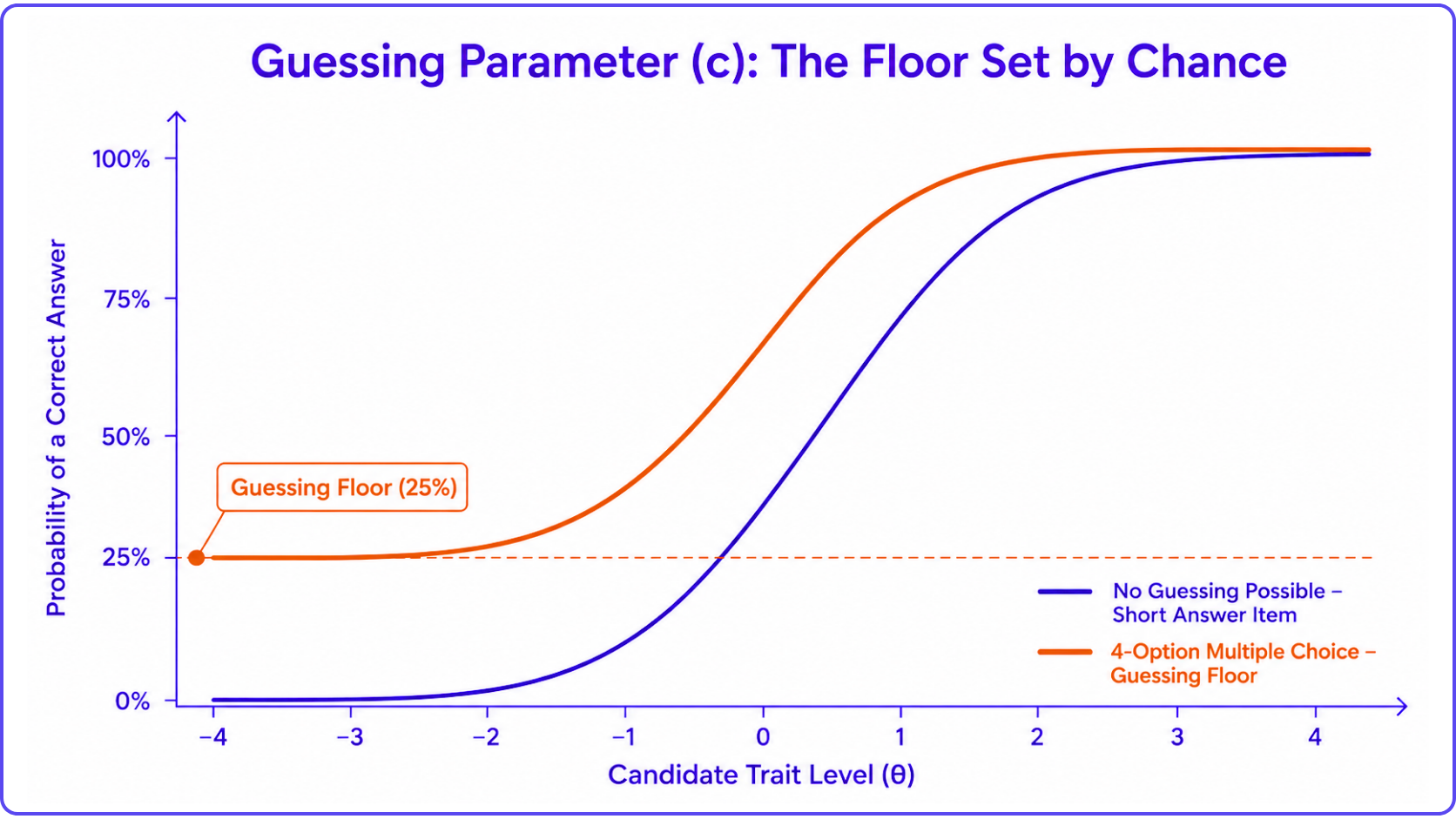
Definition: the probability of a correct answer purely by chance, relevant mainly for multiple-choice items.
Elaboration: c only matters for items where a wrong answer can be picked by accident, like multiple-choice questions. A four-option item has a theoretical guessing floor of 0.25, meaning even a very low-ability candidate has roughly a 1-in-4 chance of answering correctly. Free-response items typically have a c close to zero.
Utility: Accounting for c prevents low-ability candidates from being credited with knowledge they don't have, keeping scores fair and preventing inflated pass rates on multiple-choice-heavy tests.
Example: In a 3PL-scored assessment, a candidate who answers a hard multiple-choice item correctly by chance won't receive the same credit as one who reaches that answer through genuine skill, since the model factors in the guessing floor.
Item Characteristic Curve (ICC)
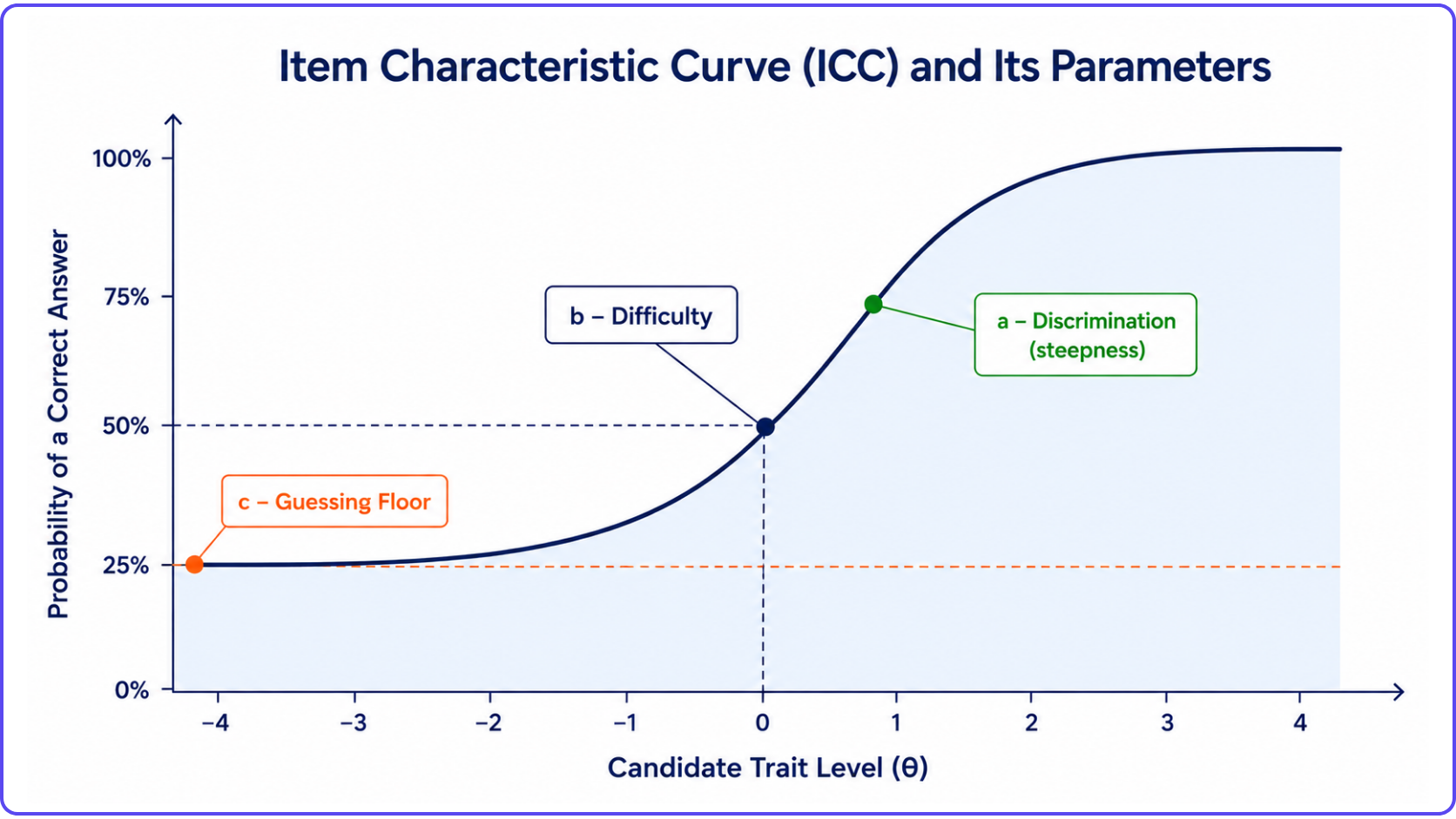
Definition: The graph showing how the probability of a correct response rises as trait level increases.
Elaboration: The ICC is the graphical signature of a, b, and c combined into a single S-shaped curve. Its horizontal position reflects difficulty, its steepness reflects discrimination, and its starting height off the x-axis reflects the guessing floor.
Utility: Psychometricians read ICCs the way a doctor reads an X-ray. One glance shows whether an item is well-behaved, a clean S-curve, or problematic, flat, inverted, or oddly shaped, which flags a question that needs fixing.
Example: An item whose ICC barely rises from left to right across the entire trait scale isn't distinguishing anyone; it's the visual equivalent of discovering a question simply doesn't work.
Use of Item Response Theory in Talent Assessment
Item response theory in recruitment and talent assessment isn't limited to cognitive tests. It underpins two distinct categories of hiring tools, each requiring its own statistical treatment.
Item Response Theory for Trait Assessment
Personality and behavioral assessments rely on graded, polytomous IRT models, since candidates respond on a rating scale rather than a right-or-wrong basis. Item response theory for trait assessment estimates where a candidate sits on a dimension, like conscientiousness or emotional stability, by weighing how closely their response pattern matches each item's discrimination and threshold values.
Curious how this plays out in practice? Explore PMaps' Personality Test suite, built on validated, IRT-calibrated item banks.
Item Response Theory for Skills Testing
Cognitive and technical skills tests are the classic use case for item response theory for skills testing, typically scored with dichotomous 1PL, 2PL, or 3PL models depending on whether guessing and item difficulty need separate accounting.
This is also where Computerized Adaptive Testing delivers the most value, since the delivery engine can select each candidate's next item in real time based on their estimated ability so far.
Ready to measure job-relevant skills accurately? Try PMaps' Skills Assessment library, calibrated for precision at every difficulty level.
Steps to Implement IRT in Your Hiring Process
This is where most in-house AI assessment projects stall. Building an IRT-scored test isn't a prompt-engineering problem, it's a data and statistics problem. Here's what a properly calibrated assessment actually requires.
- Define the construct. Pin down exactly what trait or skill the test measures, and how it maps to job performance, before writing a single question.
- Draft and pilot a large item bank. Write far more items than you need and pilot them on a representative sample; small pilot groups can't support stable parameter estimates.
- Collect response data at scale. Reliable calibration typically needs several hundred responses per item, data most individual employers don't have sitting in a spreadsheet.
- Calibrate items with specialized software. Statisticians fit models like the Rasch, 2PL, or graded response model using tools such as R, IRTPRO, or Xcalibre, work that usually requires formal psychometric training.
- Check for bias and adverse impact. Run differential item functioning analysis to confirm no item unfairly favors or penalizes a protected group.
- Deploy with adaptive or fixed-form delivery. Decide whether the assessment benefits from adaptive item selection or a standard fixed form.
- Monitor and recalibrate. Item parameters drift as the applicant pool changes over time, so recalibration needs to be a routine step, not a one-time task.
Steps three through five are where most self-built AI assessments quietly fall apart. Under the EEOC's Uniform Guidelines on Employee Selection Procedures, employers are expected to show evidence that a test is job-related and free of adverse impact, and that burden doesn't shift just because AI wrote the questions.
Skipping calibration doesn't remove the requirement to validate a test; it just removes the evidence you would need if that test is ever challenged. This is precisely the gap norm-backed providers are built to close. Established talent assessment platforms already hold years of calibrated response data across roles and industries, the exact ingredient a first-time, in-house AI assessment starts without.
Models of IRT and When to Use Them?
Item response theory models fall into two broad families: dichotomous models for right-or-wrong items, and polytomous models for rating-scale items. The right choice depends on what the assessment is trying to measure.
IRT vs. Classical Test Theory (CTT)
When people compare item response theory vs classical test theory, the difference comes down to what each model actually scores: the test as a whole, or each item on its own.
CTT isn't obsolete, it simply isn't built for high-stakes, repeatable hiring decisions. It works fine for a one-off internal quiz. It struggles the moment an assessment needs to scale across roles, get reused across hiring cycles, or hold up under legal scrutiny.
What's the Difference Between IRT and Latency?
IRT, also known as latent trait theory, estimates a candidate's ability from the pattern of correct and incorrect responses across items with known statistical properties. Response latency is a different measurement entirely: it's simply how long a candidate takes to answer each item.
Latency can flag rushed guessing, unusual pauses, or possible test-taking irregularities, but it doesn't estimate ability on its own. Some assessment platforms combine the two, layering latency on top of an IRT-based ability score as a secondary signal, rather than using it as a replacement.
Conclusion
Building assessments with AI isn't the same as building assessments that hold up. The questions might read well, but without item-level calibration, real response data, and bias testing behind them, an AI-generated test carries the scoring logic of a spelling quiz, not a validated hiring tool.
If your team has the applicant volume and the timeline to build and calibrate an IRT-scored assessment from scratch, the steps above are your starting point. For questions on which route fits your hiring stage, reach out to PMaps at assessment@pmaps.in or 8591320212.