
.webp)
.webp)


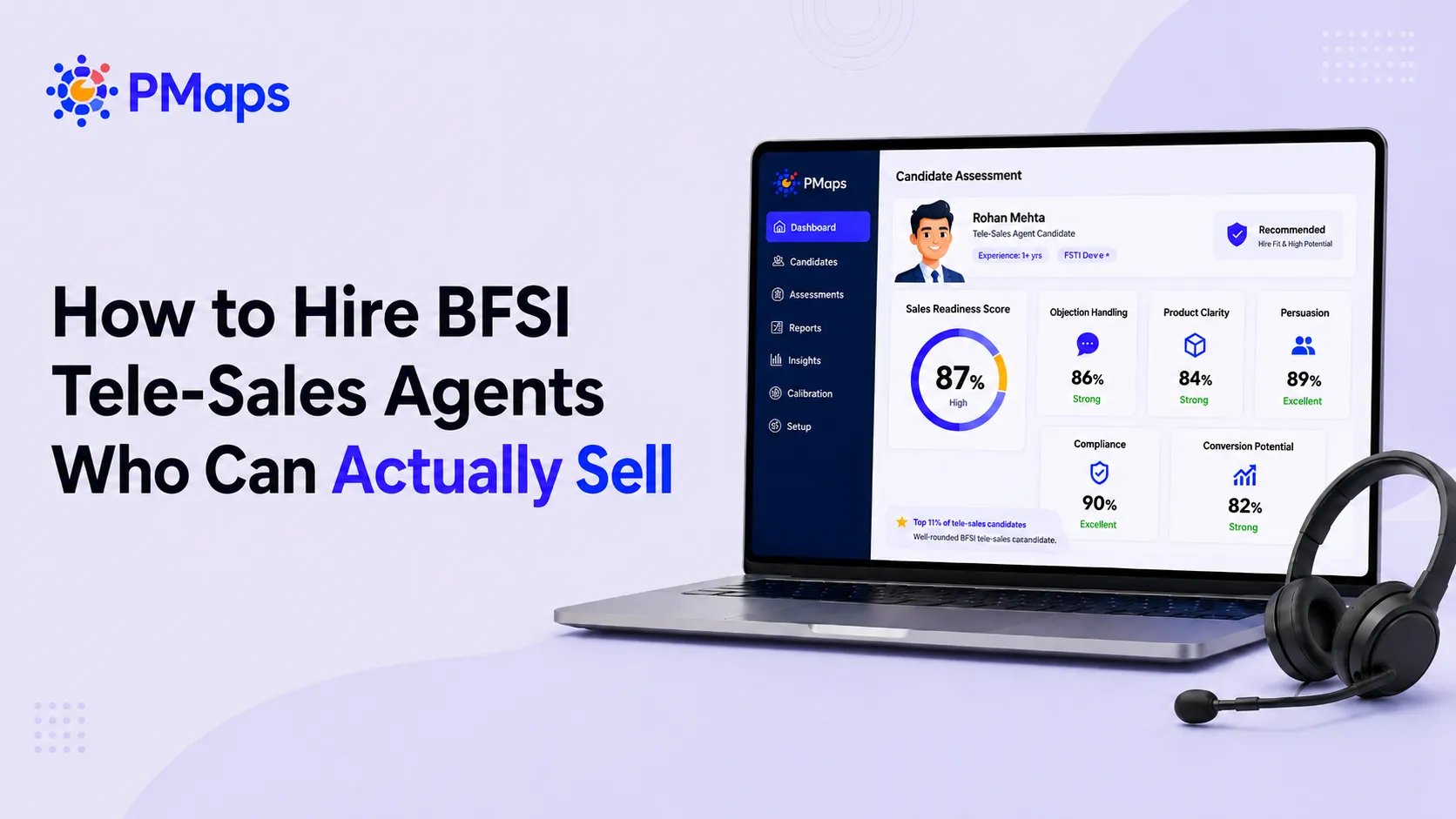
Tele-sales is one of the hardest roles in financial services to hire well. You're hiring at volume, often hundreds a month, for a young, first-job workforce, into a role with steep early attrition — and most of the screening leans on a quick interview and a gut call. The result is predictable: wide swings in productivity between agents who looked identical on paper.
It doesn't have to work that way. When you screen on the competencies that actually predict tele-sales performance, the quality of every downstream hire rises. This guide covers what those competencies are, a step-by-step process to hire telecalling agents in banking, NBFC, lending, and insurance, and the metrics to track so you know it's working.
In short: To hire tele-sales agents in BFSI, screen early — before interviews — on the two competencies that predict performance most: behavioral fit (drive, influence, conscientiousness) and attention to detail. Language ability matters less than most teams assume. Use a validated, role-specific assessment as a pre-interview gate, route intake toward sourcing channels that yield high performers, and track productivity and retention by hire.
Why BFSI tele-sales hiring is hard
Three forces make this role uniquely difficult to screen for:
- Volume. Frontline lending and insurance teams hire continuously, often 1,000+ agents a month across centers and staffing vendors. Manual screening can't keep pace, so quality control slips.
- A young, high-turnover workforce. The biggest participating age band is typically 20–24 — often in their first structured job. Early attrition is high, and a bad hire is expensive twice: once to onboard, once to replace.
- Misleading signals. Recruiters over-index on accent and fluency because they're audible in a screening call. But polished speech is not the same as the drive, resilience, and accuracy that move a sales number.
The competencies that actually predict tele-sales performance
When PMaps validated a tele-sales assessment for a leading BFSI lender across 1,118 hires, measured over a full year against real disbursement, the pattern was clear: behavioral traits did almost all of the predicting.
- Behavioral fit (the strongest predictor). Drive for results, ability to influence, conscientiousness, and the adaptability to handle rejection on call after call. In the study, this single competency carried the largest share of the predictive weight.
- Attention to detail. The capacity to stay accurate under time pressure — capturing customer information cleanly, handling multiple details without slips. The second-strongest predictor.
- Language — important, but not decisive. Spoken-language ability matters for the job, but as a predictor of sales output it contributed far less than behavioral fit. It's better treated as a developmental input than a hard gate.
Together, behavioral fit and attention to detail carried 84% of the assessment's predictive weight. The lesson: hire for behavior first, polish for language second.
See the full numbers in the predictive validity case study.
A step-by-step process to hire BFSI tele-sales agents
1. Define what "good" means for the role
Pick one objective outcome the role exists to drive — disbursement, premium collected, conversions, or appointments booked — and a threshold that separates high from low performers. This becomes the standard you hire toward and, later, validate against. (For the full method, see how to validate a hiring assessment.)
2. Build a role-specific assessment, not a generic one
A telecalling agent for an NBFC is not a generic salesperson. Use an assessment tuned to frontline BFSI sales that measures behavioral fit and attention to detail as core constructs, with language as a secondary, developmental signal. Equal-weighting every section dilutes the prediction.
3. Screen early — before interviews
Place the assessment at the top of the funnel so it filters at volume and protects recruiter time. Automate pass/route logic in your ATS so every applicant is screened consistently, without manual effort. This is what makes high-volume hiring both fast and fair.
4. Deliver in the candidate's language
BFSI frontline hiring spans many regions and languages. Offering assessments in the candidate's own language — PMaps supports 8+ Indian languages — widens the funnel and reduces drop-off without lowering the bar, because you're testing behavior and accuracy, not English alone.
5. Interview only the candidates who clear the gate
By the time a candidate reaches a human interview, the gate has already concentrated quality. Use the interview to confirm fit and motivation, not to re-do screening. Treat low language scores as onboarding inputs — pair those hires with targeted communication coaching rather than rejecting them.
6. Track outcomes and route by source
Tag every hire by sourcing channel — center or staffing vendor — and track high-performer yield per source. Quality often varies more by where you hire than how you screen: in the BFSI study, high-performer yield ranged from 40% to 75% across centers. Rebalancing intake toward proven channels lifts quality before you change a single test question.
Common mistakes in tele-sales hiring
- Screening on accent and fluency alone. Audible polish is not a performance predictor. Behavior is.
- Using a generic sales test. Frontline BFSI tele-sales has its own success drivers; a one-size assessment misses them.
- Interviewing everyone. Without a pre-interview gate, recruiters drown in volume and quality control collapses.
- Ignoring proctoring. At volume and across vendors, integrity lapses creep in. Un-proctored scores can't be trusted as a gate.
- Treating all sourcing channels as equal. They aren't. Measure yield by source and rebalance.
Metrics to track
- High-performer yield — share of hires hitting your outcome threshold (target 65%+).
- Time-to-hire — assessment-first funnels cut this materially.
- Completion rate — multi-language, role-relevant assessments reduce candidate drop-off.
- Early retention — strong screening shows up as fewer 90-day exits.
- Yield by source — high-performer rate per center and vendor, reviewed each cycle.
How PMaps helps BFSI teams hire tele-sales agents
PMaps is an AI-powered talent assessment platform that helps enterprises improve their hiring odds — scientifically. For frontline BFSI sales, that means role-specific assessments validated against real performance, delivered in 8+ Indian languages, with AI-assisted proctoring so a passing score is a genuine one.
Hiring tele-sales agents at volume? Book a 30-minute walkthrough and we'll map a validated gate to your roles and centers.





.webp)


