
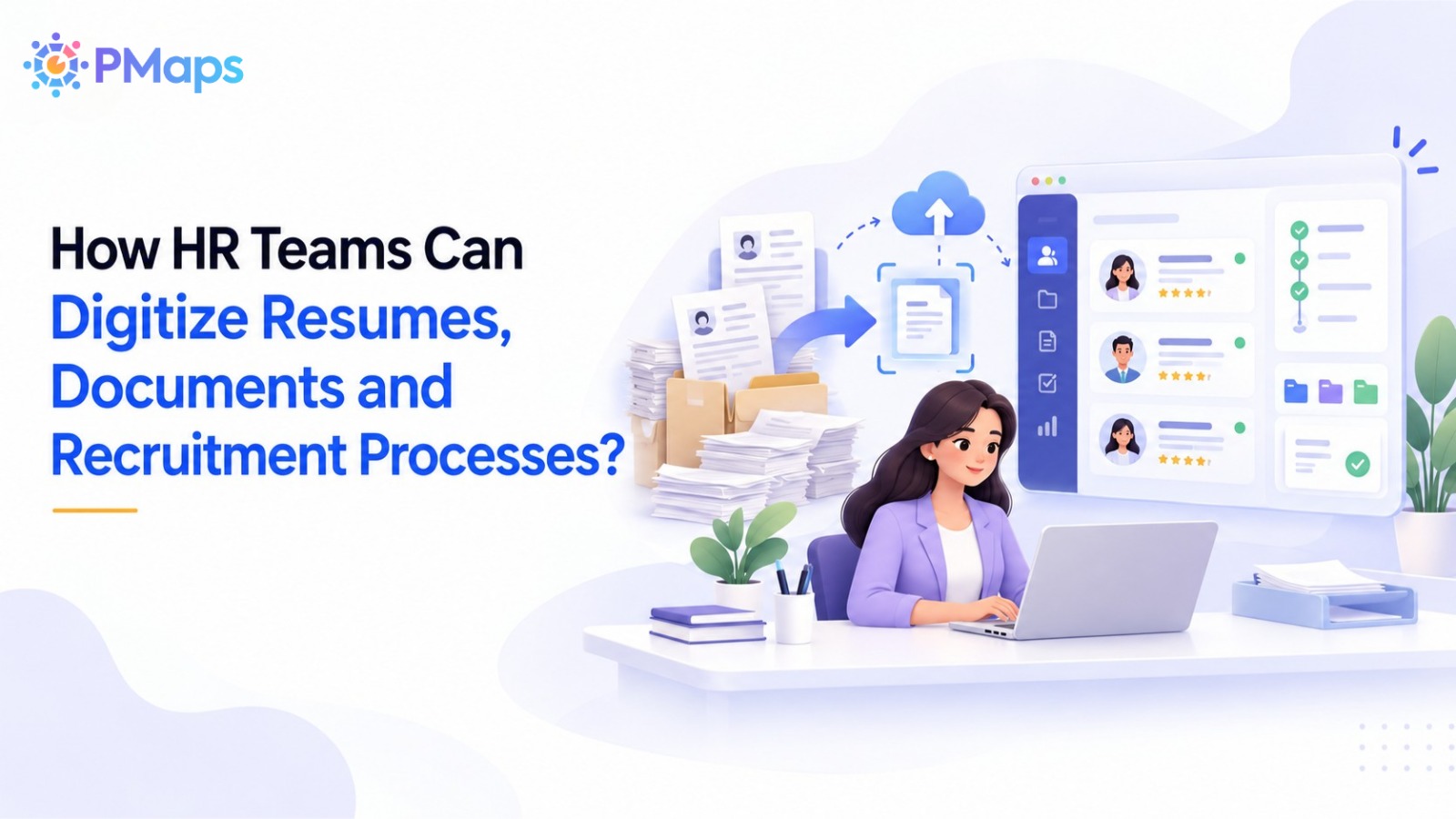
HR teams deal with a lot of manual paperwork. From resumes and employee records to administrative documents, recruitment and HR processes generate a considerable amount of information. Paper documents are harder to store, search, organize, and access compared to digital ones. HR teams therefore need efficient ways to digitize documents and make candidate and employee information easier to manage.
The shift toward AI enabled recruitment is already visible in HR teams. SHRM’s 2025 Talent Trends research found that 51% of organizations were using AI to support recruiting, with resume screening among the most common applications. Among organizations using AI in recruiting, 89% of HR professionals said it saves time or increases efficiency, while 36% reported reduced recruitment, interviewing, or hiring costs. These figures show why AI is moving beyond experimentation and into practical recruitment workflows.
Today, technology can help HR teams move beyond simply converting paper records into digital files. With document digitization, AI powered resume screening, online assessments, and digital interviews, more stages of the recruitment process can be brought into a structured digital workflow.
1. Start by Sorting Existing Paper Documents
The first thing HR teams need to do is organize all paper documents they have. This is going to take time if they are doing it for the first time, but it is a necessary step.
The point of the organization is to create two clean piles, one that will be digitized and the other that will be ignored.
The ignored pile may contain things like:
- Duplicate documents
- Outdated drafts of letters and contracts
The useful pile should be further segmented into categories such as:
- Employee records
- Resumes
- Administrative paperwork
- Other relevant HR document.
This organization helps create a cleaner foundation for the digitization process and makes it easier to determine which information needs to be converted, reviewed, and stored.
2. Scan Documents at a Readable Quality
The next step is to simply scan all the documents. Using a proper scanner here is best, but if you do not have one, you could use a phone camera as well.
Make sure that the scans are readable and do not suffer from:
- Poor lighting
- Occluded pages
- Tilted pages
- Shadows and artifacts
- Poor resolution
This is necessary for proper digitization because the quality of the original document can directly affect how accurately information is extracted later. A clear and properly aligned document gives digital processing tools better information to work with and reduces the amount of manual correction required.
3. Convert Scanned Documents Into Text
The problem with scanned documents is that they are essentially images. The text inside them is not searchable, and you cannot easily annotate or edit the information. This is where OCR comes in.
OCR technology can extract text from images and convert it into a format that is searchable and editable. HR teams can use an online image to text converter to convert scans into PDF or DOCX files within minutes. If the tool supports bulk processing, the time required to digitize large volumes of documents can be reduced further.
However, OCR tools are not infallible. Unusual fonts, blurry images, tables, or handwritten information can reduce accuracy. This is why the quality of the original scan matters and why extracted information should still be reviewed before being used.
4. Extend Digitization Into AI Powered Recruitment
Digitizing resumes and HR documents is only one part of creating a more efficient recruitment workflow. Once candidate information is available digitally, AI can support additional stages of recruitment, from understanding resumes to assessing and interviewing candidates.
This can include AI resume parsing, AI online assessment, AI voice interview, and AI video interviewing. Each technology addresses a different part of the recruitment process, allowing organizations to move from simply storing candidate information digitally to creating a more structured and technology enabled hiring workflow.
AI Resume Parsing
AI resume parsing can help HR teams process large volumes of candidate resumes by extracting relevant information from different resume formats and organizing it into structured candidate profiles. Instead of manually reading every resume to identify basic details, AI resume parsing can help identify information such as skills, educational qualifications, work experience, job titles, certifications, and other relevant candidate information.
AI resume parsing is particularly useful when organizations receive a high number of applications for a single position. By converting unstructured resume content into structured information, recruiters can search, filter, compare, and organize candidate profiles more efficiently. PMaps resume parsing guide explains how modern parsing can structure fields such as skills, education, experience, and contact information. However, extracted information should still be reviewed because differences in resume formats, terminology, and document quality can affect the accuracy of automated processing.
AI Online Assessment
AI online assessment can extend digital recruitment beyond resume screening by providing structured ways to evaluate candidates. Depending on the recruitment requirement, an AI online assessment can be designed around skills, aptitude, knowledge, role specific competencies, or other criteria relevant to a position.
An AI online assessment can help organizations move from evaluating candidates primarily through resumes to gathering additional information about their capabilities. It can also make assessments easier to administer across a larger candidate pool because candidates can complete them digitally. PMaps online pre employment assessments include role based assessments and an AI powered test builder. As with other automated recruitment technologies, assessment results need to be interpreted carefully and within the context of the role, assessment design, and other candidate information.
AI Voice Interview
An AI voice interview introduces a conversational element into the recruitment process. Instead of relying only on written application information, candidates can respond to questions through a voice based interaction. The technology can support early stage screening by asking predefined questions, recording responses, and organizing information for further review.
An AI voice interview can be useful when organizations need to conduct initial conversations with a large number of candidates without requiring recruiters to schedule and conduct every preliminary interaction themselves. It can help standardize the questions asked across candidates and create a consistent digital screening process. PMaps AI Voice Interviewer describes a structured voice interview workflow designed for role specific screening and recruiter ready reporting. However, voice based responses should be considered as one part of candidate evaluation rather than treated as a complete substitute for human judgement.
AI Video Interviewing
AI video interviewing brings another layer of digital interaction into the recruitment process by allowing candidates to respond to interview questions through video. It can support structured interview workflows in which candidates answer standardized questions, record their responses, and submit them digitally for further evaluation.
AI video interviewing can be particularly relevant for organizations managing geographically distributed candidates or large applicant volumes. It can make it easier to collect interview responses without requiring every candidate and recruiter to be available at the same time. PMaps AI Video Interview platform describes asynchronous, AI led video interviews with structured prompts and response analysis. The resulting video responses can become another source of information within the recruitment workflow. Organizations should still establish appropriate review practices and ensure that technology supports, rather than replaces, responsible human evaluation.
5. Review the Extracted Information
HR teams should not treat automatically extracted information as error free. A single incorrect character can change an email address, phone number, date, qualification, job title, or company name.
OCR and AI based tools can significantly reduce manual work, but careful review remains necessary. The advantage is that reviewing digitally extracted information is still generally faster than manually typing an entire document or processing every candidate record from scratch.
During review, HR teams should pay particular attention to:
Names and contact information, Dates of employment, Educational qualifications, Job titles, Email addresses, Phone numbers, Certification numbers, Company names, Candidate assessment information, Interview records.
This verification step becomes especially important when the information is being used for official employee records or recruitment decisions.
6. Store Documents in an Organized System
Once paper documents have been converted, they need to be stored somewhere useful. Simply creating a massive folder containing thousands of files does not solve the original problem.
HR teams should establish a consistent naming and folder structure. For example, employee documents could be organized by employee ID, document type, and year.
A resume might follow a naming convention such as:
EmployeeID_Name_Resume_2026
Similarly, employment contracts, certificates, assessment records, and other HR documents can follow the same general structure.
For larger organizations, a dedicated HR information system or document management platform can make searching and accessing these records considerably easier.
7. Protect Sensitive HR Information
HR documents often contain highly sensitive information, so digitization should not be treated purely as a convenience project.
Access permissions should be configured so employees can only view the records they actually need. Digital files should also be stored securely, and organizations should consider encryption, backups, authentication, and appropriate retention policies.
The same principle applies when recruitment processes incorporate AI resume parsing, AI online assessment, AI voice interview, or AI video interviewing. Candidate information, assessment responses, recordings, and other recruitment data should be handled according to the organization's applicable policies and requirements.
Paper documents should not necessarily be thrown away immediately after scanning, either. HR teams should follow their organization's policies and applicable legal requirements to determine when physical records can be securely destroyed.
8. Create a Consistent Workflow
Digitizing documents and introducing AI powered recruitment tools works best when these technologies become part of a repeatable HR process rather than a one time project.
For example, an HR department could use a workflow like this:
- Receive or collect the candidate or HR document.
- Scan it at an appropriate quality when a physical document is involved.
- Convert the scanned image into searchable text when necessary.
- Use AI resume parsing to structure relevant candidate information.
- Conduct an AI online assessment where appropriate for the role.
- Use an AI voice interview for an appropriate stage of initial screening.
- Use AI video interviewing as part of a structured interview process where required.
- Review extracted information and candidate responses for accuracy and relevance.
- Save digital records using a consistent naming convention.
- Store them in the appropriate HR system or secure folder.
- Apply the correct access permissions.
- Dispose of physical copies according to company policy.
With a standardized process, HR teams can reduce repetitive administrative work while creating a more organized recruitment and document management workflow.
Conclusion:
Digitization can help HR teams move from paper based processes toward more structured digital workflows. OCR can make scanned documents searchable, while AI powered technologies can extend digitization into different stages of recruitment.
From AI resume parsing and AI online assessment to AI voice interview and AI video interviewing, organizations can use technology to support different parts of the candidate journey. The objective is not simply to automate recruitment, but to create a process in which information can be captured, organized, assessed, reviewed, and managed more efficiently.
With appropriate human review, responsible data handling, and a consistent workflow, digital HR technologies can become part of a repeatable recruitment and document-management process.