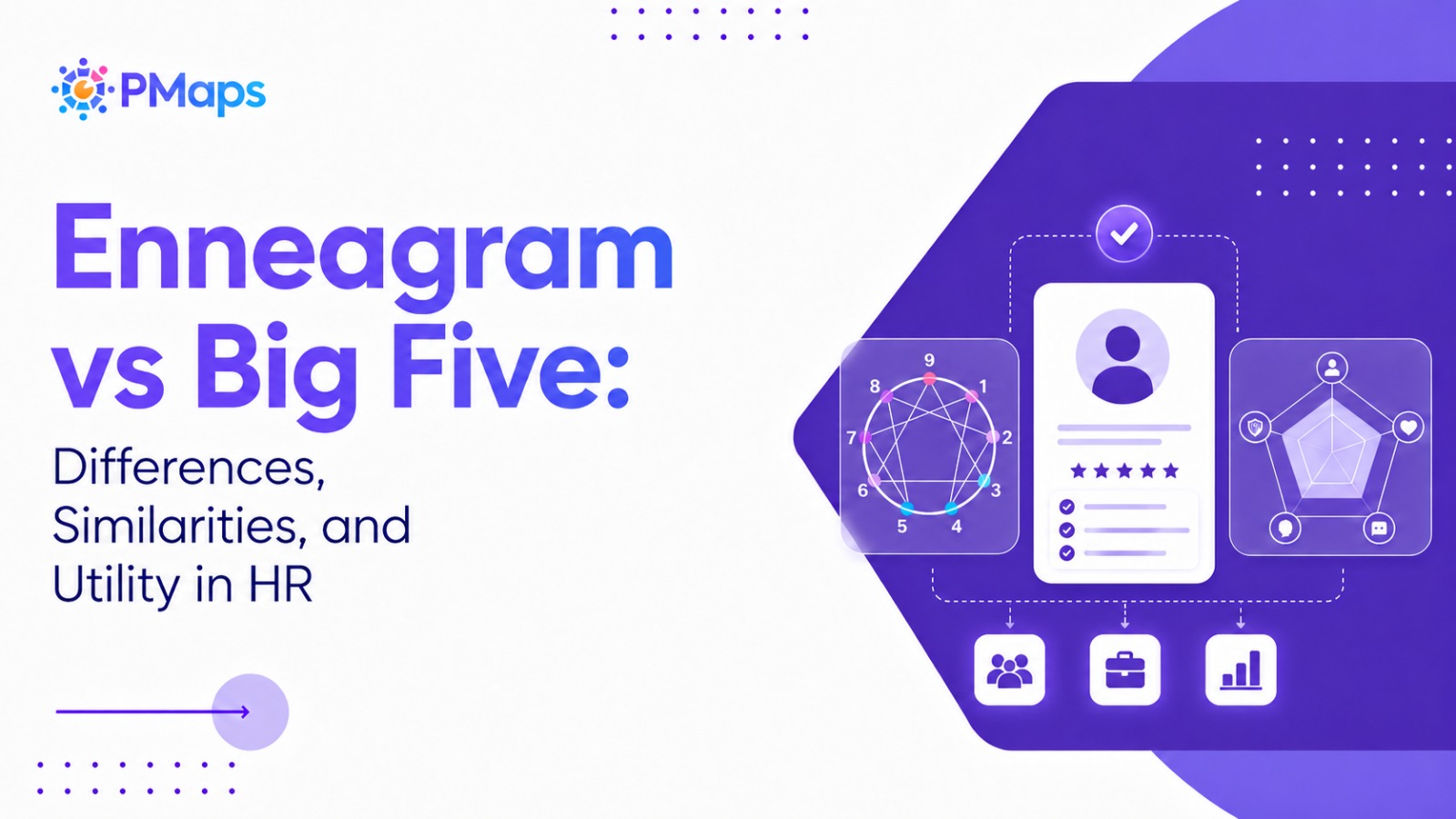
Two of the most-discussed personality frameworks in HR today sit on opposite ends of a key trade-off. The Big Five measures where people land on scientifically validated trait spectrums. The Enneagram maps why they behave the way they do. Both generate real insight, but for very different decisions.
For HR teams choosing between them or deciding whether to combine them. What matters is understanding what each framework actually measures, where its validity evidence holds, and which hiring or development question it answers best.
Understanding Big Five and Enneagram
What is the Big Five test? It is the most empirically validated personality model in psychology, measuring five continuous trait dimensions (Openness, Conscientiousness, Extraversion, Agreeableness, and Neuroticism) through standardized, Likert-scale questionnaires. Unlike type-based systems, the Big Five never places a person in a box; it shows where they fall on each spectrum relative to a normed population. It is the benchmark tool in academic research, clinical assessment, and organizational psychology.
What is an Enneagram test? The Enneagram groups personality into nine distinct types, each anchored by a core motivation, a defining fear, and specific patterns of growth and stress. It adds wings (adjacent types that shade the dominant one) and subtypes, making it far more nuanced than any number at first suggests. The framework has roots in spiritual traditions and has grown into a widely used coaching and team development tool, though it carries significantly less empirical validation than the Big Five.
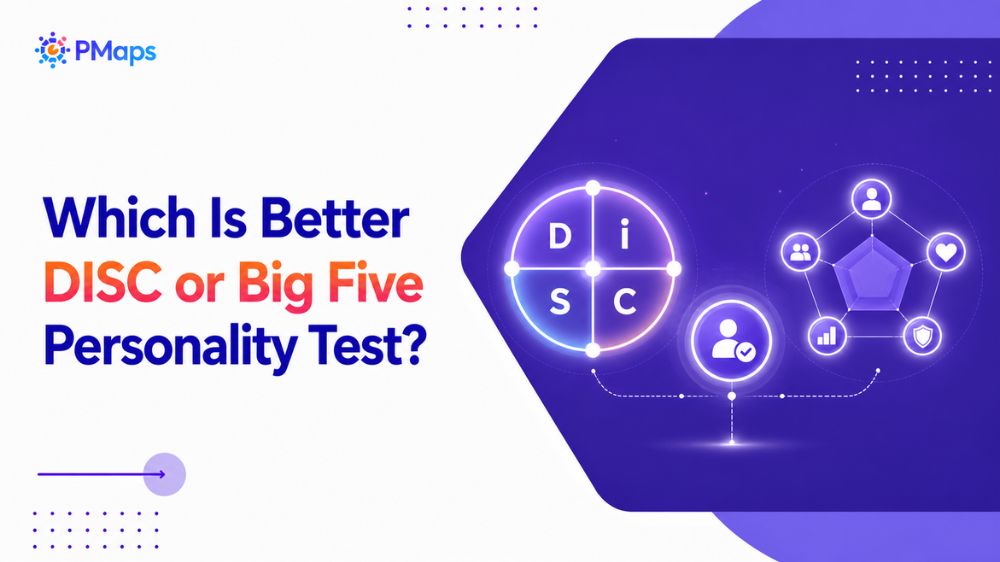
Wondering where behavior style ends and trait evidence begins? Read [DISC vs Big 5] before comparing workplace personality tools.
Key Differences Between Enneagram and Big Five Personality Test
The two frameworks differ at the foundation level, not just in output. Understanding exactly where they diverge, from what they measure to how results should be interpreted, prevents organizations from applying one to use cases it was never built for.
| Dimension | Big Five / OCEAN | Enneagram |
| Foundation | Empirical psychological research; cross-cultural factor analysis over decades | Spiritual traditions and modern psychological synthesis; limited peer-reviewed validation |
| Structure | 5 continuous trait spectrums — no types, no boxes | 9 discrete personality types with wings, subtypes, and growth/stress lines |
| What It Measures | Where you fall on each trait dimension relative to a normed population | Core motivation, fear, and desire that drive behavior |
| Scientific Validity | Gold standard — consistently replicated across cultures, ages, and languages | Limited empirical validation; no single accepted scoring standard |
| Assessment Length | 35–45 minutes | 15–30 minutes |
| Results Format | Percentile scores on five dimensions; requires trained interpretation | Type number with wing and growth/stress direction; more self-interpretable |
| Complexity to Use | Moderate to score; high to interpret correctly in organizational settings | High to understand fully, including wings, subtypes, and lines; intuitive at the surface |
| Primary Application | Research, clinical assessment, personnel selection, and career prediction | Personal growth, coaching, team dynamics, and leadership development |
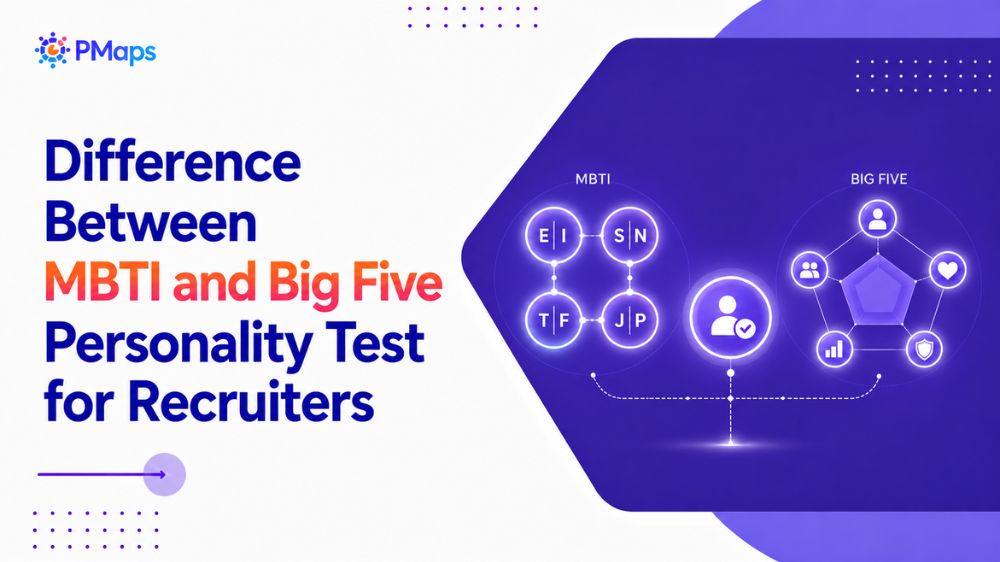
Enneagram explains motivation, but hiring needs stronger evidence. Also compare MBTI vs Big 5 before personality frameworks shape talent decisions.
Enneagram vs Big Five for Hiring and Recruitment
When it comes to pre-hire selection, the Big Five has a structural advantage: its trait scores have decades of predictive validity linking specific dimensions, especially Conscientiousness and Emotional Stability to job performance outcomes. The Enneagram adds motivational context that structured interviews rarely surface.
If you are looking for how to sequence both in a hiring pipeline, read our blog How to Use Personality Tests in the Hiring Process that covers the end-to-end approach.
| Hiring Stage | Big Five Application | Enneagram Application |
| Job Description Alignment | Map role requirements to trait profiles, such as high Conscientiousness for detail-heavy roles | Less useful at JD stage; not validated for role requirement mapping |
| Candidate Shortlisting | Objective, norm-referenced scores support defensible, consistent screening at scale | Motivational type labels lack the scoring precision needed for fair shortlisting |
| Interview Design | Low scores on specific traits flag probing areas, such as low Agreeableness for team-intensive roles | Type profile helps frame motivational questions: what drives and frustrates each type |
| Predicting Performance | Conscientiousness predicts output and reliability across most roles with strong evidence | No validated, peer-reviewed link between Enneagram type and job performance |
| Legal Defensibility | High — norm-referenced, validated, bias-auditable data supports compliance | Low — lack of validation standards makes adverse impact auditing difficult |
| Candidate Experience | Percentile results feel clinical; Neuroticism label can feel negative | Type descriptions feel affirming and accessible; lower candidate resistance |
Enneagram vs Big Five for Workplace Assessment Post-HireAfter the hire, the balance shifts. The Enneagram’s motivational depth becomes genuinely useful in coaching, team building, and leadership development, the contexts where a shared type language matters more than percentile precision.Table
| Post-Hire Use Case | Big Five Application | Enneagram Application |
| Leadership Development | Identifies trait-level strengths and development gaps for structured coaching | Growth and stress lines point directly to development focus areas per type |
| Team Dynamics | Trait profiles show potential friction points between team members | Type interactions illuminate recurring tensions and complementary pairings |
| Succession Planning | High Conscientiousness and Openness scores correlate with leadership readiness | Type-based potential profiling is less predictive; better used as a supplement to data |
| Conflict Resolution | Trait gap analysis helps HR design targeted conflict interventions | Type differences make stress and defense patterns visible in group settings |
| Manager Coaching | Trait scores give coaches specific behavioral anchors to work from | Growth paths per type give coaches a concrete direction and language for sessions |
| Engagement and Retention | Low Conscientiousness or high Neuroticism flags can signal flight risk early | Core fears and motivations per type help managers understand what keeps each person engaged |
Need deeper trait clarity before choosing a model? Explore [16PF vs Big 5] to compare factor depth and hiring relevance.
Connections Between the Enneagram and the Big Five
The two frameworks are not independent. Research into Enneagram-Big Five correlations shows consistent patterns: specific Enneagram types reliably score higher or lower on certain OCEAN dimensions, suggesting the two models are measuring overlapping psychological terrain from different angles.
| Enneagram Type | Correlated Big Five Pattern | What the Overlap Signals |
| Type 1 — The Improver | High Conscientiousness, moderate-low Neuroticism | Structured, principled, and self-disciplined; prefers order and correctness |
| Type 2 — The Helper | High Agreeableness, moderate Extraversion | Relationship-driven, empathetic; motivated by being needed |
| Type 3 — The Performer | High Conscientiousness, high Extraversion | Achievement-focused and socially confident; driven by recognition |
| Type 4 — The Original | High Openness, moderate-high Neuroticism | Creative, emotionally expressive, and sensitive to identity and meaning |
| Type 5 — The Investigator | High Openness, low Extraversion | Cerebral and private; motivated by knowledge and self-sufficiency |
| Type 6 — The Loyalist | High Conscientiousness, higher Neuroticism | Security-seeking, responsible; hypervigilant to risk and inconsistency |
| Type 7 — The Enthusiast | High Extraversion, high Openness | Energetic, optimistic, variety-seeking; avoids discomfort through stimulation |
| Type 8 — The Challenger | Low Agreeableness, high Extraversion | Assertive, direct, and control-oriented; motivated by autonomy and strength |
| Type 9 — The Peacemaker | High Agreeableness, lower Conscientiousness | Conflict-avoidant, steady, and accommodating; tends toward inertia under stress |
These correlations show that the two frameworks triangulate rather than duplicate. Where Big Five scores show what traits someone has, Enneagram types explain why those traits express as they do, particularly under stress or in growth. The combination is more diagnostic than either system alone.
When to Use: Enneagram vs Big Five Personality Test
Choosing between them depends on the decision you’re trying to make. For defensible pre-hire screening, the Big Five’s scientific validity is non-negotiable. For coaching and team alignment after the hire, Enneagram's motivational language is more actionable. As part of a broader personality assessment stack, both can run together without conflict, as they just answer different questions.
| Scenario | Recommended Framework | Reason |
| Pre-Hire Candidate Screening at Scale | Big Five | Validated, norm-referenced, legally defensible at volume |
| Predicting On-the-Job Performance | Big Five | Conscientiousness and Emotional Stability have decades of predictive evidence |
| Leadership and Executive Coaching | Enneagram | Growth and stress lines give coaches specific, actionable development direction |
| Team-Building Workshops | Enneagram | Type language creates shared vocabulary for motivation and conflict without jargon |
| Succession and HiPo Identification | Both | Big Five supports trait benchmarking; Enneagram adds motivational depth to development plans |
| Academic or Clinical Assessment | Big Five | Gold standard in research; Enneagram lacks the empirical backing for clinical use |
| Manager-Employee Coaching Sessions | Enneagram | Type-specific stress patterns and fears are immediately applicable in 1:1 conversations |
| Culture Fit Mapping | Both | Big Five Agreeableness and Conscientiousness, plus Enneagram core values, give a fuller picture |
| High-Volume BPO or Frontline Hiring | Big Five | Standardized, scalable, and auditable; Enneagram adds friction without predictive value here |
The Enneagram and Big Five are not competitors, they are different instruments answering different questions at different stages of the talent lifecycle. The Big Five tells you what a person’s personality looks like from the outside with scientific precision. The Enneagram tells you what’s driving that personality from the inside. Both answers matter in HR, just rarely at the same decision point.
The sharper question for your team is which decision you’re trying to get right first and whether your current assessment stack is actually built to answer it. To find out where PMaps can fit your assessment process, call 8591320212 or write to ssawant@pmaps.in.

.webp)
.webp)