.webp)
.webp)


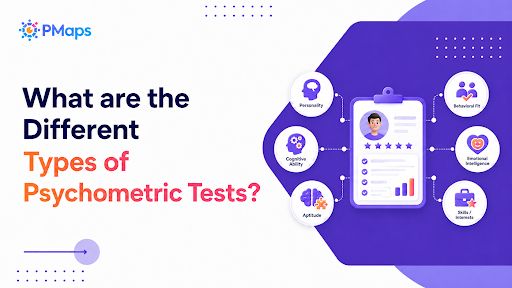
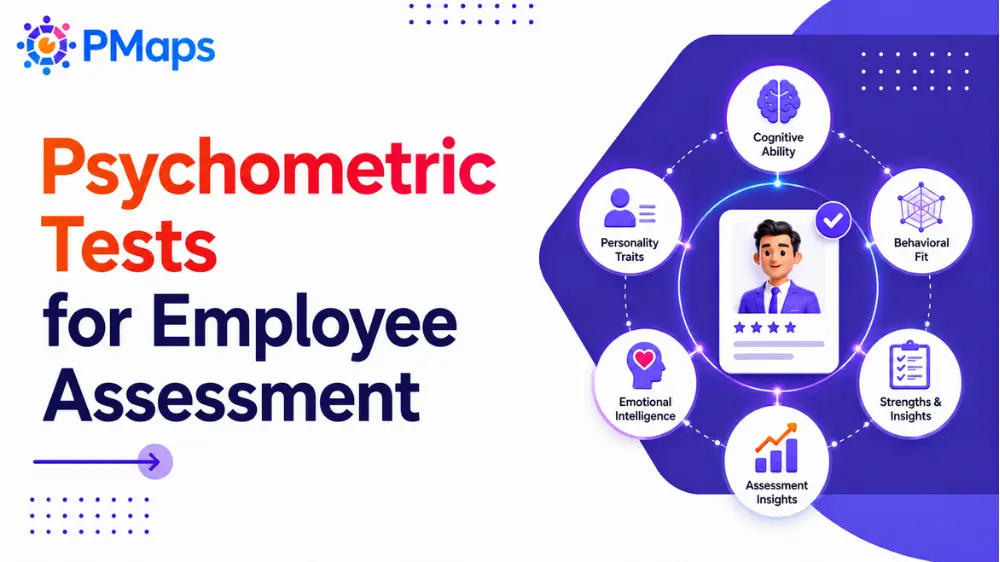
Types of psychometric tests span cognitive ability, personality, behaviour, emotional intelligence, and skills measurement. Each category targets a different layer of a candidate and a different question about how they will perform.
Organisations using data-driven hiring are twice as likely to improve recruitment outcomes and three times as likely to cut costs (LinkedIn/Ideal). With application volumes at some companies jumping from 12,000 to 45,000 in a single year, knowing which psychometric test type to deploy and when is no longer optional for HR leaders.
Psychometric Aptitude Testing
Aptitude tests measure how a candidate thinks, not just what they know. These tests expose reasoning patterns, learning speed, and problem-solving instincts that no CV or reference check can replicate.
• General Intelligence: Measures overall cognitive capacity — how quickly someone learns, adapts, and processes unfamiliar information.
• Numerical Reasoning: Tests the ability to work with figures, percentages, and data within timed, work-relevant scenarios.
• Verbal Reasoning: Assesses comprehension and written interpretation using structured passages and multiple-choice formats.
• Logical Reasoning: Evaluates a candidate's ability to identify patterns and draw conclusions from abstract sequences.
• Spatial Reasoning: Measures how well someone mentally visualises and manipulates shapes or diagrams.
• Data Interpretation: Tests the speed and accuracy with which candidates extract meaning from charts, tables, and graphs.
• Critical Thinking: Assesses the ability to evaluate arguments, spot assumptions, and reach reasoned conclusions independently.
• Cognitive Ability Tests: Umbrella assessments combining two or more reasoning types to produce a composite mental agility score.
Behaviour Testing
Behaviour tests show how a candidate acts — not how they present themselves in a room. They reveal communication style, conflict instincts, and the decision-making patterns that drive performance when no one is watching.
- Situational Judgement Tests: Present realistic job scenarios and measure the quality of a candidate's decisions under role-relevant pressure.
- Behavioural Event Interviewing: A structured method that probes specific past actions as predictors of future on-the-job behaviour.
- Video Interviewing integrated with psychometric: Combines structured visual interviews with psychometric scoring to assess communication, presence, and role alignment simultaneously.
- Voice Interviewing integrated with psychometric: AI-led voice screening that layers cognitive and behavioural scoring onto spoken candidate responses in real time.
PMaps' AI voice screener integrates behavioural scoring directly into the interview workflow, so you're not running two separate evaluations, you're running one that does both.
Personality Testing
Personality tests uncover the stable traits that shape how someone approaches work, relationships, and setbacks over time. They move evaluation beyond qualifications and into the territory of long-term culture and role fit.
• Big 5 Assessment: Measures Openness, Conscientiousness, Extraversion, Agreeableness, and Neuroticism — the five core dimensions of workplace personality.
• 16PF Testing: A 185-item instrument assessing 16 primary personality factors tied to leadership potential, learning agility, and role performance prediction.
• DISC Personality Test: Categorises behaviour across Dominance, Influence, Steadiness, and Compliance to predict communication style and management approach.
Emotional Intelligence Testing
Emotional intelligence sits beneath every high-stakes conversation. It's the ability to stay composed when a client escalates, to read a colleague's frustration before it turns into a conflict, and to lead without relying on authority alone. EI tests reveal whether those instincts are present, and how reliably they appear under pressure.
• Self-awareness: how clearly a candidate recognises their own emotional patterns and blind spots
• Self-regulation: the ability to manage impulses and maintain composure under sustained pressure
• Empathy: accurately reading others' emotional states and adjusting communication accordingly
• Social skills: navigating group dynamics, resolving conflict, and building trust across team hierarchies
• Motivation: the internal drive to perform that holds up when external recognition fades
High-EI hires outperform their peers in customer-facing and leadership roles. PMaps' Emotional Intelligence Test captures all five dimensions in a single, timed assessment that fits a standard screening workflow.
Skills Testing
Skills tests close the gap between claimed experience and actual ability. They translate job requirements into practical, testable scenarios, giving recruiters objective data on what candidates can realistically deliver from day one.
Test Library Based on 200+ Job Ontology
PMaps maintains a pre-built assessment library mapped to over 200 job roles across functions and seniority levels. Every test is aligned to a specific role's skill demands — so you're deploying something built for the job, not adapting a generic template.
• Pre-mapped competencies for entry, middle, managerial, and leadership tiers across all major functions
• Role-specific cut-off benchmarks informed by data from three million assessed candidates
• Visual, scenario-based formats that cut language bias and maintain engagement through the full assessment
• Psychometrically validated with strong predictive validity for job performance and early attrition risk
Industry-Based Assessment Libraries
Different sectors carry different risk profiles. A banking hire without regulatory awareness is a liability on day one. A BPO agent without accent clarity costs the client account. PMaps pre-configured industry libraries are built around those realities.
• BPO: Voice, chat, and back-office assessments covering fluency, typing speed, process accuracy, and customer orientation
• Retail: Field sales and store staff tests focused on target ownership, adaptability, and customer-facing behaviour
• Pharma: Assessments for medical representatives and QA roles covering compliance, scientific reasoning, and attention to detail
• GCC: Capability tests tuned to global standards, cross-functional stakeholder communication, and service delivery excellence
• Banking: Numerical aptitude, risk awareness, and behavioural tests for relationship managers and branch operations staff
• Finance: Data handling, analytical reasoning, and MIS/reporting process knowledge for analyst and finance operations roles
• Healthcare: Empathy, clinical communication, and procedural adherence tests for care coordinators and patient-facing support staff
Motivation, Value, and Culture Fitment Tests
Hiring someone whose skills match the role but whose values clash with the team is a slower way to lose them. Motivation and culture fitment assessments help flag that misalignment before it becomes an attrition problem.
• Post Hire Surveys: Structured feedback loops at Day 30, 90, and 180 that catch early misalignment and give managers a data point to act on.
• Culture Fitment Tests: Pre-hire assessments mapping candidate values, work style, ethics, and team preferences against your organisation's documented norms.
Custom AI Talent Assessments
Some roles don't map neatly to a pre-built template. Custom AI assessments let you build evaluation stacks around specific competencies, organisational benchmarks, and industry contexts without starting from scratch for every new requirement.
• Role-specific question sets built around your competency framework and defined success profiles
• AI-led scoring that removes manual evaluator bias and delivers instant, standardised candidate insights
• Proctoring and identity controls that maintain assessment integrity in remote, high-volume hiring programmes
• HRMS integration that feeds assessment data directly into your existing talent management system
Applications of Psychometric Tests in Recruitment
Knowing the types of psychometric tests in recruitment is most useful when you know which one fits which role. The table below maps each test category to common job families and the outcomes they predict.
How to Build a Psychometric Test?
Building a psychometric test from scratch means defining the target construct, selecting a validated methodology, piloting on a representative sample, and calibrating cut-offs against real performance data.
• Define the trait or competency precisely, vague objectives produce vague data
• Choose a methodology aligned to the construct: aptitude, personality, EI, or situational judgement
• Pilot the test on a sample from the actual target role before full deployment
• Set cut-off scores against empirical performance data, not assumptions about what high looks like
• Review and recalibrate benchmarks annually as role demands and team compositions shift
Most organisations find it faster to configure a pre-validated library. PMaps' ready-to-use assessment library covers 200+ roles and is mapped to real performance data, so you can move from scoping to deployment without building from zero.
What is a Good Psychometric Test?
Not every psychometric test is worth the recruiter's trust or the candidate's time. A good test isn't only well-designed — it's validated against real performance outcomes for the roles it claims to predict.
• Reliability: Produces consistent scores for the same candidate across different testing conditions and time points
• Validity: Scores predict actual job performance, not just test-taking fluency or coaching-readiness
• Fairness: Free from cultural, language, or demographic bias that could systematically skew results
• Engagement: Short and scenario-driven enough to hold attention without sacrificing measurement depth
• Scientific grounding: Backed by peer-reviewed methodology and recalibrated using live candidate and performance data
Closing Words
Psychometric test categories have expanded well beyond paper-and-pencil reasoning tests. The right combination with aptitude, behaviour, personality, EI, and skills that builds a selection process that holds up under real hiring pressure. If you're building or revisiting your assessment stack, reach us at ssawant@pmaps.in or call 8591320212. Our team will help you map the right psychometric assessment types to your specific roles and volume targets.