.webp)
.webp)


Psychometric tests have been part of workplace hiring for nearly 200 years, and adoption keeps climbing — more than 75% of The Times' Best Companies to Work For now use them and report measurable improvements in team performance.
For HR leaders, that scale creates a real tension. Cognitive ability scores predict job performance with a correlation of 0.65 to 0.74, far higher than education (0.10) or work experience (0.16) ever could. Yet the same tests can stress candidates, invite cultural bias, and produce results that untrained recruiters misread. Understanding exactly where psychometric assessment data helps, and where it falls short, is what separates organizations that use it well from those simply collecting numbers nobody fully trusts.
What is Psychometry for HR?
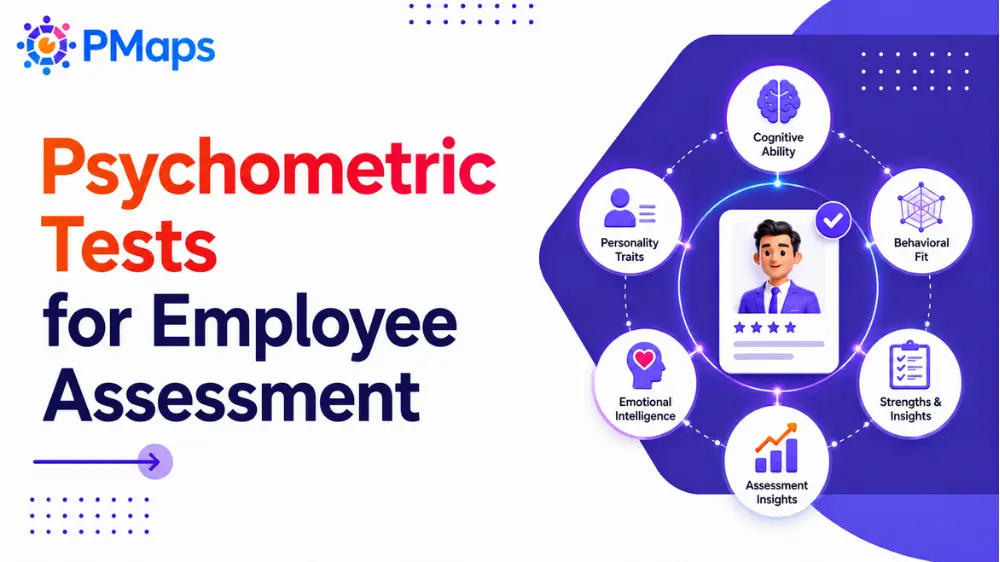
Psychometry meaning, in HR terms, is the scientific measurement of mental capability and behavioral style. The psychometric definition centers on standardized tools validated for specific psychometric properties: reliability, validity, and fairness across candidate groups. What do psychometric tests measure? Most tools assess a combination of the following:
- Cognitive ability — Measures how candidates reason, retain information, process instructions, solve workplace problems, and make decisions under time pressure, giving HR reliable signals on learning agility and role judgment across hiring contexts.
- Personality test and behavioral style — Reveals work preferences, motivation, communication habits, feedback response, and collaboration style, helping employers understand how candidates behave with managers, peers, customers, and targets in daily role situations.
- Aptitude testing — Indicates how quickly candidates learn new concepts, recognize patterns, apply instructions, and transfer knowledge to unfamiliar tasks, supporting decisions on trainability, growth potential, and future role readiness during hiring evaluations.
- Emotional intelligence — Evaluates self-awareness, empathy, impulse control, listening behavior, and composure under stress, helping teams identify people who manage pressure, conflict, customers, and relationships without reactive workplace decisions in demanding roles consistently.
- Cultural and team fit — Checks alignment with company values, ethics, leadership expectations, collaboration norms, and preferred working style, reducing mismatch between individual behavior and team performance needs after selection across departments and reporting structures.
Confused about test formats? Read What are the Different Types of Psychometric Tests before choosing one for hiring.
Advantages of Psychometric Tests
How different types of psychometric tests benefit hiring teams depends on what’s being measured. Cognitive tests sharpen accuracy in predicting performance, personality assessments reduce mismatches in team fit, and standardized scoring removes the inconsistency that comes from relying on interviewer impressions alone.
- Removes interviewer bias — every candidate answers identical, standardized questions
- Improves hiring accuracy — scores correlate more strongly with performance than resumes do
- Saves screening time — pre-interpreted reports replace hours of manual CV review
- Supports internal mobility — the same data informs promotion and succession calls
- Scales fairly — large applicant pools get evaluated on identical criteria
Disadvantages of Psychometric Assessment
Disadvantages of psychometric testing surface when the tool, not the talent, becomes the bottleneck. Traditional formats can be coached for, completed dishonestly, or skewed by cultural framing — and candidates who don’t fit a rigid answer key end up unfairly screened out.
- Trainable results — candidates can practice repeatedly and inflate scores
- Self-report bias — people answer how they want to appear, not how they behave
- Cultural skew — socially desirable answers differ sharply across regions
- Test fatigue — lengthy formats raise candidate drop-off mid-application
- Misinterpretation risk — untrained recruiters misread nuanced or borderline scores
Pros and Cons of Psychometric Tests in Hiring Assessment
Pros and cons of psychometric testing look different at the hiring stage specifically, where speed, applicant volume, and first impressions matter just as much as long-term predictive accuracy.
| Pros — Hiring Stage | Cons — Hiring Stage |
|---|---|
| Filters large applicant pools quickly | Can reject skilled but cautious test-takers |
| Standardizes shortlisting criteria across recruiters | Adds steps that can lengthen time-to-hire |
| Flags strong culture-fit candidates early | Costs scale with rising applicant volume |
| Reduces early-stage resume bias | Risk of legal challenge if tests aren’t validated |
Pros and Cons of Psychometric Tests in Post-Hire Assessment
Once someone is hired, the same tests serve a different purpose entirely — tracking growth and spotting leadership potential, rather than deciding who gets the offer.
| Pros — Post-Hire Stage | Cons — Post-Hire Stage |
|---|---|
| Identifies high-potential employees for leadership tracks | Can feel punitive if used to judge past performance |
| Personalizes training and coaching plans | Requires periodic re-testing to stay accurate |
| Supports fair, criteria-based promotion decisions | May create anxiety around ongoing evaluation |
| Benchmarks team strengths against role requirements | Needs integration with performance data to be meaningful |
How to Fix the Challenges in Psychometric Testing?
Most challenges in psychometric testing trace back to design and training gaps, not the underlying science. Addressing psychometric test bias in recruitment means fixing the tool, the process, and the people interpreting the results.
- Train recruiters thoroughly — misreading borderline scores is one of the most common errors. Structured training on interpreting reports, paired with calibration sessions across the HR team, helps scores translate into consistent decisions instead of subjective guesswork.
- Validate and localize tests — run periodic bias audits across demographic groups and offer tests in candidates’ native languages where possible. Localized norms catch cultural skew before it quietly filters out qualified candidates from underrepresented backgrounds.
- Shorten and modernize formats — long, text-heavy tests drive fatigue and drop-off. Adaptive, shorter formats, including game-based or voice-based assessments, hold attention better while still capturing valid behavioral signals.
- Randomize and proctor questions — rotating question order and adding identity verification or browser-lock proctoring reduces coaching effects and stops candidates from memorizing correct answers from online prep resources.
- Combine with other data — treat scores as one input, not the final verdict. Pairing psychometric results with structured interviews, work samples, and reference checks balances out any single tool’s blind spots.
Not sure which questions truly matter? Read Important Questions HR Should Ask in a Psychometric Test before your next hiring decision.
Finding the Right Psychometric Assessment
Choosing the right psychometric assessment matters more than choosing any assessment at all. The wrong tool, however well-marketed, produces confident-looking scores that don’t actually predict performance.
- Confirm scientific validation and published reliability data
- Check for bias-audit and localization capabilities
- Look for role-specific, not generic, scoring models
- Prioritize mobile-first, low-fatigue test formats
- Ensure integration with your existing ATS and interview process
Still comparing tools? Here’s a list of detailed comparisons on top 10 psychometric assessment platforms to help you shortlist your right assessment partner.
Final Words
Psychometric testing isn’t inherently fair or flawed — it’s only as good as the framework built around it. The real question for your HR team is whether your current process is uncovering genuine potential or quietly filtering out the right people. Not sure which way your assessments lean? Write to assessment@pmaps.in or call 8591320212 to see how a well-validated, bias-audited assessment stack performs against your actual hiring goals.