.webp)
.webp)


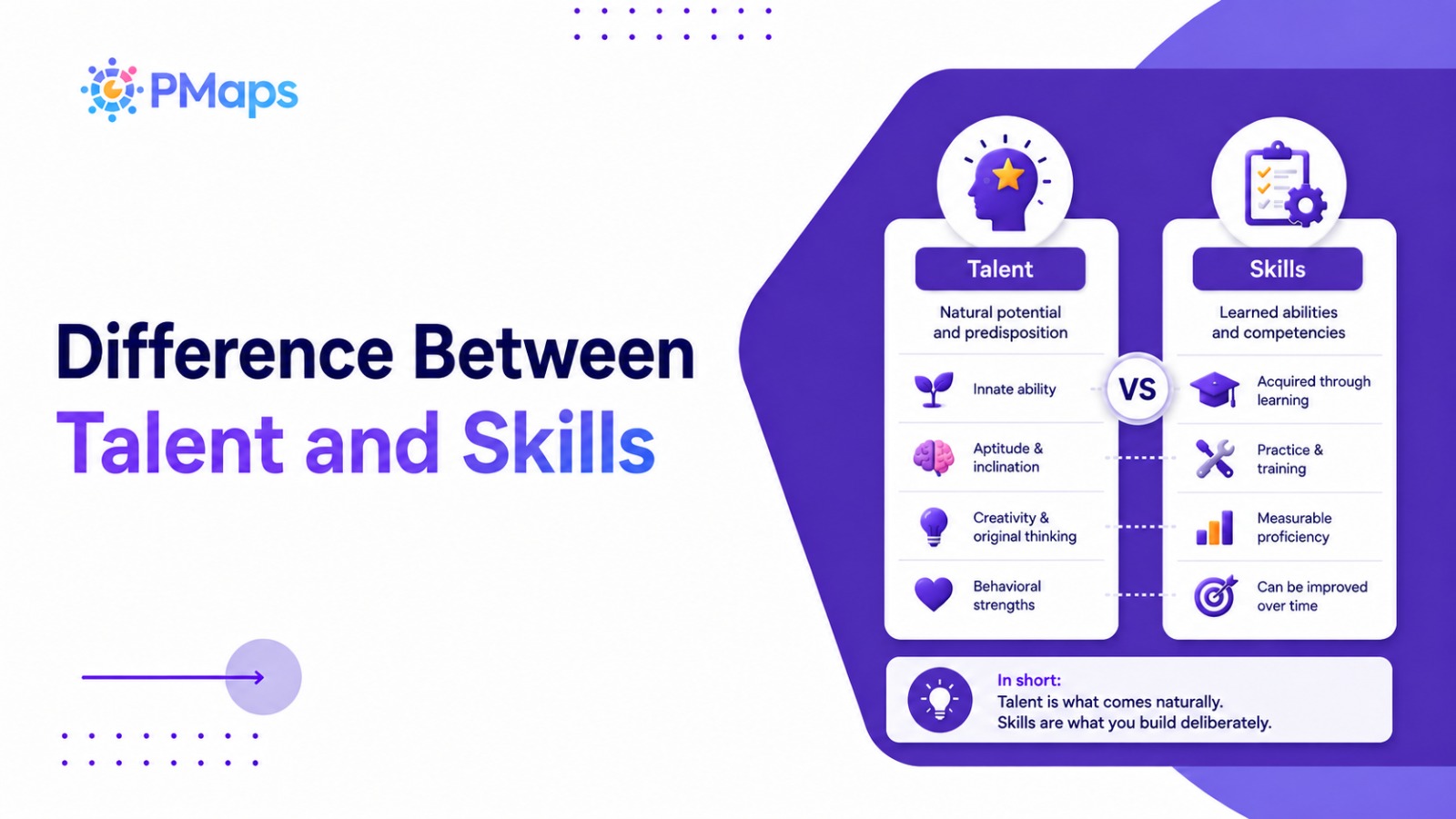
Confusing talent with skill quietly shapes who gets hired, who gets trained, and who gets left out. Skills-based hiring is now used by 81% of U.S. employers up from 57% in 2022, yet most hiring conversations still treat natural ability and learned competence as interchangeable.
This blog breaks down exactly what separates talent from skill, gives you tables to compare them across every dimension that matters in recruitment, and shows you how to use both deliberately whether you’re assessing a candidate or building your own team.
Before you label someone high-potential, check what would PMaps talent assessment reveal about their behavior, learning agility, and role-fit under pressure.
What are Talents and Skills?
Let's understand this first: What are skills? A capability built through practice, training, and repetition anyone can develop one. And what is talent all about? It is an innate aptitude that makes acquiring certain skills faster and more natural. Both feed performance, but they start from very different places.
Key Differences: Skill vs Talent
Knowing where each originates, and how each behaves under training and pressure, is what lets HR measure them correctly instead of guessing which one a candidate actually has.
Talent vs Skill Example
Examples make the difference concrete: the same observable outcome, excellent performance which can come from very different starting points, and knowing which one applies shapes how you develop the person.
Difference Between Skills vs Talent Types
Both skills and talent subdivide into distinct types, and the distinction matters in assessment: hard skills and soft skills call for different tests; cognitive and emotional talents require different observation methods.
Identifying Talent and Skills in Acquisition
Talent and skills surface through different signals in the hiring process. Knowing which tool captures which helps recruiters avoid hiring fast learners for roles requiring deep expertise, and vice versa.
Before acquisition moves ahead, what changes when every shortlisted candidate proves skills instead of only suggesting talent? Check it out now by trying PMaps Skills Assessment for 7 free days.
How Do Applications Differ in Skills vs Talent?
In practice, the same job can be done well by a highly skilled person or a naturally talented one — but the path to getting there, and the type of support each needs, looks completely different.
Ways of Developing Skills and Talent
Development methods are not one-size-fits-all. Applying skill-building techniques to raw talent without structure wastes potential; applying talent-discovery approaches to skill-deficit gaps delays necessary training.
Risk of Relying on One: Talent vs Skills
Overweighting talent in hiring creates real structural risks. Talented candidates who lack foundational skills take longer to become productive, create inconsistency in output, and often disengage when they hit structural barriers their natural ability can’t bypass alone.
• Onboarding takes longer when there are no built skills to anchor early tasks
• Output quality is inconsistent until practice structures the natural aptitude
• Talented hires with skill gaps become flight risks if growth stalls without development
• Teams relying on individual talent create key-person dependencies that are hard to manage
Overweighting skills creates a different set of risks. Highly skilled candidates who lack the underlying aptitude to grow plateau faster, adapt poorly to role changes, and end up as execution-strong but idea-poor contributors in roles that need both.
• Skills age: technically skilled hires can become obsolete faster than talent-led learners
• Reskilling highly skilled but low-talent hires costs more time and budget than it appears upfront
• Skill-only hiring filters out high-potential candidates early in their careers
• Teams built purely on skills often lack the creative and adaptive capacity for unstructured problems
The most defensible hiring decision combines both using assessment data to map where a candidate sits on each axis, then matching that profile to role requirements rather than hiring on a single dimension.
Leveraging Skills and Talent Together
The best-performing employees are rarely purely talented or purely skilled. They’re people who identified their natural aptitudes early, then deliberately built skills around them to reach a performance level neither could produce alone.
Turning Talent into Skill
Talent without structure stays raw. The path from natural aptitude to reliable, high-output skill requires deliberate practice, feedback loops, and a growth framework that makes the effort visible and sustained.
• Identify the domain where natural aptitude is already producing faster gains than peers
• Add structured practice with specific feedback rather than relying on volume alone
• Set measurable milestones so progress feels tangible, not abstract
• Pair talented individuals with skilled mentors who model disciplined technique
• Use psychometric assessments to confirm aptitude before investing development budget
Turning Skill into Talent
Skills that are practiced deeply enough, applied across enough contexts, and reinforced by genuine engagement eventually begin to feel effortless, the point where a learned competency starts producing talent-like results.
• Log enough repetition that the skill moves from conscious effort to automatic execution
• Apply the skill across varied contexts so it becomes adaptable, not just rote
• Build intrinsic motivation by finding meaning in the skill beyond the task itself
• Combine the skill with adjacent abilities to create a compound capability that’s harder to replicate
• Teach the skill to others, the transfer process deepens mastery faster than solo practice
Talent Fuels Skill and Vice Versa
Talent accelerates how fast skills are built; skills give talent a structure to express itself without burning out. Neither competes with the other, they multiply when developed in parallel rather than treated as alternatives.
• Talent without skill has a ceiling: natural aptitude stalls without disciplined technique behind it
• Skill without talent has limits too: learned competency plateaus when the aptitude ceiling is reached
• Combined, they produce compounding returns, growth continues beyond where either could reach alone
• Teams that map both dimensions fill roles more precisely and develop people more efficiently
In high-performance teams, the real competitive edge comes from knowing which dimension each person leads with, then building development plans that strengthen the weaker one rather than doubling down on what’s already strong.
• Individual development plans should target the dimension that is lagging, not the one already strong
• Promotion decisions should account for both dimensions, not just current skill-based output
• Role design benefits from mapping whether the position demands talent-led agility or skill-led consistency
• Succession planning that ignores talent mapping misses future leaders sitting in the current team
PMaps assessments are built to surface both dimensions in a single test session, mapping cognitive aptitude, behavioral talent, and role-specific skill scores together so hiring and development decisions don’t have to guess which one a candidate leads with.
Conclusion
Talent and skill are not the same thing and hiring as if they are means your assessment process is measuring one while the role demands the other. Once you can see both dimensions clearly, the right hire, the right development path, and the right promotion decision all become much easier to defend. If you’re ready to map both for your next role, call 8591320212 or write to assessment@pmaps.in, we’ll show you what both look like in a single assessment.