.webp)
.webp)


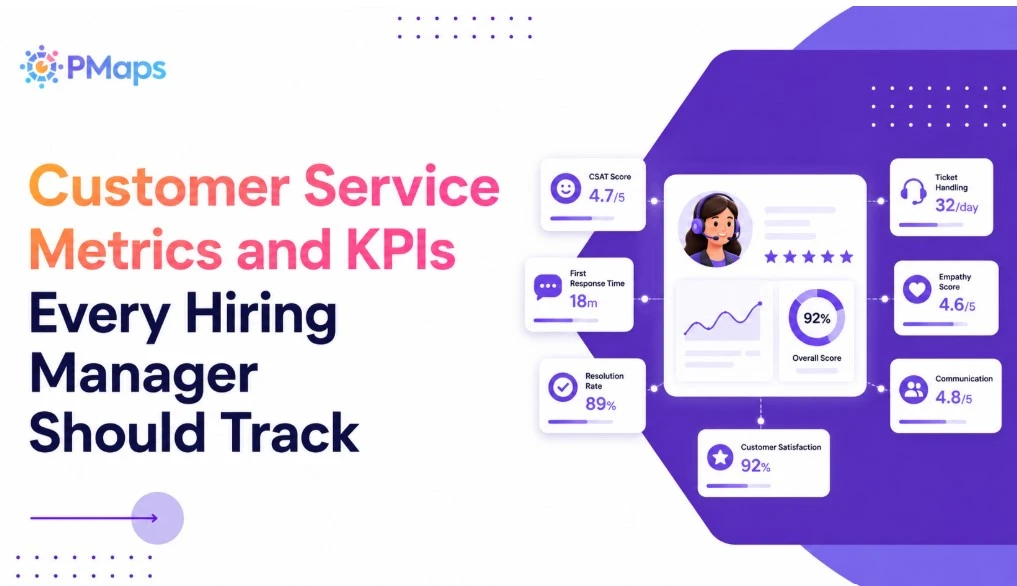
Customer service KPIs decide whether your support team protects revenue or quietly drains it. Are your agents resolving issues fast enough? Are customers leaving conversations satisfied, or simply giving up? Industry data shows nearly 67% of customer churn is preventable through stronger first contact resolution, and most customers now expect a reply within ten minutes, not hours.
Looking to assess whether your team's customer service skills hold up under pressure before the numbers tell you otherwise? Try our customer service assessment for 7 days free.
What Are Customer Service KPIs?
Customer service KPIs are specific, measurable indicators that show how effectively a support team resolves issues, satisfies customers, and contributes to retention and revenue targets. Knowing what KPIs are is one thing; understanding how they differ from everyday service metrics is the part hiring managers often get wrong.
Customer Service Metrics vs. Customer Service KPIs
Metrics and KPIs get used interchangeably, but the distinction matters when you're building a hiring scorecard or a performance dashboard. Here's how they compare side by side.
| Customer Service Metrics | Customer Service KPIs |
|---|---|
| Raw data points collected from every customer interaction | Selected metrics tied directly to a business goal or target |
| Broad in scope; covers volume, speed, and quality | Narrow in scope; chosen because they predict outcomes |
| Useful for day-to-day monitoring | Useful for performance reviews, hiring decisions, and forecasting |
| Example: number of tickets closed today | Example: first contact resolution rate against an 80% target |
The Importance of Customer Service KPI Metrics
Hiring managers who track customer service metrics consistently make faster, more defensible decisions about staffing, training budgets, and promotions. The numbers replace guesswork with evidence.
- They expose skill gaps before a customer complaint forces the issue.
- They give recruiters a benchmark for what 'good' looks like in a candidate.
- They connect frontline performance to retention and revenue outcomes.
- They make coaching conversations specific instead of vague.
Understanding KPIs Unique to Customer Service
Not every KPI applies equally to every team. Top customer service KPIs tend to fall into four buckets, each revealing a different layer of how your support function performs.
Service Quality Metrics
Service quality metrics capture how customers actually felt about an interaction, not just how fast it closed. They're the clearest signal of long-term loyalty and trust.
- Customer Satisfaction Score (CSAT) after each resolved ticket
- Net Promoter Score (NPS) measuring willingness to recommend you
- Customer Effort Score (CES) capturing how easy the process felt
These scores rarely improve through scripts alone. They depend on genuine customer service hard skills, including active listening, product knowledge, and the judgment to de-escalate a frustrated caller without a supervisor stepping in.
Solution Quality Metrics
Solution quality metrics track whether the fix actually worked, not just whether a ticket got closed. A high reopen rate quietly undermines every other KPI on this list.
- First Contact Resolution (FCR) rate
- Ticket reopen rate within a defined window
- Next issue avoidance, tracking repeat contacts on the same problem
Agents who excel here combine diagnostic thinking with patience, asking the right clarifying questions before offering a fix instead of guessing at the answer.
Handling Speed Metrics
Handling speed metrics measure how quickly your team responds and resolves, which directly shapes whether a customer feels valued or ignored during the wait.
- First Response Time (FRT)
- Average Resolution Time across all channels
- Average Handle Time (AHT) per interaction
Speed without accuracy backfires fast, so the agents who perform best here pair quick typing and system navigation with calm, confident decision-making under time pressure.
Volume of Handling Metrics
Volume metrics show capacity and workload distribution, helping hiring managers decide when a team is genuinely understaffed versus simply working inefficiently.
- Tickets handled per agent per hour
- Volume by channel: call, chat, email, social
- Occupancy rate across a shift
These numbers support hiring math directly. They tell you whether you need three more agents or simply a better routing system for existing ones.
Examples of Customer Service KPI Metrics
Putting the four categories together, here's a quick-reference list of the customer service KPIs most hiring managers end up tracking week to week.
- CSAT: percentage of customers rating the interaction positively
- NPS: likelihood of customers recommending your business
- FCR: percentage of issues solved in one contact
- FRT: average time before a customer gets a first reply
- AHT: average total time spent per interaction
- Abandonment rate: percentage of customers who give up waiting
- Cost per resolution: total support spend divided by tickets closed
How Do You Measure KPI for Customer Service?
Measuring these numbers accurately depends less on spreadsheets and more on the tools feeding them. A few options consistently work well for growing teams.
- Helpdesk and ticketing platforms with built-in reporting dashboards
- Post-interaction CSAT and NPS survey tools
- Call center analytics software for AHT and abandonment tracking
- Psychometric and behavioral assessments to predict skill before hiring
How to Improve Customer Service KPIs?
Improving these numbers is rarely about pushing agents to work faster. It usually starts further back, at how you select and train the people answering calls.
- Set realistic, role-specific targets instead of copying industry averages
- Review KPI trends weekly, not just at quarterly reviews
- Close the loop with agents on what each number means
- Audit your current hiring criteria against the KPIs you're missing.
- Use a customer service assessment to screen for the right hard and soft skills before extending an offer.
- Build a structured onboarding plan around your weakest metric category.
- Track the same KPIs for three to six months before adjusting hiring criteria again.
Pair the assessment data with a clear training roadmap. Our guide on What is Customer Service Training? breaks down what a structured program should cover for new and existing agents alike.
Looking Forward
Customer service KPIs only matter when someone acts on what they reveal. Tracking handling speed, resolution quality, and customer sentiment gives hiring managers a real basis for decisions instead of instinct alone. So the real question is: does your current hiring process actually screen for the skills behind these numbers, or does it leave that discovery for after someone's already on the floor?
If you'd rather find out before the hire than after, call us at 8591320212 or write to assessment@pmaps.in, and keep an eye on emerging customer service trends shaping how teams hire for these roles next.