.webp)
.webp)


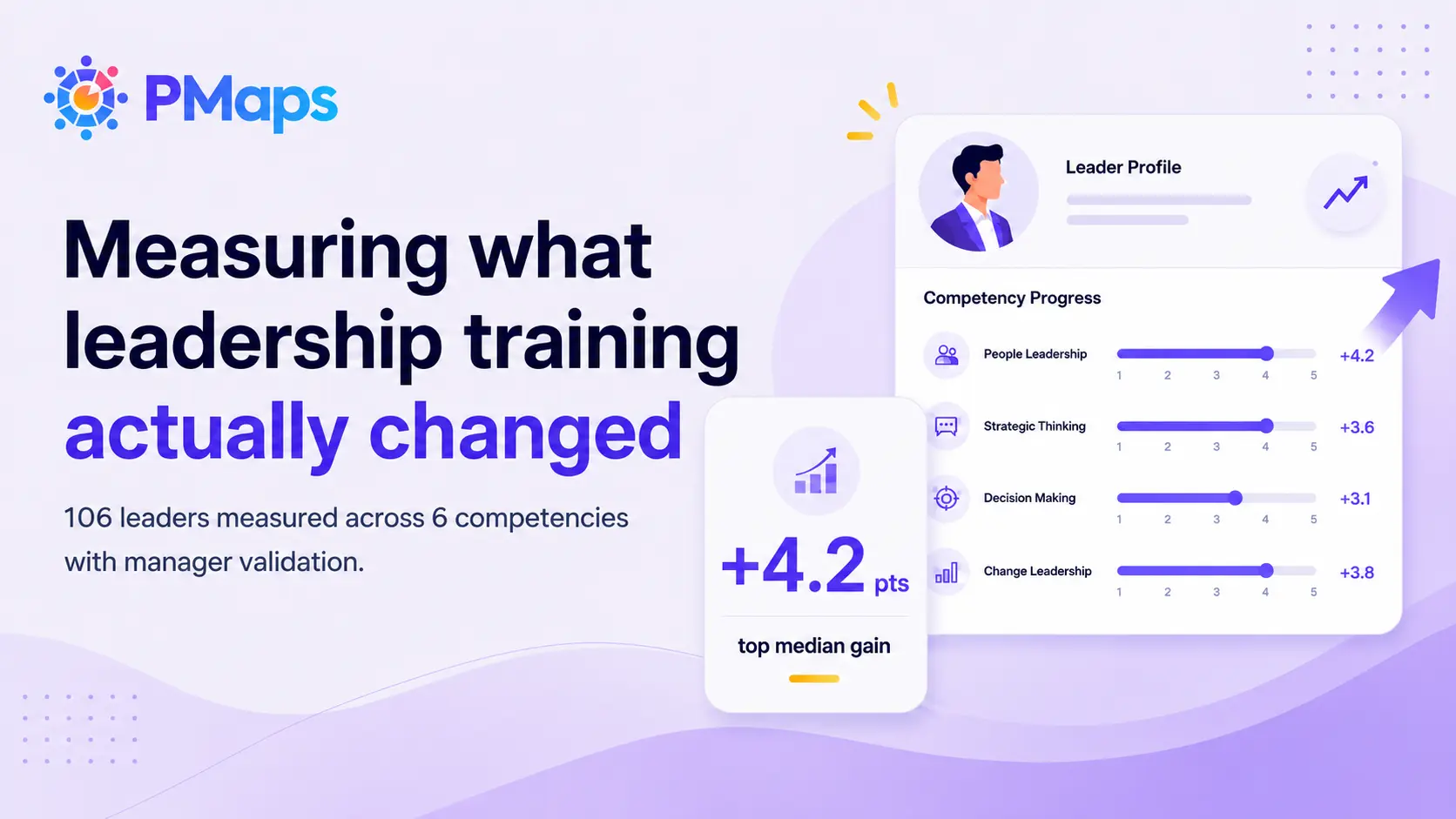
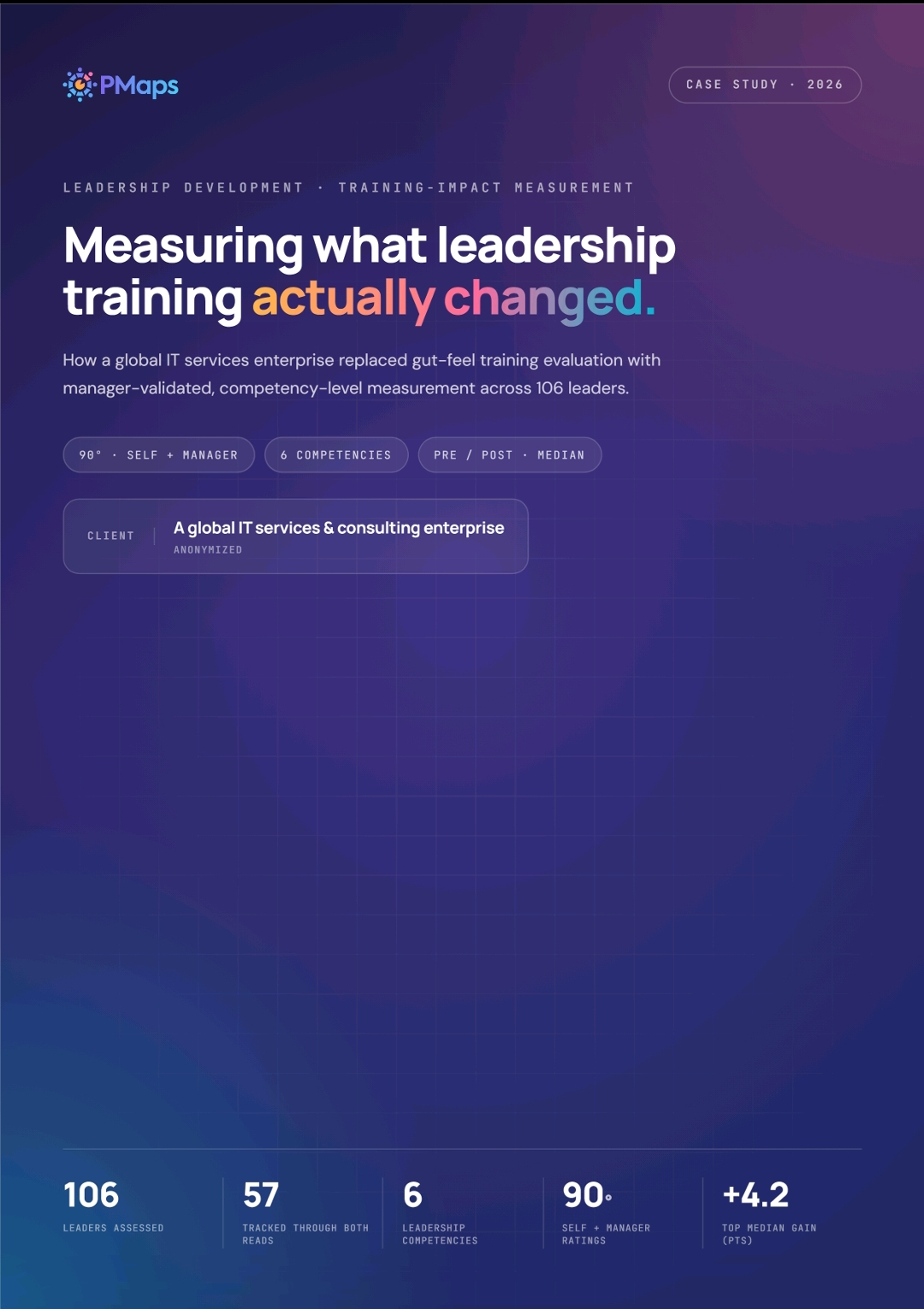
A global IT services and consulting enterprise replaced gut-feel training evaluation with manager-validated, competency-level measurement across 106 leaders — and could finally see which capabilities its investment moved, and which it didn't.
- 106 — leaders assessed
- 90° — self + manager ratings
- 6 — leadership competencies
- +4.2 pts — top median gain
A big investment, judged by gut feel
The enterprise had invested in a structured leadership development program for 106 of its mid-to-senior leaders. The investment was significant. The way its impact was being judged was not.
Like most organizations, it had no objective way to know whether the training had actually changed how its leaders performed. Every available signal failed in a different way:
- Self-assessment alone inflates. People rate themselves generously — especially after a program they want to believe worked.
- Manager opinion alone is subjective. It varies from one reviewer to the next, with no common scale to anchor it.
- Satisfaction surveys measure the wrong thing. They tell you whether people enjoyed the training, not whether they grew.
The result: no defensible way to prove what the program had strengthened, no common scale to compare leaders or competencies, and — without a captured baseline — nothing for any post-program read to be measured against.
The L&D team needed competency-level, before-and-after evidence — a read on training impact rigorous enough to stand behind in front of leadership, not a feeling that the program had gone well.
Three deliberate design choices
PMaps deployed a structured leadership competency assessment across the full cohort, built so the result would be trustworthy by design — not by hope.
Choice 01 — 90° measurement Every leader was rated on the same competencies twice — by themselves and by their manager. Pairing self-perception against an independent observer removes self-presentation bias and surfaces the gap between how leaders see themselves and how they're experienced.
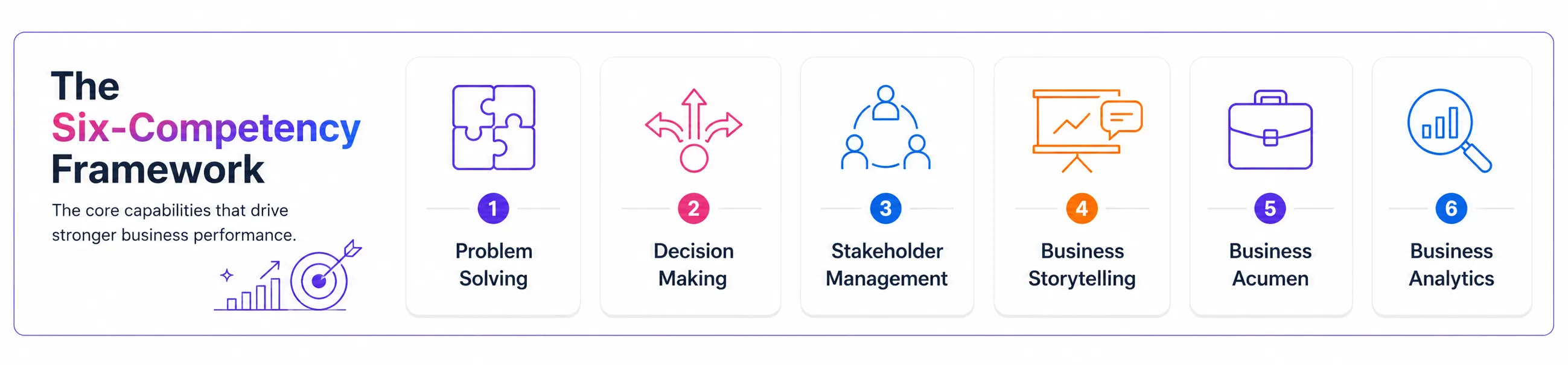
Choice 02 — A defined framework Six enterprise-relevant competencies, each scored on a common 0–100 scale, so every leader and every competency could be compared on the same terms. This structured leadership competency framework ensured consistent measurement across the entire cohort while aligning leadership expectations with business goals.
Choice 03 — Pre / post design, median-aggregated A baseline was captured before training and re-measured afterward. Cohort scores were aggregated using medians rather than averages, so a handful of extreme scores couldn't distort the picture — giving leadership a stable, trustworthy read of where the group actually stood.
Each leader received an individual report — strengths, development gaps, behavioral indicators, and pre-to-post movement. The L&D and HR leadership team received a single group dashboard: one objective view of the entire cohort.
Real impact — and honestly concentrated
A baseline was established across all 106 leaders; 57 completed the post-training re-assessment within the measurement window. Afterward, the cohort's competency medians clustered tightly around 75 / 100 — a solid, consistent leadership bench.
Stakeholder Management was the clear standout, rising to a median of 79.2 — a +4.2-point gain between the two reads. The remaining five competencies held essentially flat, within a tight 74–75 cluster.
This wasn't a vague "the training was a success." It was competency-level evidence that the program's impact was real and concentrated — strong on stakeholder capability, limited elsewhere. For an L&D team, that distinction is the difference between repeating a program on faith and redesigning it on evidence.
From a feeling to a system
Outcome cards
- Manager-validated evidence of impact — Satisfaction surveys and gut feel replaced with data leadership could stand behind.
- Per-leader gap reports — A cohort-level program turned into 106 individual development conversations.
- A defensible basis to redirect investment — Toward the five competencies the program didn't shift, and the leaders showing the most progress.
- A repeatable measurement system — Re-runnable every development cycle to track movement over time.
Why it worked
- 90° design removes the self-presentation problem that makes single-source leadership data untrustworthy.
- Median aggregation gives a robust cohort read that a few outliers can't distort.
- Competency-level granularity tells you what changed, not just whether people were satisfied.
- Individual + group reporting serves both the leader's development and the enterprise's talent strategy in one pass.
For the first time, the enterprise could see exactly which leadership capabilities its investment moved — and which it didn't — at the level of the individual leader.
PMaps is an AI-powered, bias-reducing, multi-lingual talent assessment platform that helps enterprises hire the right people and develop the ones they already have. Since 2014, PMaps has completed 2M+ assessments and is trusted by 200+ enterprise clients across 7 countries — including HSBC, Bajaj, Adani, and Tata Consultancy Services.
Its Career Elevation Assessments measure leadership capability and development impact — for internal mobility, high-potential identification, succession planning, and skill-gap analysis. Organizations can also use leadership assessment for hiring to identify leadership potential before candidates join the organization, creating a consistent framework for both hiring and leadership development.
Measure what your leadership investment actually changes
Book a 30-minute walkthrough to see how PMaps measures leadership capability and development impact — at the level of the individual leader and the whole cohort.
Book a demo | Take a 7 Days Free Trial | Custom Leadership Tests | Call to Consult