.webp)
.webp)


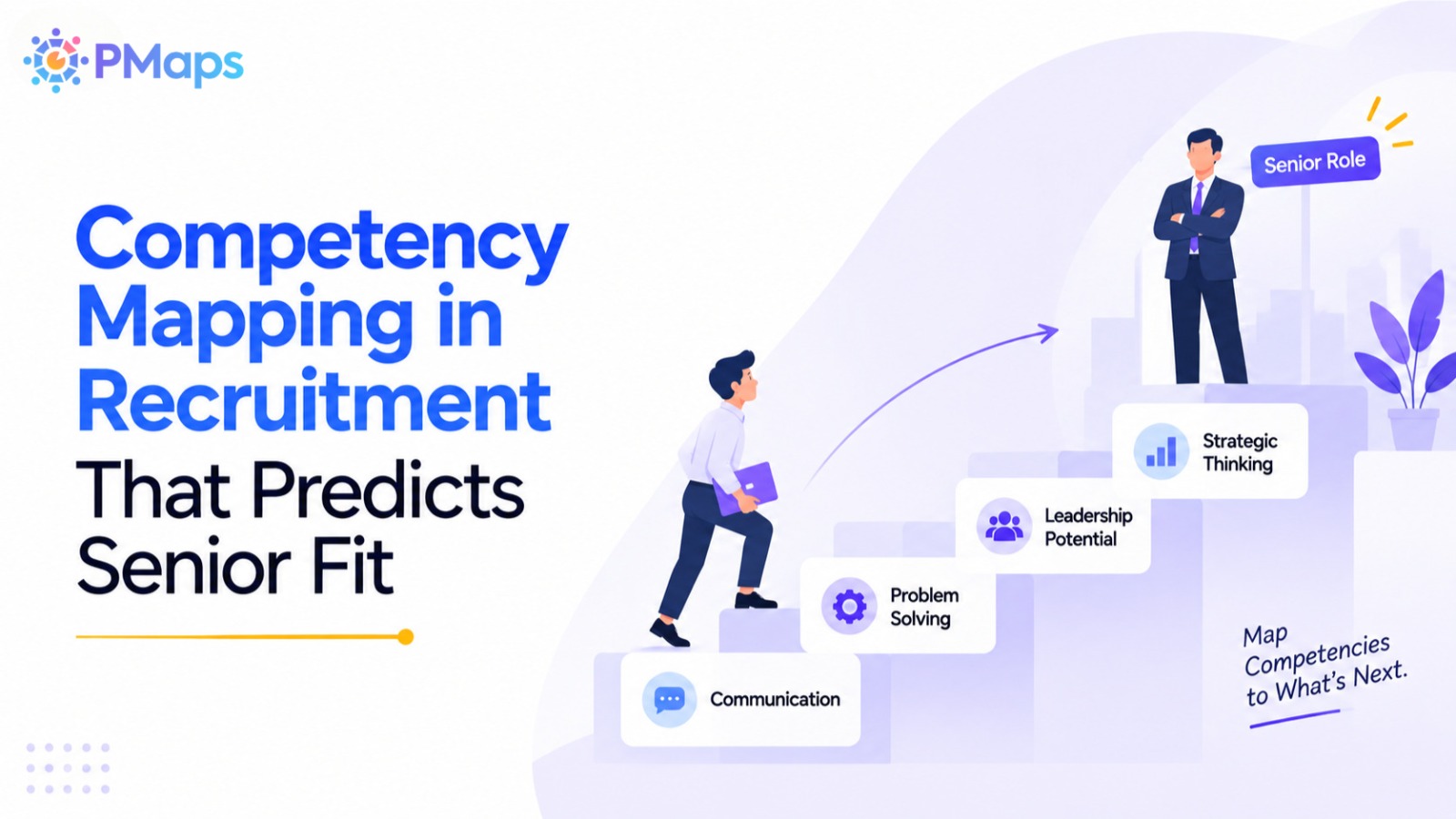
Competency mapping in recruitment is the practice of defining, before a role opens, the specific behaviors a hire must demonstrate and the level of proficiency each one requires then selecting against that definition rather than against a resume. This guide is written for talent acquisition and HR leaders hiring into senior roles, where the definition is usually missing and the cost of a wrong decision is highest. It sets out how to build the map, how to score a panel against it, and what to measure with an instrument instead.
That gap is getting more expensive. Naukri's JobSpeak index for August 2026, published on 8 September, put white-collar hiring 14% above August last year. The fastest growth was in the 13-to-15-year experience band at 18%, followed by the 8-to-12-year band at 16% ahead of freshers at 15% and well ahead of the 4-to-7-year band at 10%. The index tracks job postings and recruiter searches rather than completed hires, and Info Edge has cautioned that a shift in the festive calendar colors the annual comparison. The direction is still clear: demand is growing fastest at the senior end of the market the end where most Indian enterprises have the least structured selection in place.
What is competency mapping in recruitment?
Competency mapping in recruitment is the process of translating a role into a short list of observable behaviors, each with a defined proficiency level, and using that list as the selection standard. It replaces years of experience as the deciding variable. The map is built before sourcing begins, so every interviewer measures the same thing.
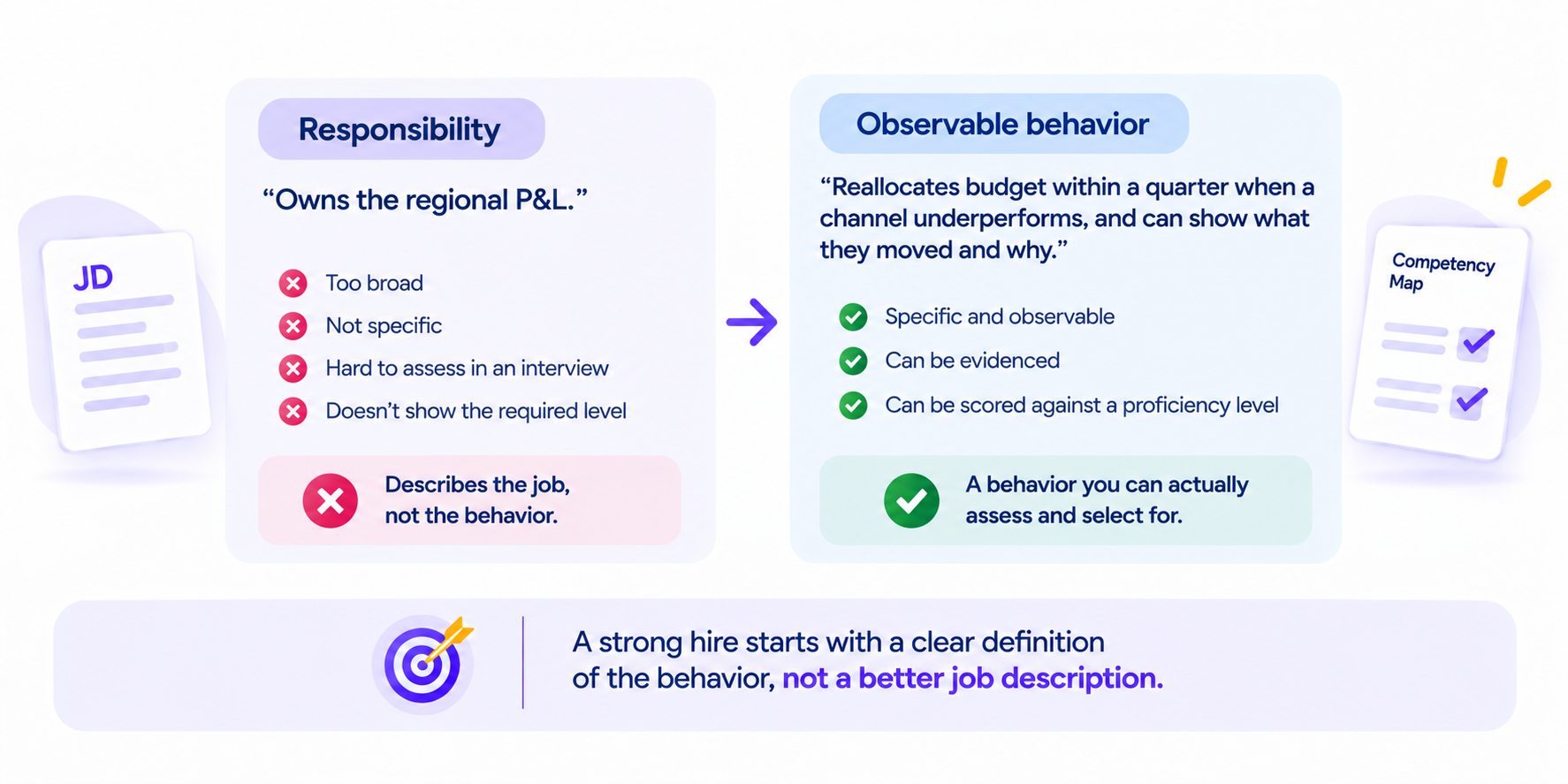
The distinction that matters is between a responsibility and a behavior. "Owns the regional P&L" is a responsibility it describes what sits on the person's desk. "Reallocates budget within a quarter when a channel underperforms, and can show what they moved and why" is a behavior. The first cannot be assessed in an interview. The second can be probed, evidenced, and scored.
A usable map for a senior role holds four to six behaviors. Fewer and the map fails to separate candidates; more and interviewers stop applying it. Each entry carries a proficiency level, because a behavior without a level tells you nothing about the bar every credible candidate will show some version of most competencies on the list.
For the broader HR definition, including how competency mapping supports training and performance management, see our guide to what competency mapping is.
Why does senior hiring need competency mapping most?
In most enterprises we work with, measurement density falls as seniority rises. Below seven years of experience, most enterprises run aptitude tests, role-specific skills assessments, and structured screening with a nameable bar. Above eight years, selection typically reduces to a resume screen and several unstructured conversations, with tenure carrying the weight.
That inversion is the problem. The junior end of the funnel, where individual decisions are cheapest to correct, is the end that carries the most measurement. The senior end, where a wrong decision costs a year of team performance and often a second search, runs on impressions gathered by people who each asked different questions.
Years of experience is a proxy, and a loose one. It stands for judgment under incomplete information, the ability to build a team rather than inherit one, and the willingness to change methods when the method stops working. Those are the capabilities a senior hire is actually bought for, and each of them can be defined and measured. Tenure records how long someone was present. It does not record what they did with the time.
Competency mapping in recruitment closes that gap without adding process. In most cases it removes the process: in our work with TA teams, those that write the map first typically drop two or three things they were about to interview for, because those items turn out to be preferences rather than requirements.
How do you build a competency map for a senior role?
Start from the decision the hire has to make, not from the job description. Ask what this person must demonstrably do in their first twelve months for the hire to be judged correct. Write four to six behaviors, each observable, each with a proficiency level. Then delete anything that cannot be evidenced.
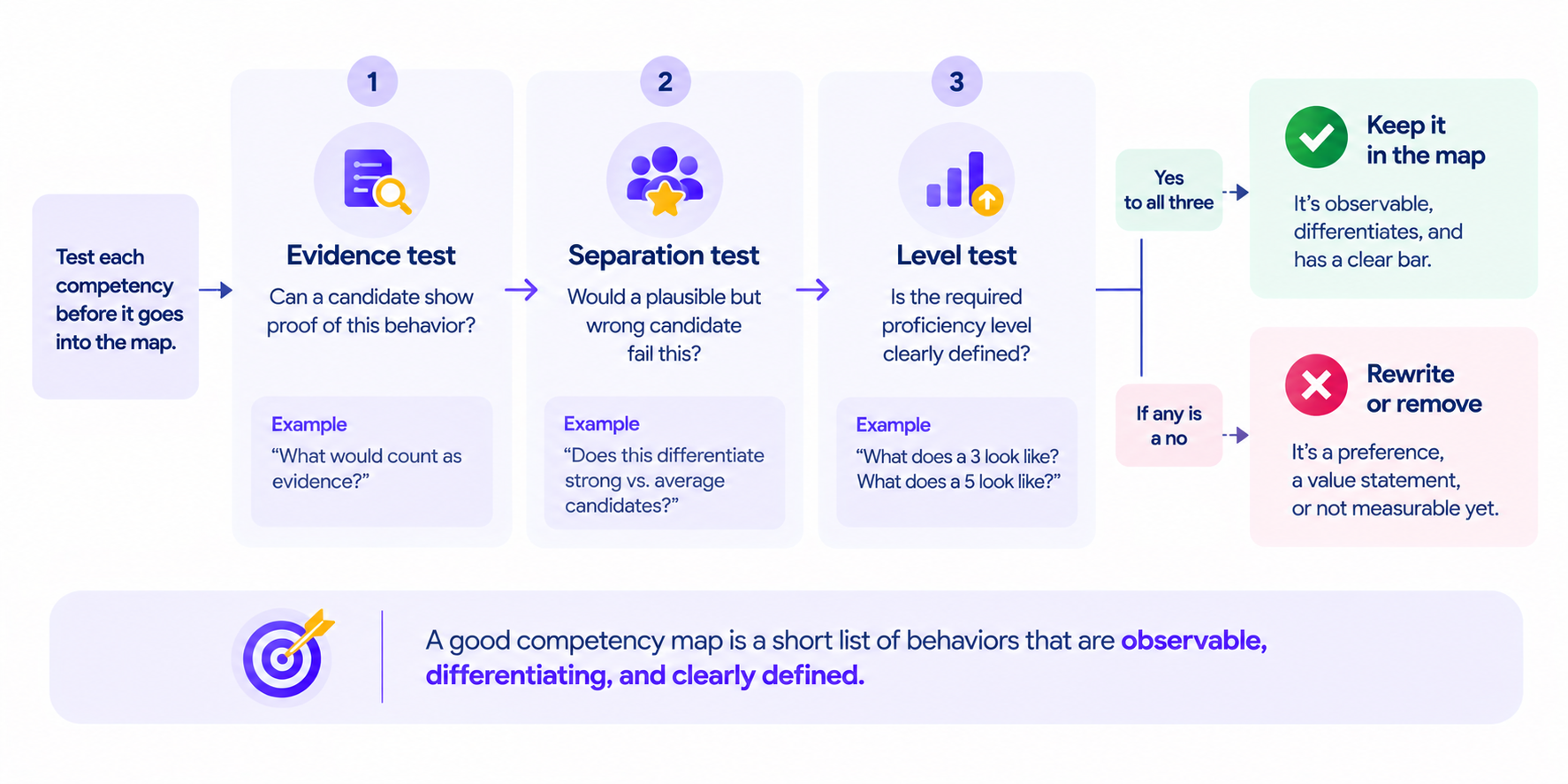
Three tests will keep the map honest.
The evidence test. For each line, name what a candidate could show or describe that would count as proof. If nothing qualifies, the line is a value statement — "high integrity," "strategic mindset" and it belongs in the culture conversation, not the selection standard.
The separation test. Ask whether a plausible but wrong candidate would fail this line. If every shortlisted candidate would clear it, the line is a threshold, not a differentiator, and it is using up interview time that a real differentiator needs.
The level test. State the proficiency required, not just the competency. "Can build a team" is a different bar at three reports than at thirty. Where a level is genuinely uncertain, that uncertainty is a hiring-manager conversation to have before the role opens, not a question to resolve in a debrief.
PMaps own competency framework is built on this structure: 73 competencies, each defined across four proficiency levels, so the same competency carries a different, written bar at each level of seniority. That is what lets a team state the level in step three rather than describe it by feel.
Where an organization already runs pre-employment assessments for job fitment further down the funnel, the map is the artifact that connects the two — the same competency language applies at both levels, so senior selection stops being a separate, unmeasured process.
How do you turn an interview panel into a measurement?
A panel becomes a measure when three things change. Every interviewer asks the same core questions drawn from the map. Every interviewer scores against the same anchored scale, where each point is described in behavioral terms. And every interviewer files scores independently before the debrief opens, not after it.
In our experience, the third change carries most of the effect, and it costs nothing but sequencing. In an unstructured debrief, the most senior or most confident voice in the room tends to set the group's position, and later speakers adjust toward it. Independent scores filed first make that adjustment visible instead of invisible, and give the hiring manager a real spread to reason about.
Anchoring the scale is the part teams most often skip. A five-point scale with no descriptions is five different scales, one per interviewer. Write what a 2 looks like and what a 4 looks like for each competency, in behavioral language, and the same candidate stops receiving a 2 from one interviewer and a 4 from another for the same answer.
None of this requires software. It requires the map, a shared question set, a written scale, and the discipline to collect scores before the conversation starts.
What should an assessment measure that a panel cannot?
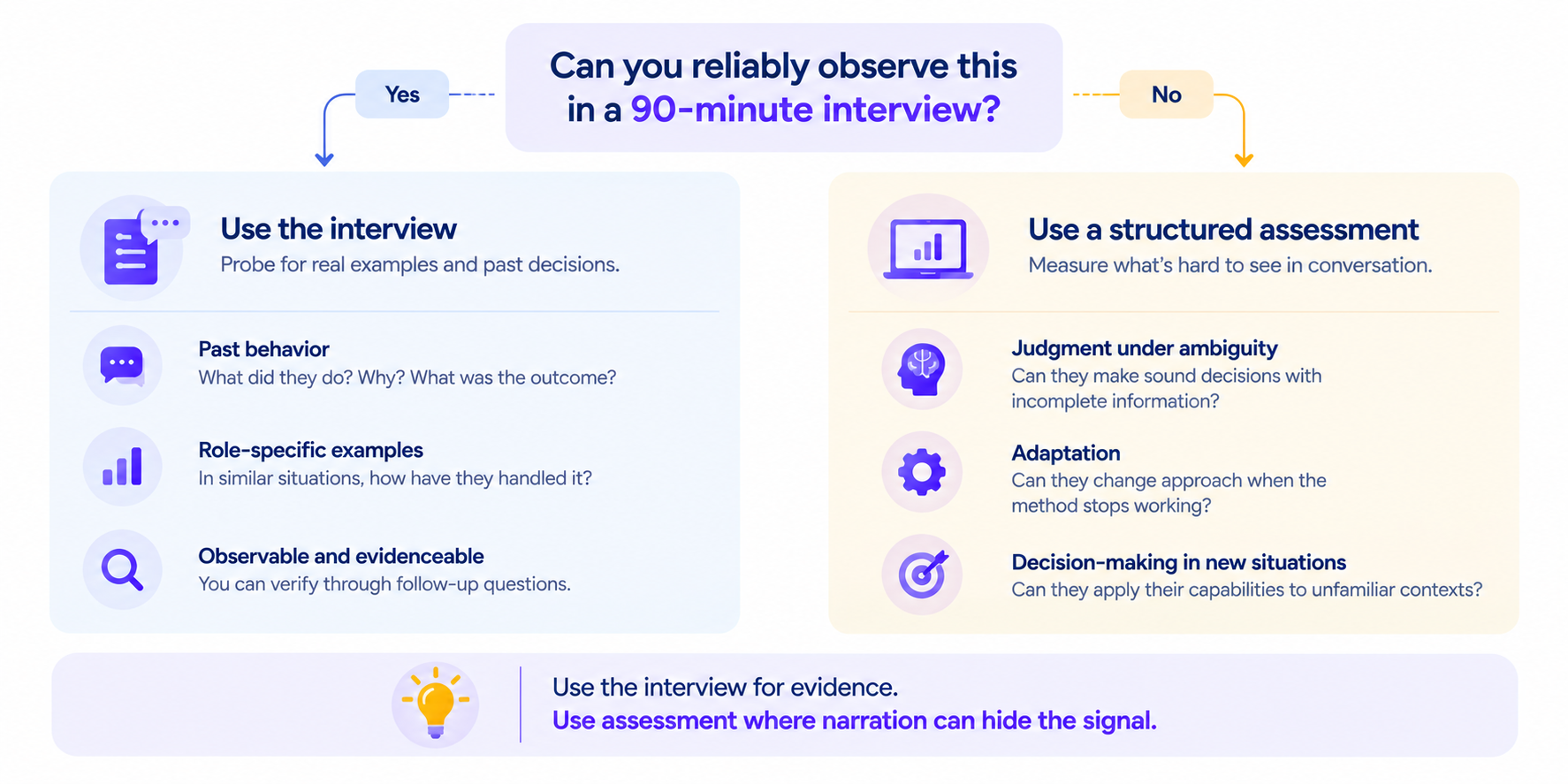
Of the four to six behaviors on the map, one or two are usually hard to observe in ninety minutes of conversation most often judgment under ambiguity and adaptation when an established method stops working. Senior candidates describe both fluently, which is exactly why interviews measure them poorly. A structured assessment is warranted there.
The reason is not that interviews are weak in general. It is that at this level, the skill of narrating a competency and the competency itself have both been practiced for years, and an interview cannot easily separate them. An instrument that presents a situation and scores the response a situational judgment test or a leadership assessment measures the decision rather than the account of the decision.
This is also where a benchmark matters. A score is only interpretable against the population it should be compared with, which is why competency-based assessment reads results against validated role benchmarks rather than a general average. The question a hiring team needs answered is not whether a score is good, but whether it is good for this role at this level. PMaps benchmarks draw on 4M+ completed assessments across 200+ enterprise clients in 7 countries, validated against real on-the-job performance and attrition outcomes.
Structured measurement of this kind reduces bias relative to an unstructured panel, because it holds the question, the scale, and the comparison constant across candidates. It does not remove bias, and no assessment should be presented as doing so.
How is competency mapping different from a job description?
A job description communicates a role to the market; a competency map defines how the role will be judged. The description lists responsibilities, qualifications, and reporting lines, and is written to attract. The map lists observable behaviors with proficiency levels, and is written to discriminate between candidates who all look qualified on paper.
Most teams already have the first and treat it as though it were the second. That is what produces the familiar senior-hiring failure: four months open, three strong-looking finalists, and no agreement in the room about what actually separates them. The job description was never built to answer that question.
The two documents should be written in that order map first, description second because the description is easier and more accurate once the behaviors are settled. Teams that map post-hire competencies through Career Elevation Assessments for internal mobility often find the same framework works for external senior hiring, which removes the translation step between the two.
Where to start
Take the senior role you are most stuck on. Write its four-to-six behavior map, set the proficiency level for each, and run your next panel with a shared question set and independent scoring. That alone changes what your debrief is about.
If you want the measurement layer underneath it, explore how PMaps builds competency-based assessments and reads them against validated role benchmarks or book a 30-minute working session on one specific role and see the map and the scoring