.webp)
.webp)


%20Hiring.avif)
Unconscious bias in GCC hiring is one of the most persistent challenges leaders face as global capability centres scale across India, the Philippines, Poland, and emerging LATAM hubs. Bias rarely appears intentional; it emerges through fast decisions, overloaded interview panels, and uneven expectations across regions.
Based on our experience supporting multi-geo GCCs, bias grows when teams depend on résumés, prior employers, accents, or pedigree shortcuts, especially under tight hiring timelines.
As GCCs shift from transactional talent models to capability-led structures, removing unconscious bias becomes essential for fair evaluation, stronger pipelines, and stable global delivery. This article explains how bias forms, where it hides in the hiring funnel, and practical ways GCCs can eliminate it.
Why Unconscious Bias Occurs in GCC Hiring
To eliminate unconscious bias in GCC hiring, one must understand the core reason for its occurrence. It often develops from the speed and scale at which talent decisions are made. Multi-geo expectations, rapid hiring cycles, and overlapping skill demands create conditions where quick judgments quietly replace structured evaluation. These biases influence selection quality, internal equity, and capability depth.
Roots of unconscious biases:
- High-volume, speed-driven hiring cycles encourage shortcuts that favour familiarity over verified capability.
- Multi-geo stakeholder expectations push interviewers to rely on subjective interpretations of communication style and cultural fit.
- Inconsistent interview calibration leads a panel member to apply personal standards rather than shared evaluation criteria.
- Heavy reliance on résumé content amplifies surface-level signals—such as employer brand, college, location, or tenure—over skill depth.
- Role complexity and overlap in digital, data, domain, and CX teams increase ambiguity, prompting reliance on assumptions.
- Time pressure on hiring managers causes decisions to drift toward quick impressions rather than structured assessments.
- The lack of behavioural baselines makes it challenging to differentiate between confidence and competence, especially in stakeholder-facing roles.
Types of Unconscious Bias That Commonly Appear in GCC Hiring
Unconscious bias in GCC hiring manifests in predictable patterns, especially when teams make quick decisions under pressure. These biases influence how résumés are read, how candidates are evaluated in interviews, and how final decisions are justified. Recognizing these patterns helps CHROs design a more consistent, skill-led hiring model.
The types of biases that affect the GCC recruiters and interviewers:
Affinity Bias
Affinity bias occurs when interviewers gravitate toward candidates who resemble their own background or communication style, unintentionally sidelining diverse talent pools. This is common in GCCs managing multi-geo workflows where familiarity feels safer under speed.
Example: A healthcare GCC prefers applicants from well-known US RCM vendors, overlooking strong internal trainees.
Halo / Horns Bias
This bias allows one positive or negative trait—such as fluency in English or a previous employer’s reputation—to overshadow the candidate’s complete capability profile. It appears frequently in digital and CX GCCs where quick signals influence judgment.
Example: A BFSI GCC overrates a candidate based solely on prior tenure at a top global bank.
Pedigree Bias
Pedigree bias overvalues academic brands or past employers as shortcuts for competence, despite inconsistent correlation with performance in complex GCC roles. It limits mobility for talent from non-metro education paths or mid-tier companies.
Example: A tech GCC rejects capable engineers because they lack elite college credentials.
Communication Bias
Communication bias arises when clarity, accent, or fluency is mistaken for overall capability. In GCCs serving global markets, strong domain talent may be undervalued if the communication style doesn’t mirror the interviewer's expectations.
Example: A pharma GCC overlooks a precise documentation analyst due to accented English.
Confirmation Bias
Interviewers form early opinions and filter later responses to support their initial view, especially under tight hiring timelines. This prevents objective evaluation and undermines the consistency of capability-based hiring.
Example: A CX interviewer decides early that the candidate lacks empathy and ignores evidence of structured problem-solving.
Availability Bias
Availability bias pushes interviewers to rely on recent memory rather than real job demands, shaping decisions through outdated patterns or isolated past experiences. This is common in GCCs with evolving CoEs.
Example: A data GCC rejects a strong analyst because a past hire with similar experience underperformed.
Groupthink in Panel Interviews
Groupthink emerges when panel members align with the dominant voice, suppressing independent judgments. In multi-round GCC interviews, this leads to uneven evaluation and missed capability signals.
Example: A financial GCC panel echoes a senior interviewer’s negative view despite contradicting notes.
How Unconscious Bias Shows Up Across the GCC Hiring Funnel
Bias in GCC hiring doesn’t appear at a single stage; it travels through the entire funnel. Each step carries distinct risks shaped by speed, volume, global expectations, and uneven interviewer calibration. Understanding these points of leakage helps leaders redesign hiring for consistency and capability.
- Job Descriptions & Role Design: Bias begins when job descriptions overemphasise pedigree, location, or preferred companies over actual skills and outcomes. This prematurely filters out strong applicants, especially from tier-2 markets or adjacent industries seeking upward mobility.
- Sourcing & Screening: Manual résumé review encourages shortcuts, such as college names, employer brands, accent assumptions in voice roles, or tenure-based judgments. With tight hiring targets, recruiters may default to familiar profiles rather than evaluate transferable skills from related GCC or industry contexts.
- Assessments & Shortlisting: Bias appears when assessment expectations differ by candidate background or when unclear scoring allows subjective interpretation. In domain-heavy GCCs—healthcare, BFSI, pharma—evaluators may unconsciously favour candidates whose prior organisations look “more compliant” or “more global.”
- Interviews & Panel Decisions: This is where bias amplifies. Panels often diverge on behavioural expectations, communication standards, or stakeholder readiness. Groupthink, early impressions, and differing global–local expectations influence how capability, intent, and potential are judged across rounds.
- Final Decision-Making: Bias affects the closing stage, as hiring managers tend to favour candidates who feel “lower risk” due to familiarity or past employers. This disadvantages high-potential talent from emerging GCC hubs or candidates shifting from adjacent roles into digital, data, or analytics pathways.
How to Remove Unconscious Bias from GCC Recruitment
Removing bias from GCC hiring requires structural fixes, not individual intention. As GCCs scale across Bangalore, Manila, Krakow, and evolving hubs, leaders need repeatable systems that keep evaluation anchored in skills, capability, and performance potential—not résumé shortcuts or subjective impressions.
- Standardize Job Requirements Using a Skills-First Framework: Create capability maps for GCC roles in analytics, finance, digital, and operations to ensure requirements reflect outcomes, not pedigree or location.
- Introduce Blind Hiring for Early Talent & Lateral Roles: Hide name, gender, college, location, and previous employer during first-round screening to minimise pedigree and geography-driven assumptions.
- Use Skill Assessments Before CV Evaluation: Deploy role-specific tests for finance accuracy, analytical reasoning, customer experience, and engineering to surface real capability before résumé influence creeps in.
- Reduce Manager Subjectivity via Panel Calibration: Align interviewers on what “good” looks like through calibration sessions that standardize behavioural expectations across geographies and CoEs.
- Implement Structured & Competency-Based Interviews: Use AI interviewers that evaluate the same behaviours, reducing drift caused by personality, preference, or role familiarity.
- Mandatory Interviewer Training for Bias Awareness: Fast-scaling GCCs rely on many new interviewers; structured training helps teams recognise bias cues and apply a consistent, skills-first approach across global panels.
Building a Bias-Resistant Hiring Culture in GCCs
A bias-resistant hiring culture emerges only when GCC leaders commit to fairness as a capability requirement, not an HR initiative. This foundation strengthens workforce diversity, widens talent access, and improves long-term role readiness across global portfolios.
- Leadership alignment on fairness and skills-first strategy ensures hiring decisions reinforce capability, not familiarity.
- Cross-location hiring guidelines help regional leaders in India, the Philippines, and Eastern Europe apply consistent evaluation standards.
- Diversity KPIs and balanced scorecards make fairness measurable, enabling quarterly reviews of representation, funnel leakage, and candidate experience.
Technology & AI Solutions to Reduce Bias in GCC Hiring
Unconscious bias in GCC recruitment decreases when technology supports early-stage decisions with data, consistency, and transparent logic. AI must serve as a corrective layer, not a substitute for judgment, helping teams apply skills-first shortlisting at scale.
- AI-based screening with AI recruit that reduces human subjectivity by clustering applicants based on skills, not pedigree.
- Automated standardized assessments to maintain consistency across Bangalore, Manila, Krakow, and other distributed GCC teams.
- Predictive models identify candidates aligned to capability needs, improving accuracy in skills-first shortlisting.
- Bias governance and oversight ensure algorithms don’t replicate historical patterns; humans review signals before rejection.
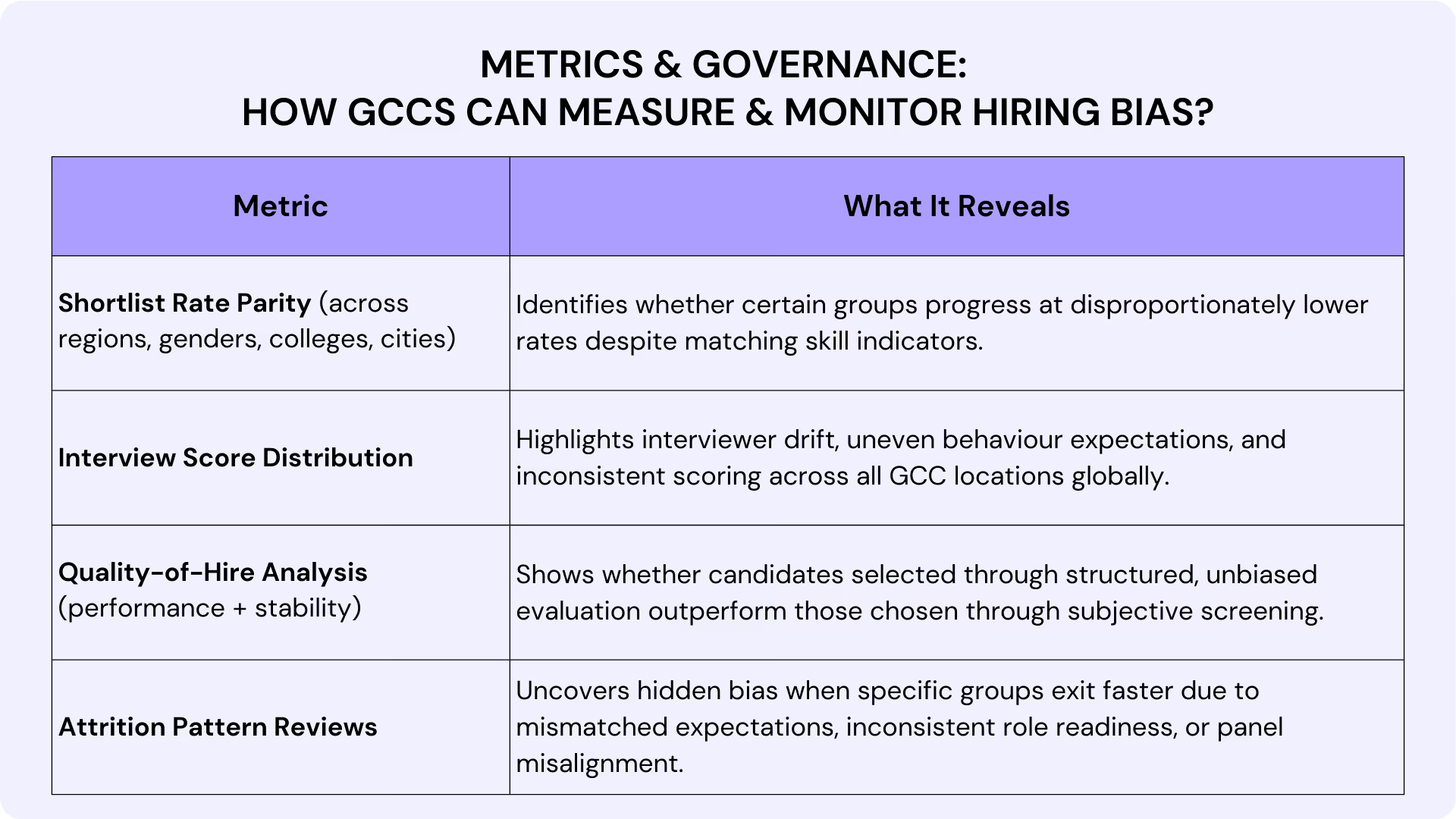
Metrics & Governance: How GCCs Can Measure and Monitor Hiring Bias?
Bias reduction only becomes sustainable when GCCs treat it as an operating metric rather than an awareness exercise. Strong governance relies on consistent measurement—capturing where bias shows up, how it impacts outcomes, and which teams require calibration. These metrics help CHROs spot patterns early and maintain a skills-first, capability-led hiring model across global hubs.
Conclusion
Removing unconscious bias in GCC hiring is about building systems that make fair decisions the default. When job requirements are skills-first, assessments come before résumés, panels stay calibrated, and AI handles early-stage subjectivity, GCCs hire stronger talent with far fewer blind spots. If you’re shaping a bias-resistant hiring model for your centre, our team can help you audit gaps and design a skills-first recruitment framework. Connect with us at 8591320212 or assessment@pmaps.in.