Technical
Post-Hire
Skill-Gap
Pre-Hire
Surveys
Personality
Language
Culture
Skill
Domain
Cognitive
Behavioral
left arrow

Types of Language Testing: Guide English Language Tests for Companies

HR Trends & Practices
Author:
Pratisrutee Mishra
December 17, 2025

Recruiters today rely on different types of language testing to understand how confidently candidates can communicate in real work settings. These tests help hiring teams look beyond résumés and see whether someone can listen, read, speak, or write English with accuracy. As roles grow more global, knowing which types of English language tests to use—and when—can influence hiring quality dramatically.

Many HR teams ask, “what is a language test” in practical terms? Simply put, it’s a structured way to measure how well someone uses a language—not just what they claim on paper. In this guide, you’ll explore the types of language testing, how they differ, and how recruiters use them to make fair hiring decisions.

Main Types of Language Tests for Hiring

When recruiters explore different types of language testing, the goal is simple: understand how confidently a candidate can use English in real work situations. Each category evaluates different skills, which is why knowing the main types helps you choose the right tool for the role.
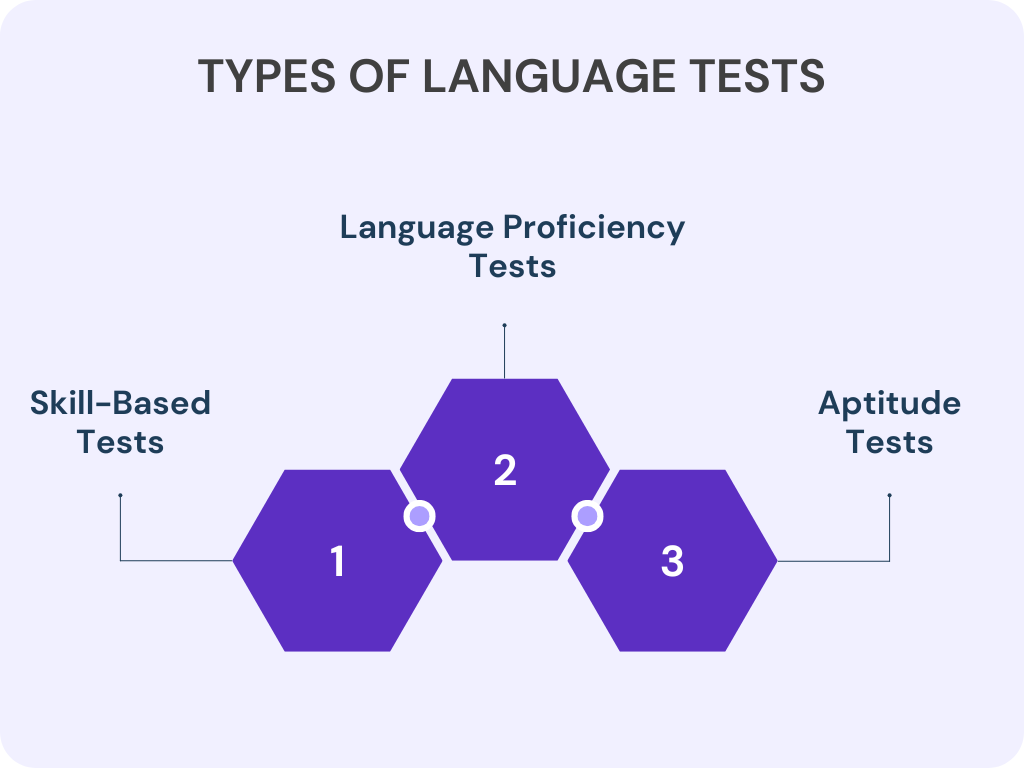
Types of Language Tests

Skill-Based Tests

Skill-based language tests measure reading, writing, listening, and speaking skills, either separately or together. They help recruiters see a candidate’s current abilities before training or assigning roles. These tests are especially helpful during onboarding, internal moves, or when creating learning plans.

  • Reading Comprehension Tests: These tests show how well candidates interpret written information—emails, briefs, policies, or instructions. They help recruiters understand whether someone can follow details accurately.
  • Listening Skills Test: These tests assess how well candidates process spoken information such as accents, speed variations, instructions, or customer situations. 
  • Written Communication Assessment: Writing assessments review grammar, structure, clarity, tone, and coherence. It is used in support, content, coordination, and analyst roles. These reveal how well candidates can write messages that are clear and easy to act on.
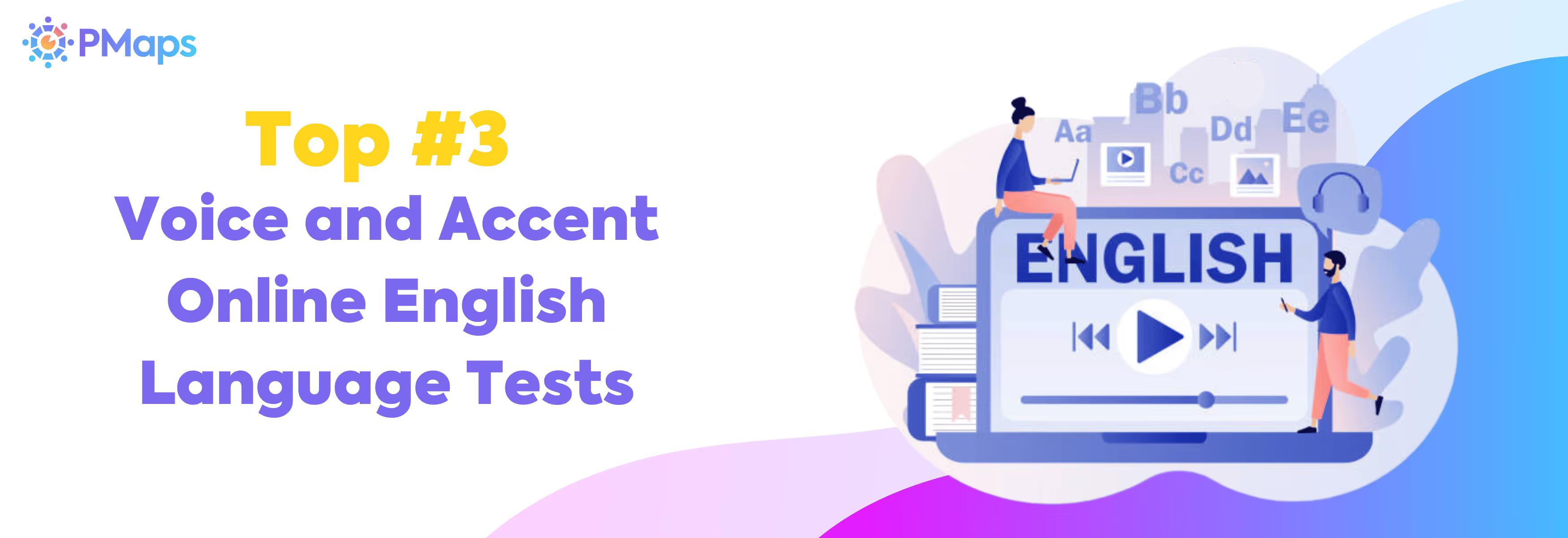
  • Voice and Accent Tests: Speaking assessments measure pronunciation, fluency, pacing, and confidence. These are important for customer-facing or collaboration-heavy roles where verbal clarity influences daily interactions.

HR Insight: GCC and BPO hiring often benefit from compact language testing that combines all key test types in one flow for faster, more accurate shortlisting.

Language Proficiency Tests

These measure overall command over a language, independent of a course or curriculum. Popular types of English language test formats like IELTS, TOEFL, or PTE are used to assess what English language proficiency test requirements are for international communication, education, or work.

Aptitude Tests

These don’t test current ability but rather the potential to learn a new language. For roles requiring future upskilling or multilingual adaptability, aptitude tests predict how well a candidate might pick up a second language.

In addition to the main categories, language tests can also be grouped by their structure and scoring. These other groupings help explain how each test is designed and how it fits different hiring needs.

Other Categorization of Language Tests

Beyond the core types of tests in types of language testing, hiring managers should also consider how tests are designed and interpreted. These additional categories influence how reliable and job-relevant the results are.

Norm-Referenced vs. Criterion-Referenced

Norm-referenced tests compare a candidate’s score against others. They're useful for ranking applicants when hiring at scale. In contrast, criterion-referenced tests assess whether a candidate meets a fixed skill standard—ideal for roles with minimum proficiency requirements.

Discrete-Point vs. Integrative Tests

Discrete-point tests focus on one element at a time—like grammar or vocabulary. They help in technical language evaluations. Integrative tests, on the other hand, assess multiple skills together, reflecting how language is actually used in the workplace.

Direct vs. Indirect Tests

Direct tests ask candidates to perform the skill—like speaking or writing in English. Indirect tests measure related abilities through structured formats like multiple-choice questions. Both serve different purposes, depending on the role’s communication demands.

Knowing about test categories is important, but it’s equally necessary to see how they work in real-world situations. Let’s look at how language tests are created, scored, and used, especially in today’s hiring and remote work settings.

How Language Testing Works in Practice

Choosing the right english language test for is only the first step. Recruiters also need to know how each test works, what skills it checks, and how the scores relate to real language use on the job. This helps ensure the results are accurate, relevant, and aligned with the communication needs of the position.

Test Design and Task Types

Effective language tests mirror real-world communication. Tasks are developed to reflect workplace situations, such as email writing, listening to instructions, or responding verbally to prompts. Frameworks like ACTFL emphasize functional communication ability across personal, academic, and professional domains.

Scoring and Proficiency Levels

Most types of English language test formats align with global standards. The CEFR scale (A1–C2) is common in Europe and beyond, while the ILR scale (0–5) is used by the US government. The ACTFL levels range from Novice to Distinguished. These benchmarks help recruiters interpret scores meaningfully across borders and roles.

Validity, Reliability, and Fairness

Reliable tests are consistent across test-takers and time. Validity means the test measures what it claims—like actual communication skill, not just grammar. Fairness involves unbiased tasks and accessibility. Top providers conduct regular studies to maintain these standards.

Remote / Online Language Testing

Remote testing has become standard. Tools now include AI-driven proctoring, recorded AI interviews, and adaptive question formats. These allow companies to assess candidates globally while ensuring test security and integrity—key for remote-first or multinational teams.

Quick Note: Specialized sales assessments and customer service assessments include specific types of language tests that capture right tone, clarity, listening accuracy, and conversational structure. 

Once you understand what language test processes in practice, the next step is to choose the right one. Your choice should match the job’s needs, the skills you expect, and the level of language ability you want.

How to Choose the Right Language Test

Choosing the right test starts with understanding what the job actually demands. Not every role needs the same level of English ability, and not every test measures the same skill. Here’s how hiring teams usually decide:

  • Match the test to daily tasks: If the role relies on email, use a writing test. If it requires customer calls, use a speaking or listening test. For mixed roles, choose an integrated assessment.
  • Think about the learning demands: For jobs that require growth into multilingual or cross-border communication, language aptitude tests help identify candidates who learn quickly.
  • Check the difficulty level: A test meant for leadership roles won’t suit entry-level hiring. Pick a level that reflects the job, not an unrealistic benchmark.
  • Look for fairness and neutrality: Tests should avoid cultural references, slang, or phrasing that disadvantages non-native speakers. This keeps evaluations objective.
  • Choose something practical to score:  HR teams need clear reports that show strengths, risks, and examples—not vague numbers. Good tools make shortlisting easier, not harder.

Conclusion

Language testing is most effective when the assessment matches real job demands. Using the right mix of reading, writing, speaking, listening, or aptitude tests helps teams hire with fairness and clarity. For structured, bias-free testing tailored to your roles, connect with PMaps at 8591320212 or assessment@pmaps.in

Download Now

Mindfull Hiring

Oops! Something went wrong while submitting the form.

Frequently Asked Questions

Learn more about this blog through the commonly asked questions:

What are the 4 levels of language testing in hiring?

Language testing in hiring often refers to evaluating four core skills: speaking, listening, reading, and writing. These form the foundation of most English language proficiency tests used in recruitment.

What is A1, A2, B1, B2, C1, C2 in language proficiency?

These are levels defined by the Common European Framework of Reference for Languages (CEFR). A1 and A2 indicate basic ability, B1 and B2 cover independent users, while C1 and C2 represent advanced proficiency required for professional communication.

How many types of basic skills are there in language?

There are four basic language skills: reading, writing, listening, and speaking. A well-rounded assessment evaluates all four to measure comprehensive proficiency.

What are the 5 important language skills in English?

Along with the core four—speaking, listening, reading, and writing—some models include a fifth: thinking in the target language. In hiring, however, the focus remains on measurable communication skills.

Resources Related To Test

Related Assessments

English Language Assessment

time
59 Mins
type bar
Entry Level
Popular

Assess grammar, comprehension, and fluency with this online English language assessment for hiring.

Typing Skills Assessment Test

time
5 mins
type bar
Entry Level
Popular

Assess speed and accuracy with a mobile-friendly typing test for entry-level hiring.

Written Communication Assessment

time
10
type bar
Entry Level

Designed to identify professionals who excel in drafting concise, impactful documents and correspondence, vital for all

Verbal Ability Assessment

time
20 min
type bar
Entry Level

Measures understanding, processing, and communication of verbal information accurately.

Subscribe to the best newsletter. Ever.

Your email is only to send you the good stuff. We won't spam or sell your data.

Thank you! Your submission has been received!
Oops! Something went wrong while submitting the form.
Get a callback

Get a Callback

Need support? Fill out the form and we'll get back to you shortly.

Get a Callback

Need support? Fill out the form and we'll get back to you shortly.

Valid number

Thank you!

Thank you! Your submission has been received!
You can check submitted datas from "Project Settings".
Oops! Something went wrong while submitting the form.
✓ Valid number