.webp)
.webp)


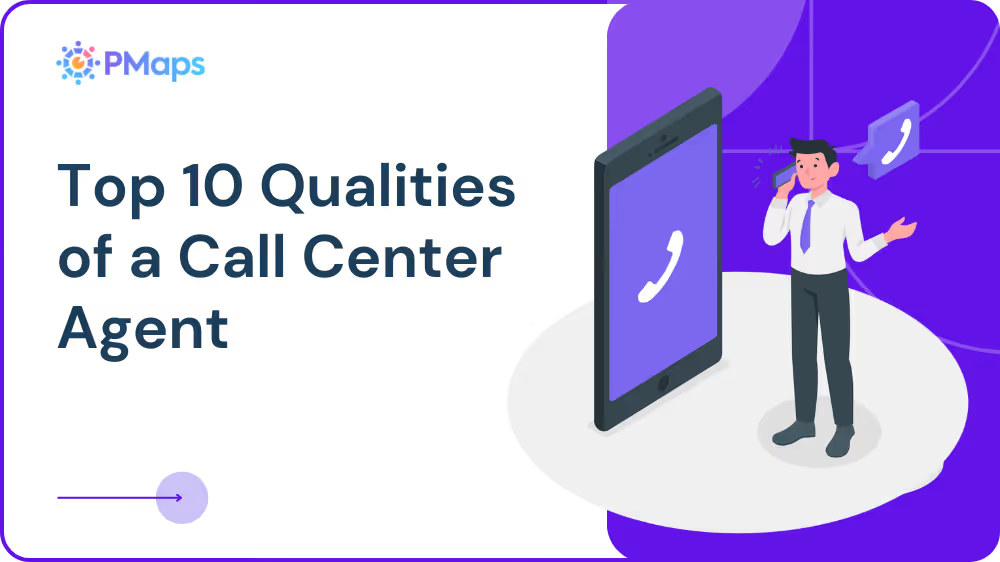
Call center agent performance separates directly from candidate quality at the point of hire. The agents who perform consistently, stay longer, and handle difficult interactions without breaking composure aren't hired by luck—they're identified through a screening process that assesses the right skills before a single hour of training is invested. This guide covers what those skills are, how to distinguish them in candidates, and what the highest-performing call centers do differently at the hiring stage.
Core Skills Every Call Center Agent Needs
Communication Clarity
The ability to convey information clearly, without jargon and without requiring the customer to ask twice, is the foundational skill of call center performance. Agents who communicate clearly reduce handle time, increase first-call resolution, and leave customers with less frustration. This isn't the same as being talkative or enthusiastic—it's the specific ability to structure information, pace delivery, and confirm understanding within a live conversation.
Active Listening
Active listening means processing what a customer says, not just waiting for a pause to respond. Agents who listen actively catch the real issue beneath what's stated, reducing escalations and repeat contacts. In assessment, this is observable through how accurately candidates summarize information presented to them and whether their responses address the actual question asked.
Composure Under Pressure
Call centers generate pressure constantly—difficult customers, queue backlogs, conflicting information, and performance metrics all create stress. Agents who maintain composure under that pressure perform more consistently and stay in role longer. Composure isn't an attitude—it's a measurable behavioral pattern that shows up in tone stability, response pacing, and decision-making quality when scenarios escalate.
Empathy and Tone Management
Customers in distress respond to how they're spoken to as much as what they're told. Agents with genuine empathy—demonstrated through tone, word choice, and pacing—de-escalate faster, resolve faster, and generate higher satisfaction scores. The distinction between scripted empathy and genuine responsiveness is detectable in unstructured conversation and in voice assessment scenarios.
Process Adherence
Call centers operate on structured processes for compliance, consistency, and quality reasons. Agents who can follow process without sounding robotic—and who adapt when the situation requires deviation—are significantly more valuable than those who either ignore process or become paralyzed when scripts don't match reality.
Problem-Solving Speed
Most customer interactions contain a problem that needs a solution. Agents who can identify what's needed, navigate available options, and reach a resolution without excessive hold time or escalation deliver better outcomes across every metric that call centers track.
Multitasking and System Navigation
Modern call center work requires simultaneous attention to a live conversation, CRM data entry, knowledge base lookup, and often chat or ticketing systems. Agents who can manage this without losing conversational quality handle higher volumes with fewer errors.
How High-Performing Call Centers Screen for These Skills
The organizations that consistently hire stronger call center talent assess these skills directly rather than inferring them from resumes or unstructured interviews. The approaches that produce reliable results share a few consistent features.
Structured Voice Assessment
Structured voice screening evaluates communication clarity, tone, composure, and fluency against standardized criteria—consistently, across every candidate. Unlike a recruiter phone screen where evaluation varies by caller and conversation, structured voice assessment produces comparable scores that make shortlisting both faster and more defensible. For high-volume call center hiring, this is often the highest-impact change an organization can make to screening quality.
Simulation-Based Evaluation
Putting candidates into realistic job scenarios—a difficult customer interaction, an ambiguous problem requiring a decision, a process they need to follow under time pressure—surfaces behavioral patterns that no resume or credentials check can reveal. Simulation-based assessment is particularly effective for empathy, composure, and problem-solving evaluation because these skills only appear under conditions that replicate actual job demands.
Role-Benchmarked Scoring
Screening scores are most useful when they're compared against a benchmark built from your current high performers. Organizations that calibrate their assessments against known performance data—and update those benchmarks regularly—make consistently better hiring decisions than those using generic scoring.
Multilingual Screening Where Relevant
For call centers serving multilingual populations, screening in the relevant language matters. Assessing English-language responses for a role that primarily requires Hindi, Tamil, or Kannada fluency produces misleading results. The screening tool needs to match the actual communication demands of the role.
The Hiring Stage Is Where Call Center Performance Is Set
Training can improve process knowledge and product familiarity. It cannot instill composure in candidates who don't have it, or develop genuine empathy in agents who weren't assessed for it at the point of hire. The call centers that reduce attrition, improve CSAT, and build stable teams do it by screening for the right skills—consistently, at scale, before training begins.
PMaps' ai voice agent for recruitment conducts conversational, structured screening calls at scale and delivers scored results hiring teams can act on.