.webp)
.webp)



Figuring out how to hire Sales Engineer talent starts with aligning the role to how your business delivers technical solutions that drive customer outcomes. This position influences deal progression, solution adoption, and revenue impact. The strongest hires combine technical expertise, business insight, and persuasive communication, ensuring consistent deal momentum and client satisfaction.
What is a Sales Engineer?
A sales engineer bridges technical depth and commercial intent. They run demos, handle objections, and translate product capability into outcomes that buyers understand. In smaller teams, they partner closely with founders and sales. In larger teams, they support territories, solutions, and complex deal cycles.
Quick tip: Attract stronger candidates with a clear, role-focused Sales Engineer job description that highlights technical depth and deal impact.
Where to Find the Best Sales Engineer Candidates?
If you want to hire a sales engineer who can hold their own in technical buyer conversations, look beyond generic sales pools. The strongest profiles often sit where product depth meets customer problems—solution communities, pre-sales ecosystems, and domain-heavy industries. This step in How to Hire sales engineer talent works best when you source for proof: demos delivered, objections handled, and requirements translated into workable solutions.
- Solutions partner ecosystems where pre-sales professionals collaborate on integrations, deployments, and multi-stakeholder technical evaluations.
- Vendor certification cohorts for platforms like cloud, cybersecurity, and ERP that attract technical communicators with buyer-facing confidence.
- Implementation and customer onboarding teams in SaaS where candidates already convert requirements into configurations and clean handovers.
- Technical community meetups in DevOps, data, and security where engineers transition into demo-led, consultative pre-sales roles.
- Industry trade forums in manufacturing, telecom, or medical devices where sales engineers build credibility through domain knowledge.
How to Screen for Good Sales Engineers?
Screening a sales engineer should simulate the exact moments where deals are won or lost: discovery depth, demo clarity, and objection handling under pressure. Strong candidates ask sharper questions than sales, map requirements to capability without overpromising, and document next steps so delivery teams are not surprised later. This is the fastest way to hire a sales engineer who can support complex cycles and protect credibility in front of technical buyers.
- Use AI Recruit to shortlist profiles with demo ownership, solution scoping, and measurable win-rate influence.
- Run a short work-sample or employee assessment on relevant skills of converting a buyer brief into a requirements map plus a proposed demo flow.
- Use AI video interviewing for an objection roleplay: security, integrations, pricing, and “build vs buy.”
- Close with an HR round to validate collaboration habits, escalation judgment, and comfort with travel or calls.
How to Assess Skills of Sales Engineers?
To hire a sales engineer who improves win-rate, assess how they diagnose problems, translate requirements, and protect credibility under scrutiny. Assessing relevant skills is the most reliable step in How to Hire sales engineer talent because it reveals whether the candidate can support deals without overpromising and can hand off cleanly to delivery teams. Done right, hiring a sales engineer becomes a repeatable process, not a gamble. Running a structured sales skills assessment before the live demo round helps isolate technical communication gaps that interviews alone tend to miss.
Pro Tip: Try a role-based Sales Engineer Assessment that blends discovery skills, solution mapping, and objection-handling through realistic customer scenarios.
What Soft Skills are Important for Sales Engineers?
Sales engineers rely on more than technical knowledge but having strong soft skills help them communicate value, build trust, and support complex buying decisions.
- Commercial curiosity that asks “why now” and “what changes” before suggesting a solution.
- Clear communication that explains trade-offs without jargon or defensiveness.
- Confidence under challenge when security, engineering, and procurement push back.
- Collaboration discipline that keeps sales aligned and delivery protected from scope surprises.
Hard Skills of Sales Engineers that You Must Test
Evaluating sales engineers requires assessing hard skills like product expertise, technical problem-solving, and data analysis to ensure effective client solutions.
- Discovery depth: requirements gathering, constraint mapping, and success criteria definition.
- Demo execution: narrative flow, technical accuracy, and recovery when things break.
- Solution design basics: integrations, data flows, security considerations, and realistic effort sizing.
- Competitive objection handling: “build vs buy,” performance limits, and roadmap alignment.
How to Interview a Sales Engineer?
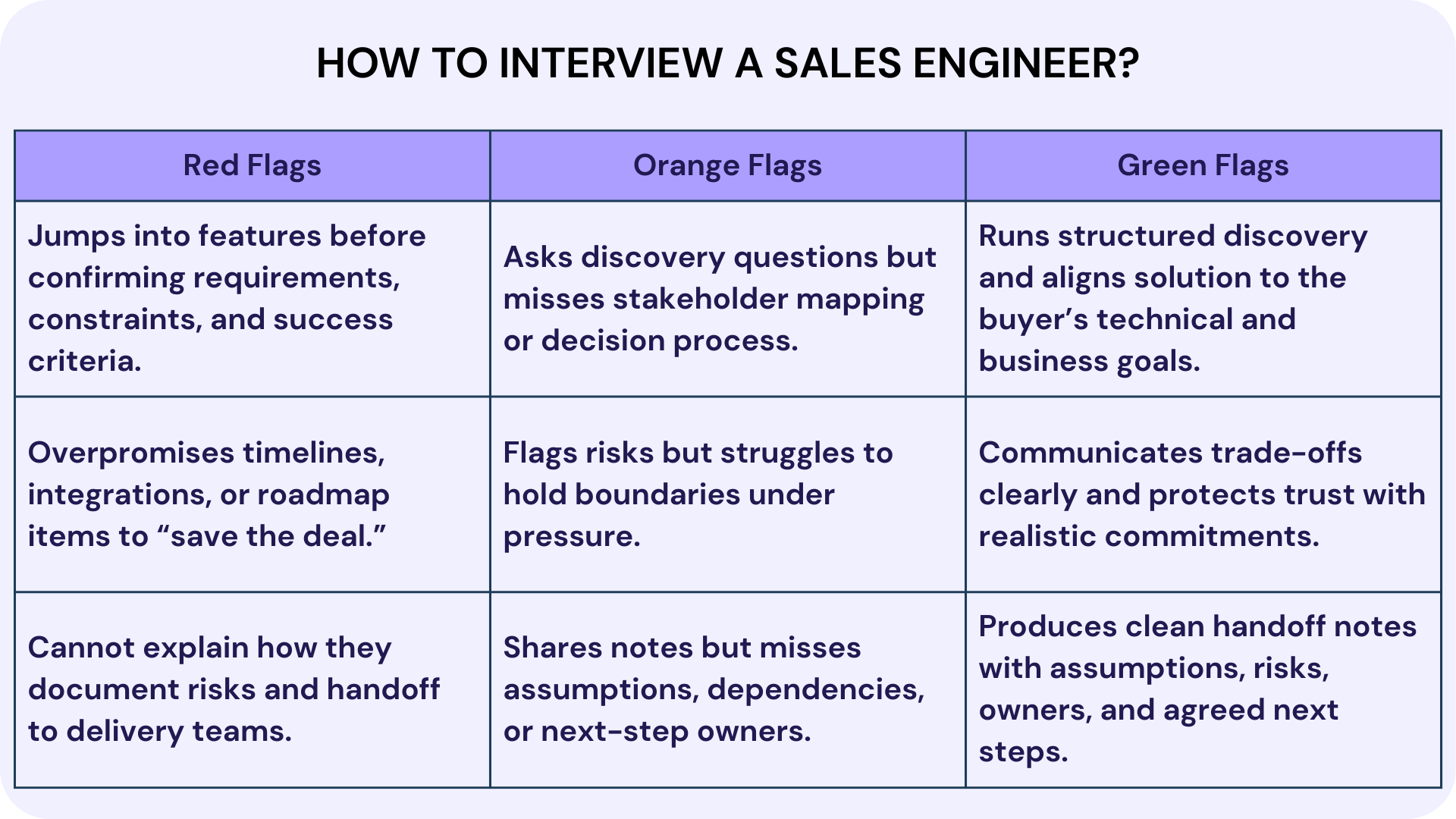
Interviewing a sales engineer should mirror a real technical evaluation call. Start with a discovery drill: give a vague buyer goal and ask what they would ask first. Then run a 7–10 minute demo slice and interrupt with one tough objection on security, integration, or performance.
Finally, ask for a handoff summary: what gets documented for delivery, and what assumptions must be validated. This format shows whether you can hire a sales engineer who protects credibility, manages trade-offs, and keeps momentum without overselling.
Bonus Resource: Sales Engineer interview questions bank is focused on discovery depth, demo control, and effective objection handling.
How Much Does a Sales Engineer Cost?
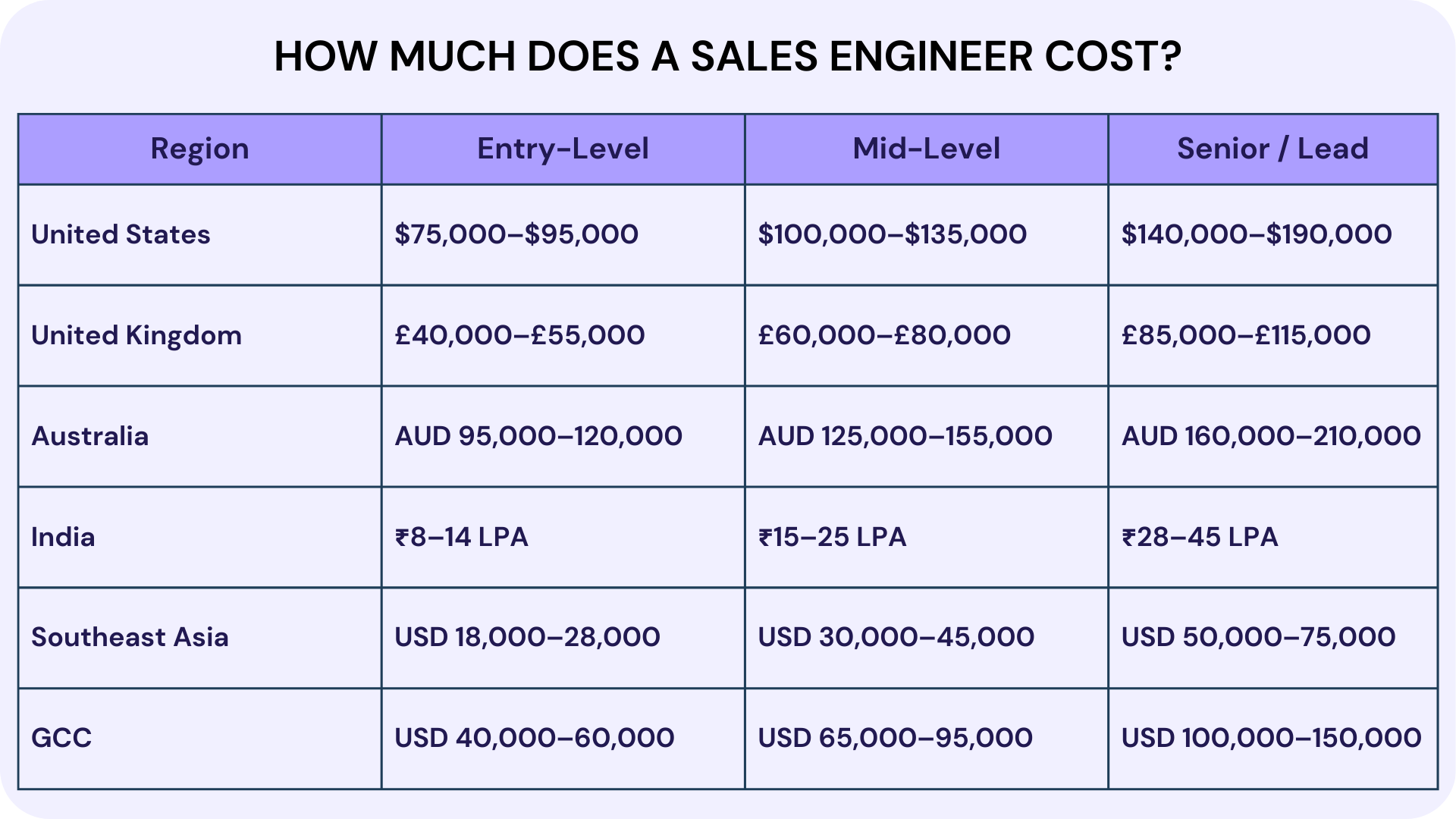
Cost depends on how technical the product is, how long the sales cycle runs, and whether the role owns discovery, demo, and solution design. Entry profiles support demos and basic scoping. Mid-level candidates run evaluations and handle objections. Senior hires lead complex stakeholder cycles and reduce deal risk when you hire a sales engineer.
Conclusion
When you know how to hire Sales Engineer talent, you can more objectively evaluate discovery skills, demo control, and judgment under pressure. Prioritizing the ability to translate requirements into solutions, document risks, and maintain credibility reduces deal surprises and improves win rates. Contact PMaps at 8591320212 or assessment@pmaps.in for role-based assessments and custom screening support.