.webp)
.webp)


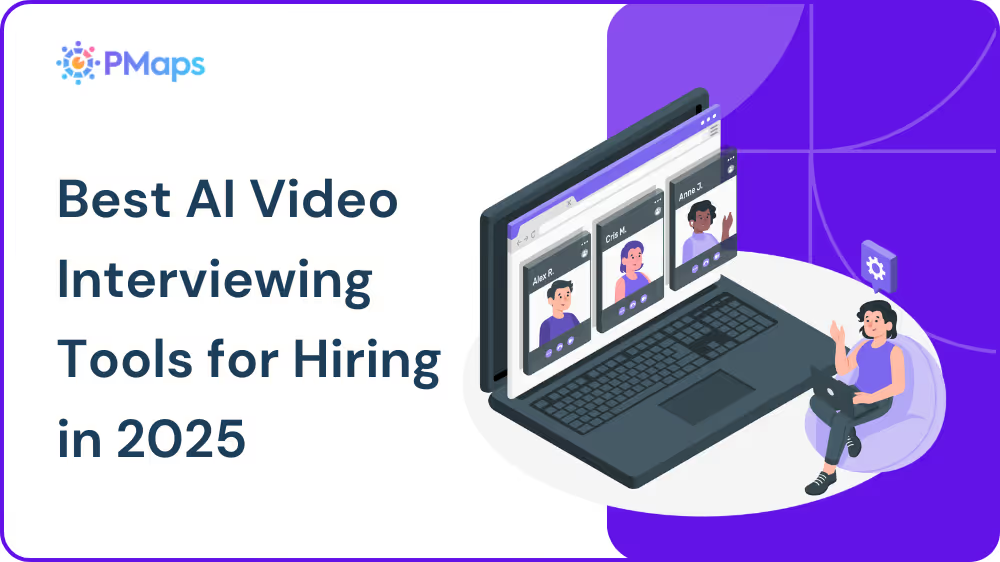
AI video interviewing has moved well past early novelty. The platforms available in 2025 offer genuine evaluation depth—analysing verbal responses, communication clarity, and in some cases behavioural signals—while handling the logistics of scheduling and candidate coordination automatically. For hiring teams managing volume, this combination of assessment quality and operational efficiency changes what's possible in the screening stage.
This guide covers the tools worth evaluating, what each does well, and how to choose based on your actual hiring context.
What to Look for in an AI Video Interviewing Tool
Not all AI video platforms deliver the same value. The best tools share a consistent set of traits that distinguish genuine evaluation capability from basic recording and playback.
- Structured scoring that produces comparable outputs across all candidates—not just raw video footage for recruiters to review manually.
- Asynchronous capability so candidates can complete interviews on their own schedule, removing the coordination overhead that slows screening.
- Integration with existing ATS and HR systems so candidate data flows automatically without manual export and re-entry.
- Transparent AI logic that hiring teams can explain to candidates and defend to stakeholders.
- Scale without quality loss—the assessment experience should be consistent whether ten or ten thousand candidates are being screened.
Best AI Video Interviewing Tools in 2025
PMaps AI Video Interview
PMaps AI Video Interview is built for high-volume hiring in communication-intensive roles. Candidates receive a secure link, complete structured video responses asynchronously, and the platform evaluates speech and tone, problem-solving and analytical thinking, and behavioural cues including engagement and responsiveness. Recruiters receive scored, ranked candidate reports rather than raw footage, which significantly compresses the time from application to shortlist. PMaps also integrates AI voice interviewing alongside video, giving hiring teams flexibility to run telephonic or video screening depending on the role and candidate pool. The platform handles multilingual hiring and is specifically optimised for BPO, customer service, sales, and frontline sectors.
HireVue
HireVue is one of the most established enterprise AI video interviewing platforms globally. It combines structured asynchronous video interviews with game-based cognitive assessments, producing predictive hiring scores that teams use to prioritise candidates at volume. HireVue's AI evaluates verbal content and response structure, and its enterprise integrations are among the strongest in the category. It is particularly well-suited for large organisations running high-volume graduate and frontline hiring programmes.
Spark Hire
Spark Hire focuses on one-way video interviews with a straightforward, candidate-friendly interface. Hiring teams set questions, candidates record responses on their own time, and recruiters review with rating and commenting tools. Spark Hire does not offer deep AI scoring of responses—it is primarily a video collection and collaboration platform rather than an evaluation engine. It works well for teams that want to replace early-stage phone screens with video but prefer human review over automated scoring.
Vidcruiter
Vidcruiter offers both live and pre-recorded video interviewing with structured rating guides and automated scheduling. Its platform supports compliance recording, skills-based question libraries, and panel interview coordination. Vidcruiter is a strong choice for organisations in regulated industries or those running structured panel processes where documentation and consistency are priorities.
Montage (now part of Outmatch/Harver)
Montage, now integrated into the Harver platform, combines video interviewing with behavioural and cognitive assessment. Harver's strength is in volume hiring for hourly and frontline roles, where its predictive assessments and automated scheduling reduce time-to-hire significantly. The combined platform suits retail, logistics, hospitality, and BPO environments with high turnover and continuous hiring needs.
How to Choose the Right Platform
A few practical decision points narrow the field quickly.
- Volume: If you're screening hundreds of candidates per role, you need automated scoring—not just video storage. PMaps and HireVue are built for this scale.
- Role type: Communication-heavy roles benefit most from voice and video evaluation. Structured scoring of tone, clarity, and response quality is particularly valuable for customer-facing and sales positions.
- Candidate experience: Asynchronous interviews reduce drop-off for candidates who can't commit to scheduled slots. Most platforms on this list support async; verify the mobile experience before committing.
- Integration: A video tool that creates a data island will be abandoned quickly. Confirm ATS compatibility before evaluating features.
- Reporting: Ranked outputs and benchmarked scores save recruiter time. Tools that deliver raw footage without structured scoring shift the evaluation burden back to the hiring team.
The right AI video interviewing tool is the one that fits your workflow, scales with your volume, and consistently improves candidate and recruiter experience.
PMaps' voice ai recruiter platform conducts conversational, structured screening calls at scale and delivers scored results hiring teams can act on.