
.webp)
.webp)

Most DISC tools assign a label. PMaps shows how people behave naturally, how they adapt under structure, and what shifts under pressure, so hiring and development decisions are grounded in real behavioral insight.
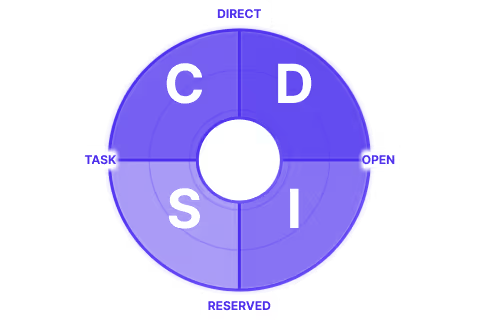
DISC is a behavioral framework that maps how individuals approach decisions, communicate, and pace and structure their work. It measures observable behavioral tendencies and not intelligence, performance, or clinical disposition. For organizations, DISC creates a shared language for evaluating how a person shows up in a role, responds to management, handles pressure, and works with others. It is rigorous enough to inform decisions and simple enough for managers to act on immediately, making it effective across hiring, onboarding, coaching, and team design.
Direct, decisive, results-driven Thrives in competitive environments.
Enthusiastic, collaborative, people-focused. Thrives in open environments.
Patient, reliable, team-oriented. Thrives in predictable environments.
Accurate, structured, quality- driven. Thrives in systematic environments.
By combining primary and secondary DISC styles, PMaps produces 12 name archetypes, each with a distinct behavioral logic that hiring teams and manager recognize immediately.
PMaps is built for enterprise hiring and development decisions. Here's what sets it apart from standard DISC personality tests.
✓ Self image: Natural, unpressured state
✓ Work image: Adapted workplacebehavior
✓ Under pressure: Behavior when stressrises
✓ Primary + secondary DISC style combinations
✓ Distinct behavioral logic per blend
✓ Immediately usable by hiring teams
✓ What motivates this person and drives engagement
✓ Psychological needs for stability and performance
✓ Practical levers to increase retentionand role fit
✓ Reduces social desirability bias
✓ Prevents pattern gaming
✓ More trustworthy profiles
✓ Essential for high-stakes hiring

✓ Full report with all insights
✓ Real candidate example
PMaps DISC supports the full range of people decisions, from pre-employment screening to leadership development and team design.
Learn more about PMaps through commonly asked questions:
Start exploring on your own, get a guided walkthrough, or talk to our assessment scientists about your format, language, and benchmarking requirements.
Live walkthrough tailored to your roles and hiring volume. See exactly how DISC test works for your team.
Click HereConnect with our specialists to normalize the DISC using your people data for higher accuracy.
Click HereDownload a sample DISC report to see the output — traits, scores, behavioral insights, and interview probes.
Click Here