
.webp)
.webp)

Compare leading Harver alternatives that offer advanced assessments, scalable workflows, and stronger predictive insights. This guide helps HR teams identify platforms that better match organizational needs, role complexity, and hiring volume.


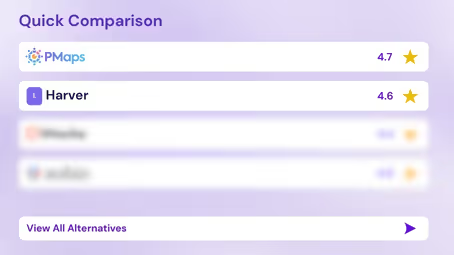
82%+ of employers now use digital assessments and workflow automation, according to Gartner, to improve hiring accuracy in high-volume environments. Platforms increasingly integrate simulations, AI scoring, and behavioral insights.
Harver is known for its high-volume hiring workflows, behavioral assessments, and job simulations. Still, many teams explore alternatives that offer deeper analytics, broader assessment libraries, or greater customization flexibility. This guide highlights platforms designed to enhance accuracy, improve efficiency, and support scalable hiring needs across diverse roles.


PMaps provides visual psychometric and skills assessments designed to measure personality, behavior, and cognitive ability using image-based formats that minimize text dependency. This approach reduces test anxiety, improves comprehension, and enhances engagement—especially for frontline, sales, and customer-facing roles. PMaps delivers fast, predictive insights that support high-volume hiring environments and enable companies to make clearer, more confident job-fit decisions across distributed teams.
Organizations choose PMaps for its engaging visual assessments, substantial behavioral depth, and predictive scoring models. It’s ideal for companies seeking richer job-fit insights, reduced test fatigue, and highly candidate-friendly assessments—especially for customer-facing and high-volume roles.

HireVue provides AI-powered video interviewing and skills assessments to help enterprises screen and evaluate candidates at scale with speed and consistency.
Best for large enterprises wanting AI-driven video interviewing combined with skills assessments to screen high candidate volumes efficiently.
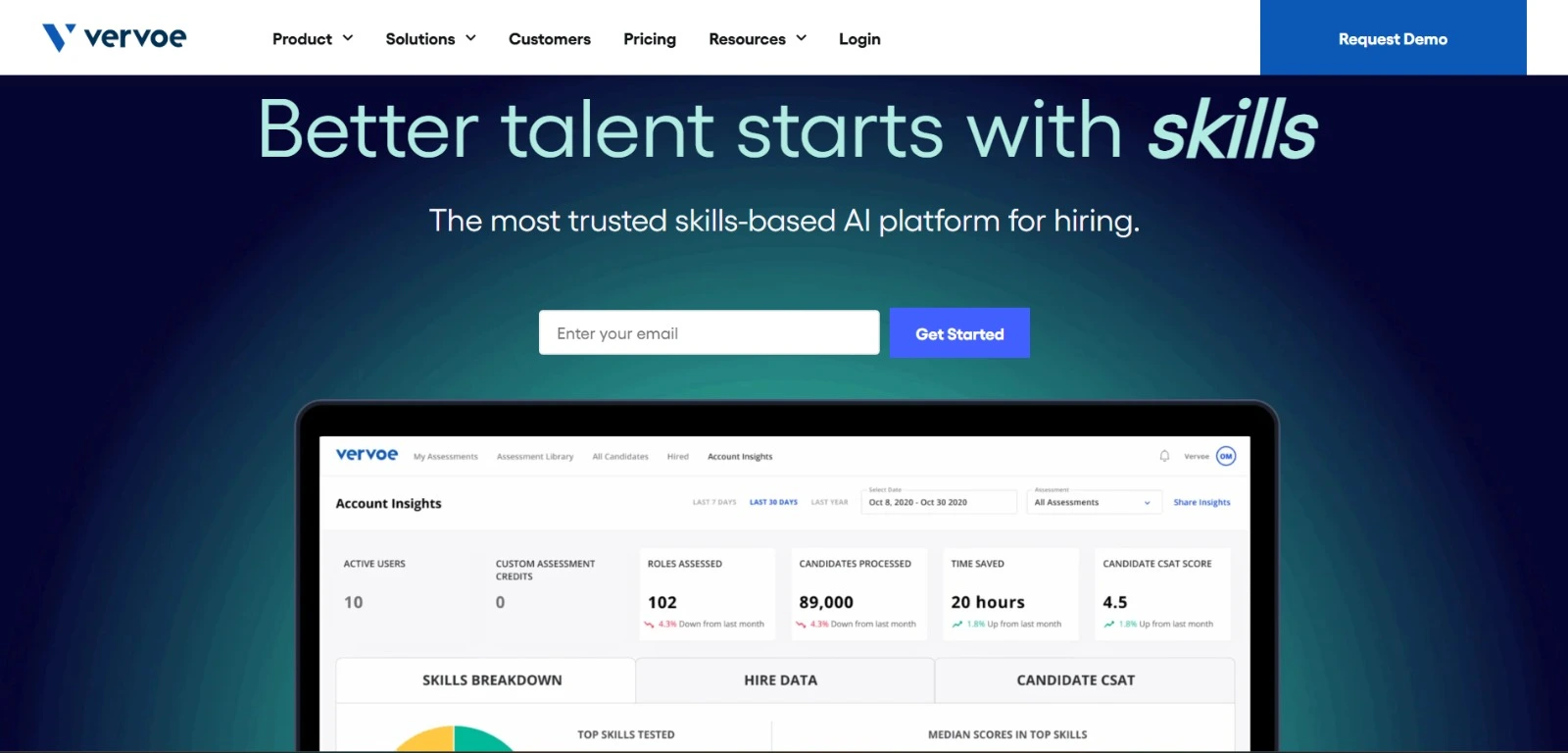
Vervoe is a skills-based hiring platform that evaluates candidates through immersive job simulations, practical tasks, and AI-graded assessments.
A strong alternative for teams prioritizing skills-first hiring — ideal when real job performance and practical ability matter more than traditional cognitive or personality scores.
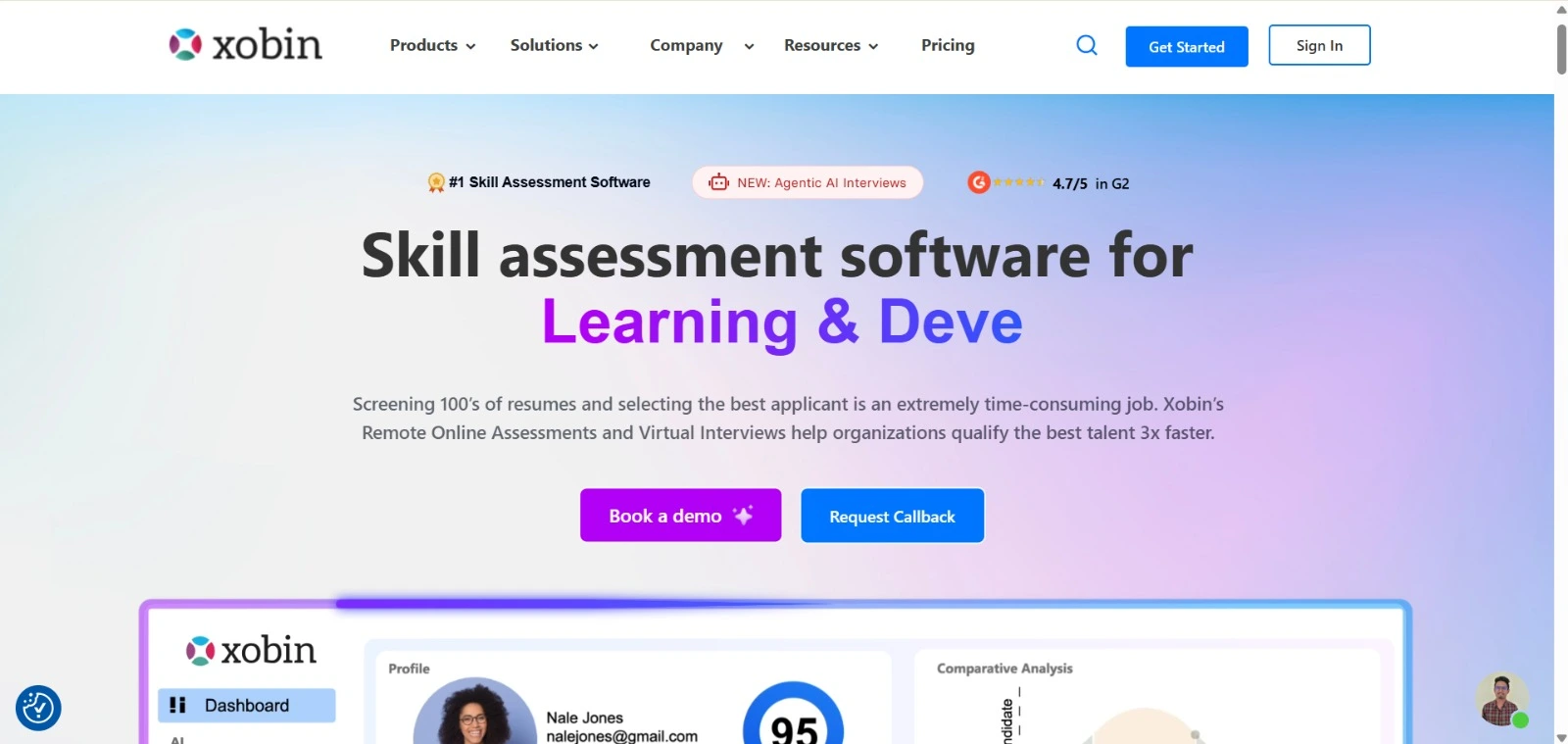
Xobin is an AI-powered talent assessment platform trusted by 5,000+ companies across 60+ countries to hire faster and more accurately. It offers pre-built customizable 3400+ skills based and 2500+ role-based assessments, coding simulators, psychometric tests, video interviews, and AI-powered proctoring in a single platform. With built-in recruitment automation, ATS capabilities, and deep analytics, Xobin enables organizations to adopt skills-first hiring and make data-driven talent decisions at scale.
Companies switch to Xobin for its all-in-one AI hiring platform that combines assessments, interviews, proctoring, and ATS in a single ecosystem. With extensive skill tests, automation, and deep analytics, Xobin helps teams make faster, fairer, and more data-driven hiring decisions.
Equip is a skills testing platform offering pay-per-use assessments across technical, aptitude, and domain skills.
Budget-friendly option for teams needing quick, straightforward skills verification without large platform commitments.
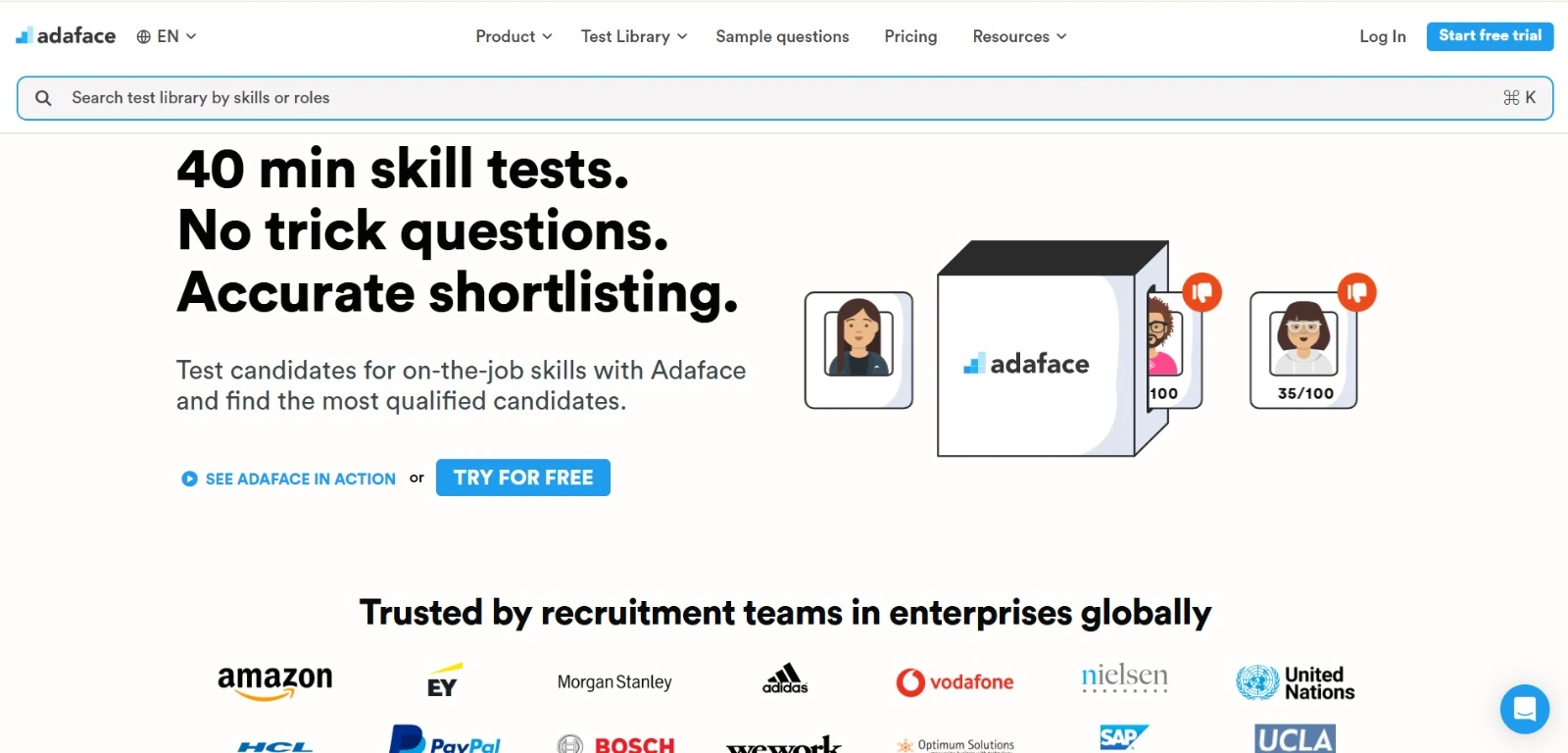
Adaface is a conversational assessment platform that evaluates job-ready skills through chatbot-driven, scenario-based questions.
A compelling choice for teams seeking practical, candidate-friendly assessments that prioritize real-world skills over trick questions.

WeCP is a developer skills assessment platform with 200,000+ curated technical questions across 2,500+ skills for engineering hiring.
Strong option for engineering hiring with a vast technical question library and live coding interview capabilities.
iMocha is an AI-powered skills assessment platform offering 2,500+ tests across digital, technical, cognitive, and language competencies.
Strong for organizations scaling technical hiring with broader skill coverage and enterprise-grade analytics.

eSkill provides customizable pre-employment skills tests across clerical, IT, healthcare, finance, and operations domains.
Good for organizations needing affordable, customizable domain-specific skills testing across a wide range of job functions.

Korn Ferry provides enterprise-grade talent assessment and leadership advisory services using validated psychometric frameworks and performance prediction models.
Best for organizations prioritizing deep leadership assessment and succession planning with enterprise-grade psychometric rigor.
Choosing the right Harver alternative depends on your hiring priorities—assessment depth, workflow automation, behavioral insight, and scalability. Compare platforms on pricing transparency, analytics strength, role-specific content, and integration support. Select a solution that improves prediction accuracy, reduces manual effort, and aligns with your long-term talent strategy.

Determine whether your enterprise needs to deepen leadership evaluation, scale cognitive and behavioral testing, or enable domain-specific assessments. With Mettl’s wide test coverage, the real question becomes whether the platform advances your internal frameworks for skill verification and role benchmarking across global teams

A strong high-volume, structured assessments, but enterprises should evaluate their own hiring realities. Routine operational hiring requires automation and proctoring stability, while specialist or leadership roles demand rigorous psychometrics and customizable models. Select a platform that can flex across these hiring archetypes.

While modular pricing can be efficient, enterprises should review adjacent costs: custom content development, consultancy support, localization, and integration maintenance. The platform you choose must maintain predictable costs during peak hiring seasons and large-scale development initiatives.

An enterprise platform must connect cleanly with ATS, HRIS, LMS, and workforce planning tools. While many offer integrations, organizations should evaluate whether data flows support multi-country reporting, unified profiles, and talent mobility programs without manual stitching or dependency on external teams.

Global enterprises must confirm data residency fit, encryption standards, and scalability of proctoring without friction. Security should reinforce candidate trust while meeting audit requirements across regions, especially for regulated industries.

Beyond raw scores, leaders need evidence pathways such as skill comparatives, behavioral indicators, bias monitoring, and workforce trends. The right platform must deliver insights that meaningfully shape hiring strategy, internal mobility, and capability development not just assessment results.
Harver offers strong workflow automation and simulations, but exploring alternatives ensures your hiring framework keeps pace with evolving skill needs. Compare platforms on pricing, assessment depth, analytics, customization, and scalability. The right alternative should improve prediction accuracy, enhance the candidate experience, and streamline high-volume decision-making across your organization.
Begin by clarifying your hiring needs—assessment types, automation depth, behavioral insight, and scalability. Compare platforms based on pricing, reporting depth, customization options, and integration support to ensure they fit your processes and long-term talent goals.
Yes. Some platforms offer deeper skill intelligence, advanced psychometrics, or richer reporting dashboards. These tools help teams achieve clearer performance predictions and more actionable insights than traditional workflow-focused hiring platforms.
Many alternatives, such as Xobin, Testlify, and PMaps, support high-volume hiring with automation, candidate ranking, and secure proctoring. They help teams maintain consistency while managing large applicant pools across various roles and locations.
Pricing varies widely, especially between SMB-friendly tools and enterprise-focused platforms. Evaluate subscription costs, feature inclusions, candidate limits, and scalability. Choose a platform that maintains value as your hiring volume or assessment complexity grows.
Most modern assessment tools offer native ATS integrations or API support. Ensuring compatibility early helps streamline workflows, reduce manual tasks, and maintain a unified hiring pipeline across sourcing, testing, and decision-making.

Need support? Fill out the form and we'll get back to you shortly.
