
.webp)
.webp)

Compare innovative talent assessment platforms delivering accurate skills evaluation, behavioral insights, and efficient hiring workflows. References include insights from G2, Capterra, and leading assessment comparison sources.


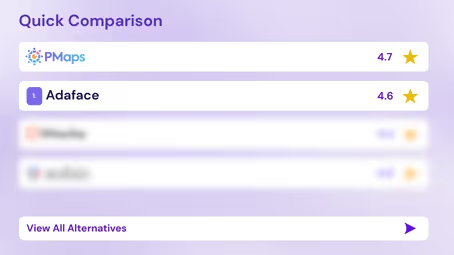
24% improvement in hiring accuracy has been reported by organizations using structured skills assessments, according to research across leading assessment providers. Modern platforms now integrate AI scoring, behavioral analytics, and job simulations to elevate decision-making across roles.
Adaface is valued for conversational assessments and candidate-friendly test formats, earning strong feedback for screening efficiency. Yet many organizations explore alternatives offering broader test libraries, deeper psychometric insights, or advanced analytics. This comparison helps HR leaders identify platforms aligned with evolving workforce needs and more sophisticated hiring goals.


PMaps is a scientifically designed talent assessment platform that applies visual psychometrics, cognitive evaluation, and behavioral modeling to predict job fit with accuracy. Its image-based assessments reduce candidate fatigue, enhance engagement, and deliver objective insights across customer-facing, sales, service, and operational roles, making evaluation more consistent and predictive in high-volume hiring environments.
Organizations choose PMaps for its visual, candidate-friendly assessments, predictive behavioral insights, and AI-backed scoring. It’s ideal for companies wanting deeper job-fit intelligence, better engagement, and faster, more consistent evaluations across diverse roles.
SHL is a global leader in psychometrics, delivering validated cognitive, behavioral, and personality assessments at enterprise scale. Its talent solutions support high-stakes hiring, leadership evaluation, and long-term succession planning. SHL’s analytics-driven framework enables organizations to standardize decision-making across regions, functions, and job levels, making it a preferred choice for complex workforce structures.
Organizations choose SHL for scientific rigor, global reach, and predictive insights that support both hiring and long-term talent strategy. It suits enterprises prioritizing validated assessments and unified, compliant evaluation frameworks.
TestGorilla delivers structured skills assessments designed for scaling teams and high-volume hiring. Its large test library, simple workflows, and standardized scoring make it suitable for a wide range of roles. Organizations use TestGorilla to streamline early-stage screening, improve consistency, and reduce manual evaluation effort across distributed hiring teams, particularly when managing repetitive or fast-moving recruitment cycles.
Teams move to alternatives when they need richer behavioral insights, deeper customization, or enterprise-grade intelligence beyond TestGorilla’s early-stage screening focus.
Mercer Mettl provides a broad range of cognitive, behavioral, technical, and leadership assessments grounded in strong psychometric rigor. It supports global enterprises with scalable workflows, secure remote proctoring, and customizable models aligned to competency frameworks. Organizations rely on Mettl to standardize hiring, enable internal mobility, and build workforce capability across distributed teams and multi-role environments.
Organizations choose Mettl for breadth, compliance strength, and customizable frameworks aligned with enterprise competency models. It fits teams needing structured, multi-role evaluation at scale.

Equip makes skill-based hiring fast and frictionless. Its adaptive tests, automated scoring, and ready-to-launch role libraries allow teams to assess real-world abilities without lengthy setup or complicated tools. Designed with simplicity in mind, Equip is perfect for startups and scaling businesses that need dependable results without enterprise overhead.
Switch to Equip when you need straightforward, reliable assessments that save time and reduce complexity while maintaining hiring accuracy.
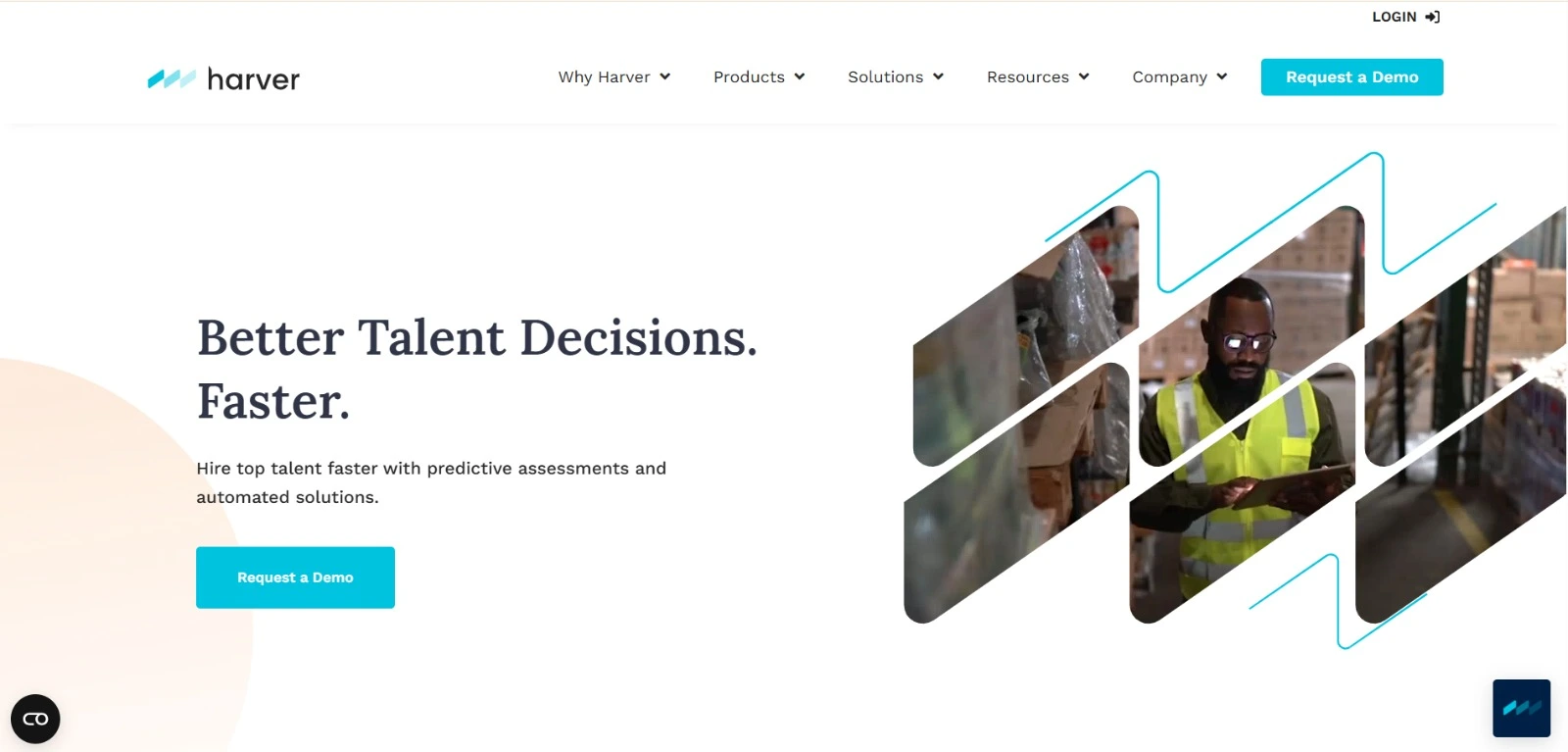
Harver is a high-volume hiring and talent decision platform designed to streamline recruitment through workflow automation, job simulations, and behavioral assessments. It enables organizations to evaluate large applicant pools efficiently while maintaining consistent decision-making across multiple locations. Harver is especially effective for frontline, retail, BPO, and logistics roles where speed, scale, and predictive job-fit insights are essential.
Organizations choose Harver for its high-volume efficiency, role-specific job simulations, and automation-driven consistency. It is ideal for companies that need structured, scalable hiring processes across distributed teams and frequently filled operational roles.
.jpeg)
The Predictive Index offers behavioral and cognitive assessments focused on workplace behavior, team dynamics, and organizational design. Its tools help companies strengthen talent strategies, refine leadership styles, and improve team cohesion. Widely used for long-term talent planning and leadership development, PI supports organizations in building scalable competency frameworks that align people's decisions with business priorities.
Organizations choose PI for its behavioral science depth and team-focused insights. Ideal for companies aligning people strategy with organizational design.
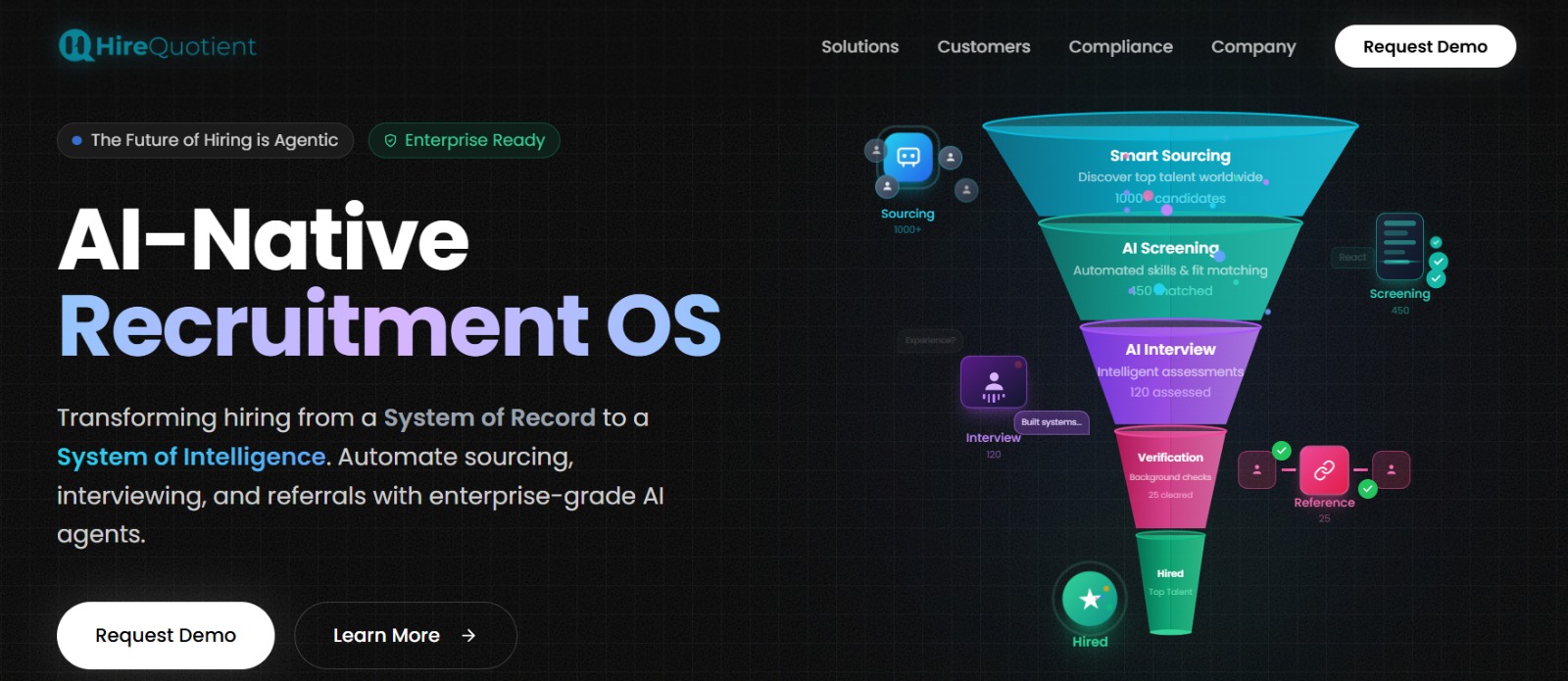
HireQuotient delivers AI-driven assessments that measure communication, business, and functional skills. Its no-code test builder and simulated job tasks enable rapid evaluation across sales, operations, support, and marketing roles. The platform’s virtual interviewer is valued for improving early-stage screening speed and consistency, helping hiring teams reduce manual effort while maintaining objective, role-aligned evaluation standards.
Companies choose HireQuotient for its rapid, AI-driven workflow that reduces screening time and offers practical, scenario-based evaluation for non-technical roles.
WeCP is a technical assessment platform built to evaluate engineering, QA, and DevOps skills through real-world coding tasks and cloud-based labs. Its structured testing environments enable accurate benchmarking of technical ability across multiple domains. Enterprises rely on WeCP for scalable, role-aligned technical hiring that supports diverse tech stacks and consistent evaluation standards in fast-growing engineering teams.
Organizations choose WeCP when they need deeper technical validation than generic coding tests provide, especially for engineering-heavy teams hiring across multiple domains.
Choosing the right Adaface alternative depends on your priorities such as assessment depth, customization flexibility, reporting clarity, role alignment, and integration needs. Compare platforms on pricing transparency, skill coverage, proctoring strength, and candidate experience. Select a solution that enhances evaluation accuracy while supporting scalable, consistent hiring workflows.

Define Your Needs
Identify whether you require early screening, functional skill checks, or adaptive conversational assessments that provide meaningful cognitive and behavioral insights.

Assess Candidate Volume
Ensure the platform can manage high applicant volumes without reducing evaluation quality and offers customization for niche or low-volume hiring needs.

Evaluate Pricing Models
Compare subscription and per-test pricing, considering extra costs for proctoring, premium content, or customization to gauge true scalability.

Test Integration Capabilities
Check ATS, HRIS, and communication system compatibility to ensure smooth workflows, automated shortlisting, and unified reporting.

Verify Security & Compliance
Confirm SOC 2, ISO, GDPR compliance and data residency options while ensuring candidate-friendly monitoring and secure test environments.

Analyze Reporting Depth
Choose platforms offering insights beyond basic scores, including cognitive indicators, behavioral patterns, and risk flags that support fast, data-backed hiring decisions.
Adaface offers conversational, candidate-friendly assessments, but exploring alternatives helps ensure your platform meets evolving hiring goals. Compare each solution on pricing, assessment depth, customization, integrations, and reporting strength. The right alternative should improve prediction accuracy, enhance candidate experience, and support scalable, future-ready hiring processes.
Start by assessing your hiring goals such as skill depth, behavioral insights, test customization, and reporting needs. Compare platforms on pricing, integrity controls, integration options, and how well their assessments reflect real job performance for your key roles.
Some alternatives provide deeper psychometrics, cognitive mapping, or visual behavioral testing. These tools help teams understand motivation, communication style, and role fit, areas where conversational assessments alone may not deliver comprehensive predictive insights.
Pricing varies significantly across platforms. Evaluate not only plan costs but also test limits, candidate volume, analytics access, and required add-ons. Choose a solution that scales affordably with your hiring needs without restricting essential features.
Platforms like Harver, Xobin, and Testlify excel in high-volume environments through automation, strong proctoring, and fast evaluation cycles. They help teams maintain consistency across large applicant pools while reducing manual workload.
Most modern assessment platforms offer native ATS integrations or open APIs. This ensures seamless workflows, unified data, and reduced administrative work, especially when managing multi-stage hiring pipelines or high-volume recruitment.
Yes. HackerRank and Codility specialize in technical assessments with realistic coding tasks and collaborative interview modes. They allow engineering teams to evaluate practical problem-solving and code quality more effectively than general-purpose conversational assessments.

Need support? Fill out the form and we'll get back to you shortly.
